French Sentence Starters That Make You Sound Natural Instantly
One of the biggest reasons French learners freeze mid-sentence isn’t vocabulary or grammar—it’s not knowing how to start. You know what you want to say, but your mind goes blank the moment you open your mouth. That’s exactly where French sentence starters change everything. In this guide, you’ll learn how native speakers naturally begin sentences, buy time to think, soften opinions, and keep conversations flowing—without sounding stiff or robotic.
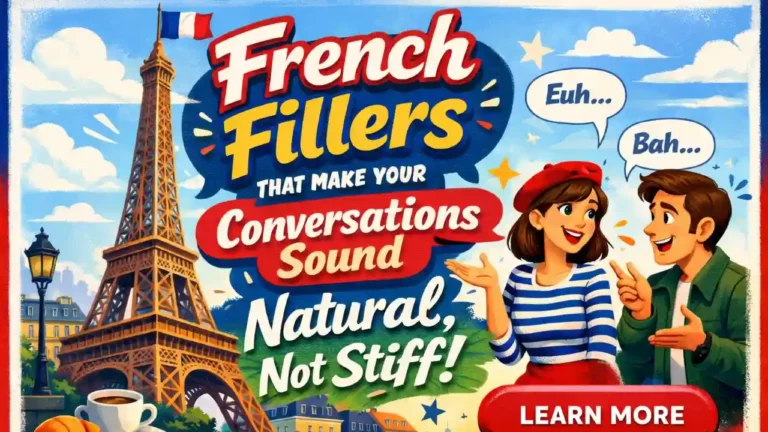
French Fillers That Make Your Conversations Sound Natural, Not Stiff
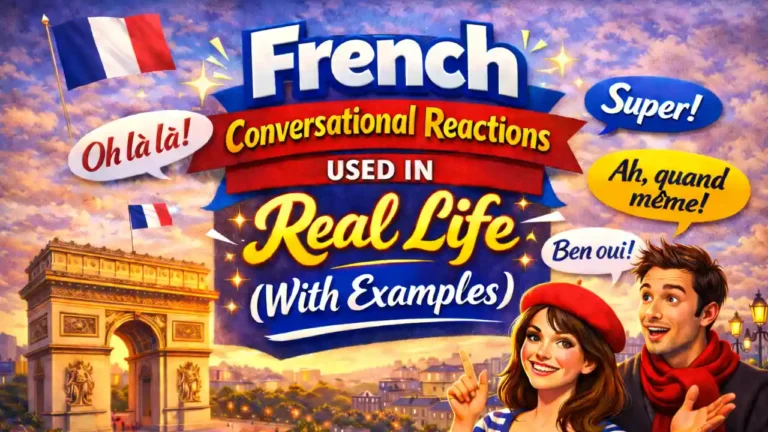
French Conversational Reactions Used in Real Life (With Examples)
What Are French Sentence Starters and Why They Matter
French sentence starters are short expressions placed at the beginning of a sentence to:
- Ease you into speaking
- Give you thinking time
- Set tone and intention
- Make speech sound fluid and natural
Native speakers rarely jump straight into the core message. They frame it first.
Compare:
- Je ne suis pas d’accord.
- En fait, je ne suis pas trop d’accord.
The second feels calmer, more conversational, and more human.
Sentence starters are a bridge between knowing French and speaking French.
They build directly on common French expressions and prepare you for fillers and reactions.
Why Learners Sound Robotic Without Sentence Starters
When learners don’t use sentence starters, conversations feel abrupt.
Common problems:
- Every sentence starts with je
- Opinions sound too direct
- Pauses feel awkward
- Responses feel rehearsed
That’s because jumping straight into meaning leaves no space for rhythm or emotion.
Sentence starters solve this by:
- Creating a soft entry point
- Reducing pressure
- Making speech feel spontaneous
Once you start using them, conversations become easier to manage.
The Most Common French Sentence Starters Used by Native Speakers
These are everyday starters you’ll hear constantly in real conversations.
| French Sentence Starter | Pronunciation | Meaning / Use |
|---|---|---|
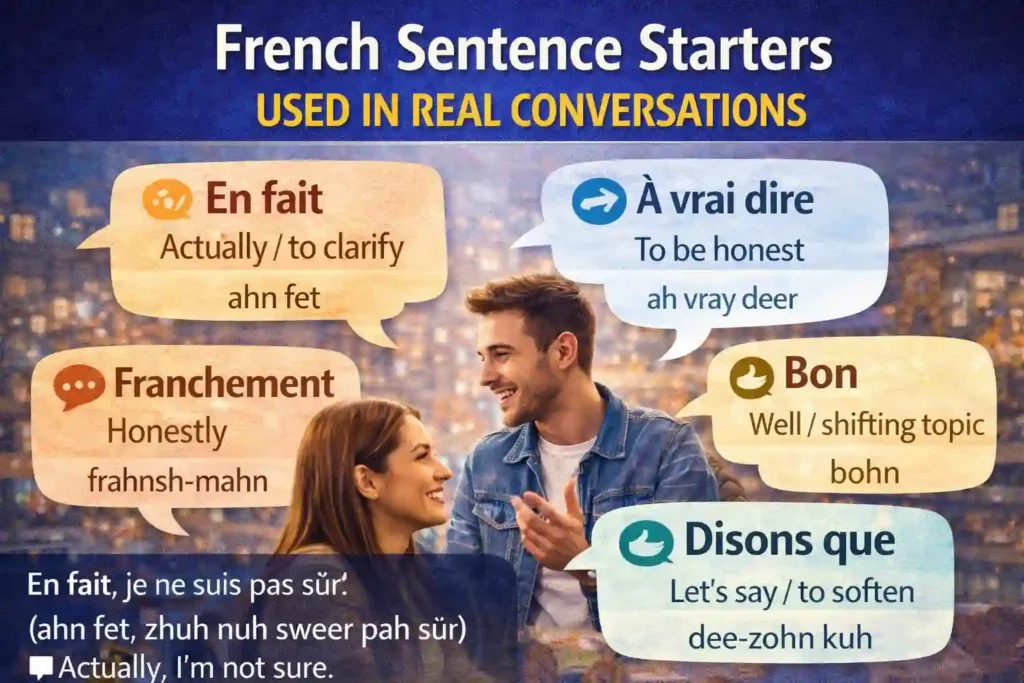
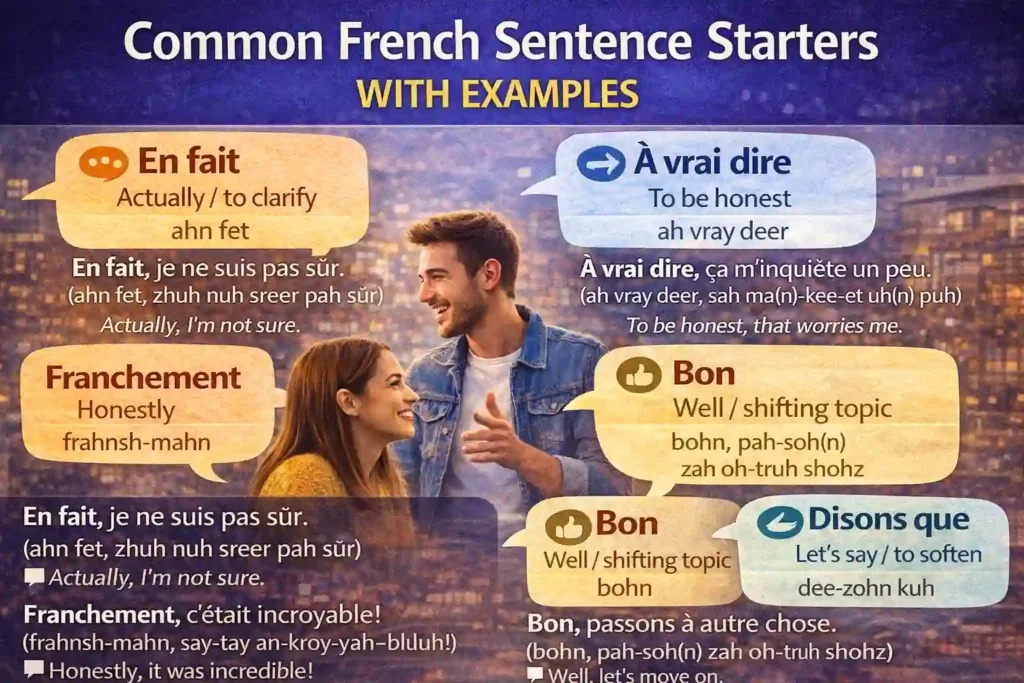
| En fait | ahn fet | Actually / to clarify |
| Franchement | frahnsh-mahn | Honestly / frankly |
| À vrai dire | ah vray deer | To be honest |
| Disons que | dee-zohn kuh | Let’s say / to soften |
| Honnêtement | on-eh-tuh-mahn | Honestly |
| Bon | bohn | Well / shifting topic |
Real-life example
En fait, je ne suis pas sûr.
(ahn fet, zhuh nuh sweer pah sür)
→ “Actually, I’m not sure.”
These starters are not filler—they shape how your message is received.
Sentence Starters for Giving Opinions Naturally
Native speakers rarely state opinions bluntly. They soften them first.
Use these starters when sharing thoughts.
| Starter | Pronunciation | Use |
|---|---|---|
| À mon avis | ah mohn ah-vee | In my opinion |
| Je trouve que | zhuh troov kuh | I think that |
| Perso | pehr-soh | Personally |
| Franchement | frahnsh-mahn | Honestly |
| Pour moi | poor mwah | For me |
Real-life example
Perso, je préfère rester chez moi.
(pehr-soh, zhuh pray-fair reh-stay shay mwah)
→ “Personally, I prefer staying home.”
This sounds far more natural than jumping straight into je préfère.
Sentence Starters to Buy Time While Thinking
Native speakers don’t panic when they need time. They signal it.
These starters help you think while still speaking.
| Starter | Pronunciation | Use |
|---|---|---|
| Alors | ah-lohr | Well / starting |
| Euh | uh | Hesitation |
| Voyons | vwah-yohn | Let’s see |
| Attends | ah-tahn | Wait / hold on |
| Ben | behn | Casual reaction |
Real-life example
Alors… je dirais que oui.
(ah-lohr… zhuh dee-ray kuh wee)
→ “Well… I’d say yes.”
This is a key skill for French conversations because silence often feels worse than speaking imperfectly.
Sentence Starters for Explaining or Clarifying
When you need to explain, these starters help structure your thought.
| Starter | Pronunciation | Use |
|---|---|---|
| En fait | ahn fet | Clarification |
| C’est-à-dire | say-tah-deer | That is to say |
| Parce que | parss kuh | Because |
| Du coup | doo koo | As a result |
| Donc | dohnk | So / therefore |
Real-life example
Du coup, j’ai décidé de partir plus tôt.
(doo koo, zhay day-see-day duh par-teer ploo toh)
→ “So, I decided to leave earlier.”
This prepares readers for the upcoming article on French fillers, which often overlap with these starters.
Sentence Starters for Softening Disagreement
Disagreeing directly can sound harsh in French. These starters soften the message.
| Starter | Pronunciation | Use |
|---|---|---|
| Je ne suis pas sûr | zhuh nuh sweer pah sür | I’m not sure |
| Pas forcément | pah forss-uh-mahn | Not necessarily |
| Peut-être que | puh-et etr kuh | Maybe |
| Disons que | dee-zohn kuh | Let’s say |
| Ça dépend | sah day-pahn | It depends |
Real-life example
Disons que je ne suis pas totalement d’accord.
(dee-zohn kuh zhuh nuh swee pah toh-tahl-mahn dah-kor)
This keeps conversations calm and respectful.
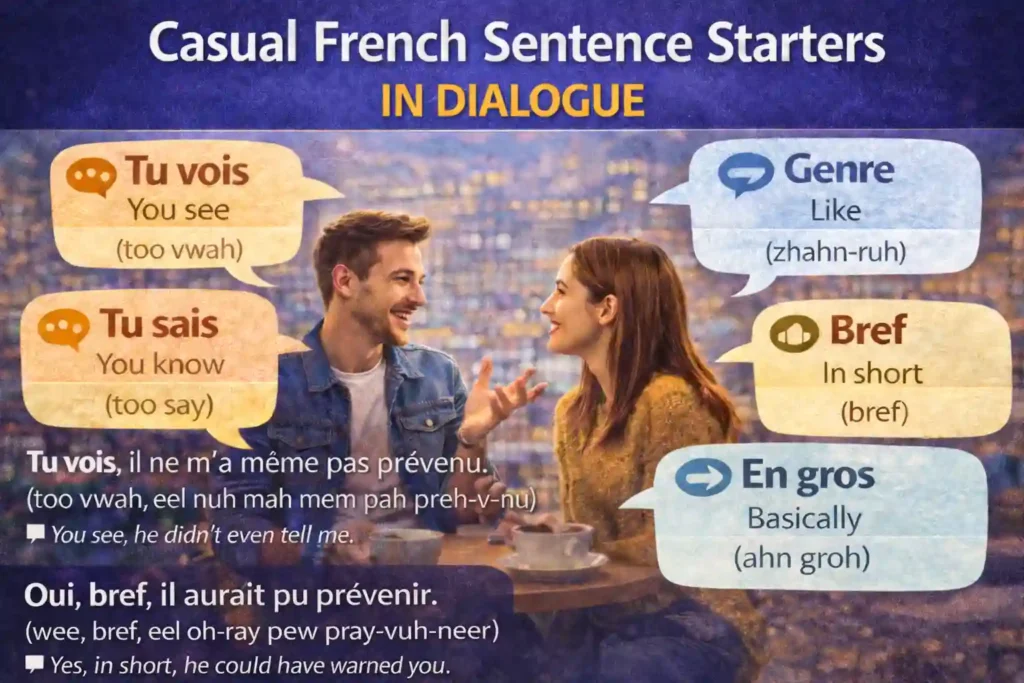
Sentence Starters Used in Casual French Speech
Spoken French relies heavily on casual starters.
| Starter | Pronunciation | Use |
|---|---|---|
| Tu vois | too vwah | You see |
| Tu sais | too say | You know |
| Bref | bref | In short |
| Genre | zhahn-ruh | Like |
| En gros | ahn groh | Basically |
Real-life example
Tu vois, c’est pas si compliqué.
(too vwah, say pah see kohm-plee-kay)
These are extremely common in real dialogue and lead naturally into French conversational reactions.
Common Mistakes Learners Make With Sentence Starters
Avoid these errors:
- Using too many sentence starters in a single sentence
- Repeating the same starter over and over
- Using casual starters in formal writing
- Translating English sentence starters directly into French
Example mistake:
- Using actuellement to mean “actually”
Correct usage:
- En fait
Being aware of these issues early helps prevent fossilized mistakes later and leads to more natural French over time.rs Effectively
A simple daily routine:
- Choose 3 starters
- Say them out loud
- Use them in personal sentences
- Insert them into short dialogues
Example practice:
- En fait, je pense que… contains thought
- Franchement, j’aime pas trop… expresses opinion
- Alors, on fait quoi ? starts conversation
Sentence starters are tools, not decorations.
How Sentence Starters Prepare You for Real Conversations
Once you master sentence starters:
- You hesitate less
- You sound calmer
- You react faster
- Conversations feel manageable
They form the foundation for:
- French fillers
- Conversational reactions
- Natural dialogues
Now that you’ve seen how sentence starters create the base for French fillers, reactions, and natural conversations, let’s go one step further and learn how to actually use them to build full sentences you can say with confidence in real life.
How To Build Natural French Sentences With Sentence Starters (Simple Method)
Knowing sentence starters is good. Knowing how to use them in real sentences is what makes you sound natural. Many learners know what to say, but they get stuck when trying to put the sentence together. This simple method will help you speak without freezing.
The Easy 4-Step Formula
Use this simple pattern:
Sentence starter + subject + verb + idea
Example:
- À mon avis, je pense que c’est une bonne idée.
Ah moh-nah-vee, zhuh pahnss kuh say oon bon ee-day-ah
In my opinion, I think it’s a good idea. - En fait, je ne comprends pas.
On fet, zhuh nu kom-prah pah
Actually, I don’t understand. - Franchement, je préfère rester ici.
Frahnsh-mon, zhuh pray-fair res-tay ee-see
Honestly, I prefer to stay here.
You can use this same pattern again and again in daily conversations.
Real French Examples You Can Use Right Away
Here are natural examples you can copy and say:
| French Sentence | Pronunciation | Meaning |
|---|---|---|
| À mon avis, c’est important. | Ah moh-nah-vee, say im-por-tahn | In my opinion, it’s important |
| En fait, je ne sais pas. | On fet, zhuh nu say pah | Actually, I don’t know |
| Personnellement, j’aime apprendre le français. | Pair-so-nel-mon, zhem ah-pron-druh luh frahn-say | Personally, I like learning French |
| Je dirais que c’est mieux comme ça. | Zhuh dee-ray kuh say myuh kom sah | I would say it’s better this way |
| Il me semble que tu as raison. | Eel muh sohm-bluh kuh tu ah ray-zon | It seems to me that you are right |
Say them out loud. Don’t worry about being perfect. Fluency grows from using the language, not from waiting to be perfect.
Using Sentence Starters In Real Conversations
Real conversations are not perfect. People pause. They think. They change their minds. Sentence starters help you sound natural when this happens.
When You Want To Share Your Opinion
- À mon avis, c’est une bonne idée.
Ah moh-nah-vee, say oon bon ee-day-ah
In my opinion, it’s a good idea. - Personnellement, je ne suis pas d’accord.
Pair-so-nel-mon, zhuh nu swee pah dah-kor
Personally, I don’t agree.
When You Need Time To Think
- Alors… je dirais que oui.
Ah-lor… zhuh dee-ray kuh wee
So… I would say yes. - En fait… laisse-moi réfléchir.
On fet… less-mwah ray-fleh-sheer
Actually… let me think.
When You Want To Disagree Politely
- Il me semble que ce n’est pas la meilleure solution.
Eel muh sohm-bluh kuh suh nay pah lah may-yur soh-loo-syon
It seems to me that this is not the best solution.
This sounds calm and respectful. It keeps conversations friendly.
Sentence Starters For Writing (Emails, Homework, Exams)
Sentence starters also make your writing clearer and easier to follow.
| Purpose | French | Pronunciation | Meaning |
|---|---|---|---|
| Start a point | Tout d’abord | Too dah-bor | First of all |
| Add an idea | En plus | On ploo | In addition |
| Show contrast | Cependant | Suh-pahn-don | However |
| Give examples | Par exemple | Par eg-zahm-pluh | For example |
| End a text | En résumé | On ray-zoo-may | In summary |
Example Paragraph
Tout d’abord, apprendre le français demande de la patience.
Too dah-bor, ah-pron-druh luh frahn-say duh-mon duh lah pah-syans
First of all, learning French takes patience.
En plus, pratiquer un peu chaque jour aide beaucoup.
On ploo, prah-tee-kay un puh shak zhoor ehd boh-koo
In addition, practicing a little every day helps a lot.
Cependant, il ne faut pas abandonner trop vite.
Suh-pahn-don, eel nu fo pah ah-bahn-doh-nay tro veet
However, you should not give up too quickly.
Practice Section (Say It Yourself)
Try to complete these sentences out loud:
- ___, je pense que c’est une bonne idée.
- ___, je ne suis pas sûr.
- ___, c’est difficile au début.
Possible answers:
- À mon avis
- En fait
- Franchement
Now make your own sentences using:
- Personnellement
- Je dirais que
- Il me semble que
Say them out loud. This is how you train your mouth and brain together.
Sentence Starters and Fillers Work Together
When you speak, you can mix fillers and starters to sound more natural.
Examples:
- Alors… à mon avis, c’est possible.
Ah-lor… ah moh-nah-vee, say poss-ee-bluh
So… in my opinion, it’s possible. - Euh… franchement, je ne sais pas.
Uh… frahnsh-mon, zhuh nu say pah
Um… honestly, I don’t know.
This is normal speech. Native speakers talk like this all the time.
Common Mistakes To Avoid
- Don’t repeat the same starter all the time
Use variety to sound natural. - Don’t use very casual starters in formal writing
Use neutral ones when writing emails or essays. - Don’t translate directly from English
Use French sentence patterns as they are.
A Simple Daily Practice You Can Do In 5 Minutes
- Pick 3 sentence starters
- Make 2 sentences for each
- Say them out loud
- Change the topic and repeat
Example:
- À mon avis, ce livre est intéressant.
- À mon avis, apprendre le français prend du temps.
Final Words
French sentence starters help you begin speaking without fear. They give you time to think, help you express ideas clearly, and make your French sound natural instead of forced. If you practice a few every day and use them in real conversations, your confidence will grow quickly. You don’t need perfect grammar to start speaking. You need simple tools you can use right now. Sentence starters are one of the best tools you can learn first.
Conclusion
French sentence starters are one of the most powerful tools for sounding natural in conversation. They help you enter speech smoothly, express opinions politely, and think while speaking—all without pressure. By mastering French sentence starters, you move away from robotic, textbook French and closer to the way native speakers actually communicate. Combined with expressions, fillers, and reactions, they turn speaking French into something fluid, confident, and genuinely enjoyable.