Imagine describing something that will already be finished in the future. Maybe by next year you will have learned French, or by tonight you will have finished a project. In French grammar, this idea is expressed with the French future perfect, known as le futur antérieur.
The future perfect is one of the French tenses that is part of the indicative mood that allows speakers to describe an action that will be completed before another future action. Once learners understand how the French futur antérieur works, they can speak about deadlines, predictions, assumptions, and sequences of future events with much more precision.
Now that you know what it expresses, let’s break down how the French future perfect tense works, how to form it, and when to use it naturally in conversation.
What Is The French Future Perfect?
The French future perfect tense, called le futur antérieur, describes an action that will have happened before another future event.
In English, this tense often uses the structure “will have done.”
Example:
J’aurai fini avant midi.
I will have finished before noon.
Here is the timeline:
First action → finishing
Second action → noon
The finishing will already be completed before the second future moment.
Another example:
Quand tu arriveras, j’aurai déjà mangé.
When you arrive, I will have already eaten.
The eating will happen before the arrival.
This is the core idea behind the French future perfect tense: describing something that will already be completed in the future.
Why The French Future Perfect Matters
Many learners ignore the future perfect French tense, but it plays an important role in natural communication.
This tense allows you to:
• Talk about deadlines
• Describe future completion
• Express predictions about the past
• Show logical sequences of events
For example:
Dans deux ans, j’aurai terminé mes études.
In two years, I will have finished my studies.
This sentence feels much more precise than simply saying je terminerai mes études.
The futur antérieur in French helps you sound more fluent because you can explain future timelines clearly.
How To Form The French Future Perfect
The structure of the French future perfect tense is very similar to other compound tenses.
Formula:
Subject + Future of Auxiliary Verb + Past Participle
The auxiliary verbs are:
avoir
être
Example with avoir:
J’aurai parlé
I will have spoken
Example with être:
Elle sera arrivée
She will have arrived
Once you understand this structure, forming the French futur antérieur tense becomes straightforward.
Future Tense Of Avoir
Since most verbs use avoir, you must know its future tense.
Future of avoir:
j’aurai
tu auras
il aura
nous aurons
vous aurez
ils auront
Examples:
J’aurai compris la leçon.
I will have understood the lesson.
Nous aurons terminé le travail.
We will have finished the work.
Ils auront oublié le rendez-vous.
They will have forgotten the appointment.
These forms appear constantly when using the French future perfect tense.
Future Tense Of Être
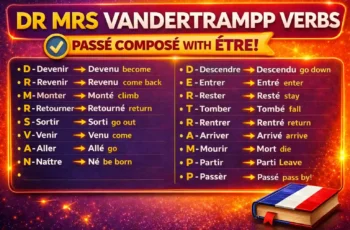
Some verbs use être instead of avoir, especially movement verbs and reflexive verbs.
Future of être:
je serai
tu seras
il sera
nous serons
vous serez
ils seront
Examples:
Elle sera partie avant minuit.
She will have left before midnight.
Ils seront arrivés à l’aéroport.
They will have arrived at the airport.
When être is used, the past participle must agree with the subject.
Past Participles In French Future Perfect
Just like other compound tenses, the French futur antérieur requires a past participle.
Examples of past participles:
parler → parlé
finir → fini
prendre → pris
voir → vu
manger → mangé
Examples in sentences:
J’aurai vu ce film.
I will have seen that movie.
Elle aura pris le train.
She will have taken the train.
Nous aurons mangé avant ton arrivée.
We will have eaten before your arrival.
Understanding past participles is essential for mastering the French future perfect tense.
Agreement Rules With Être
When the auxiliary verb is être, the past participle agrees with the subject.
Examples:
Elle sera arrivée.
She will have arrived.
Ils seront partis.
They will have left.
Elles seront tombées.
They will have fallen.
Notice the endings:
arrivé → arrivée
parti → partis
tombé → tombées
This rule applies to all compound tenses, including the French future perfect tense.
Negative Sentences In French Future Perfect
To form negative sentences, place ne before the auxiliary verb and pas after it.
Structure:
Subject + ne + future auxiliary + pas + past participle
Example:
Je n’aurai pas terminé.
I will not have finished.
Elle ne sera pas arrivée à temps.
She will not have arrived on time.
Nous n’aurons pas compris la question.
We will not have understood the question.
This structure is consistent across most French compound tenses.
Asking Questions In Future Perfect
You can ask questions in the French future perfect tense using three methods.
Intonation:
Tu auras fini ?
Will you have finished?
Est-ce que:
Est-ce que tu auras fini ?
Inversion:
Auras-tu fini ?
All three structures are common in French conversation.
When To Use The French Future Perfect
Understanding when to use the futur antérieur is key to mastering this tense.
Here are the most common situations.
Future Action Completed Before Another Future Event
Example:
Quand tu arriveras, j’aurai terminé le rapport.
When you arrive, I will have finished the report.
The finishing happens before the arrival.
Deadlines Or Expectations
Example:
D’ici demain, nous aurons résolu le problème.
By tomorrow, we will have solved the problem.
The tense expresses completion before a deadline.
Logical Assumptions About The Past
French speakers often use the futur antérieur to make guesses about the past.
Example:
Il aura oublié notre rendez-vous.
He must have forgotten our meeting.
This usage appears frequently in everyday French.
French Future Perfect Vs Futur Simple
Many learners confuse the futur antérieur with futur simple.
The futur simple describes a future action.
Example:
Je finirai ce travail.
I will finish this work.
The future perfect French tense describes an action that will already be completed.
Example:
J’aurai fini ce travail avant midi.
I will have finished this work before noon.
The difference is subtle but important.
French Future Perfect Vs Passé Composé
The passé composé describes a completed past action.
Example:
J’ai fini.
I finished.
The futur antérieur describes a completed future action.
Example:
J’aurai fini.
I will have finished.
Although both tenses use a past participle, the auxiliary verb tense determines the timeline.
Reflexive Verbs In French Future Perfect
Reflexive verbs use être in the futur antérieur.
Example:
Je me serai levé tôt.
I will have gotten up early.
Elle se sera préparée rapidement.
She will have prepared herself quickly.
Nous nous serons rencontrés avant la réunion.
We will have met before the meeting.
As usual, the past participle agrees with the subject.
Signal Words Often Used With Futur Antérieur
Certain expressions frequently appear with the French future perfect.
avant — before
d’ici — by / within
quand — when
après — after
déjà — already
Example:
D’ici ce soir, j’aurai terminé le projet.
By tonight, I will have finished the project.
These expressions help indicate the future timeline.
Example Conversation Using Future Perfect
Here is a short dialogue using the French future perfect tense.
Marie: Quand arriveras-tu à Paris ?
When will you arrive in Paris?
Paul: J’arriverai vers 18 heures.
Marie: Parfait. J’aurai déjà réservé la table au restaurant.
English meaning:
Marie: When will you arrive in Paris?
Paul: Around 6 PM.
Marie: Perfect. I will have already reserved the table.
This example shows how the futur antérieur naturally appears in conversation.
Common Mistakes Learners Make
Many learners struggle with the French future perfect tense because of a few common errors.
Using Futur Simple Instead
Incorrect:
Quand tu arriveras, je finirai le travail.
Correct:
Quand tu arriveras, j’aurai fini le travail.
Forgetting Agreement With Être
Incorrect:
Elle sera arrivé.
Correct:
Elle sera arrivée.
Using Present Auxiliary Instead Of Future
Incorrect:
J’ai fini.
Correct future perfect:
J’aurai fini.
Avoiding these mistakes will help your French future perfect sentences sound natural.
How To Practice The French Future Perfect
The best way to master the future perfect in French is to practice using timelines.
Step 1
Choose two future events.
Example:
You arrive at 7 PM.
I finish cooking.
Step 2
Identify the earlier event.
Cooking finishes first.
Step 3
Put it in futur antérieur.
Quand tu arriveras, j’aurai fini de cuisiner.
Repeat this exercise with different verbs and situations.
Final Thoughts
The French future perfect tense may seem advanced at first, but it follows a clear and logical structure.
Remember three key elements:
Use the future tense of avoir or être
Add the past participle
Use it to describe an action completed before another future event
Once you start using the futur antérieur in French, your ability to describe future timelines becomes much more precise. You will be able to discuss plans, deadlines, expectations, and predictions in a way that sounds natural and fluent.