Struggling to sound natural in French even after learning the basics? This French pronunciation guide explains exactly how to sound like a native faster by focusing on the sounds, rules, rhythm, and mistakes that matter most. Instead of scattered tips, this is a complete system designed to fix what actually makes learners sound foreign.
Quick Answer: What Actually Improves French Pronunciation Fast?
Fast improvement comes from focusing on the highest-impact elements first:
- Core French sounds (R, U, OU, nasal sounds)
- Silent letter patterns
- Liaison and word connection
- Sentence rhythm and intonation
- Repetition and listening-based practice
Everything else is secondary. Once these are controlled, speech becomes clearer and more natural.
Why Most Learners Still Sound Foreign
Many learners spend months learning vocabulary and grammar but ignore pronunciation. The result is predictable: correct sentences that still sound unnatural.
French pronunciation is not intuitive for English speakers because:
- Spelling does not reflect sound directly
- Several sounds do not exist in English
- Words connect differently in real speech
- Rhythm is smoother and less stressed
Until these differences are trained deliberately, the accent remains unchanged.
The Core French Sounds That Change Everything
Pronunciation improves quickly when the most noticeable sounds are fixed first.
The French R Sound
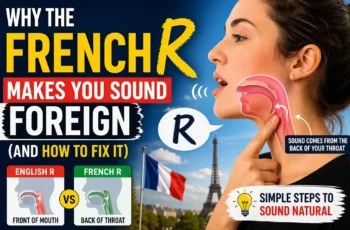
The French R is produced in the back of the throat, not at the front of the mouth.
Words like rouge, très, and français rely on this sound. Using an English R instantly signals a foreign accent.
This sound should feel controlled, not exaggerated.
For deeper practice, see: How To Pronounce The French R (Step-By-Step)
OU Vs U In French
These two sounds are often confused but completely different.
- OU resembles “oo”
- U requires rounded lips with a different tongue position
Words like tu and tout must sound distinct.
For a full breakdown, see: OU Vs U In French (The Difference You Can Hear Instantly)
AN Vs ON Vs IN (Nasal Sounds)
Nasal sounds are essential to French pronunciation.
Examples include:
- Bon
- Blanc
- Vin
The final “n” is not pronounced. The sound resonates through the nose.
For focused training, see: AN Vs ON Vs IN In French (Nasal Sounds Made Simple)
French Vowel Stability
French vowels are more stable than English vowels.
They do not glide. They stay clean and controlled.
For a complete guide, see: French Vowel Sounds Explained Clearly
Consonants That Change Sound
Some consonants shift depending on context.
Understanding these patterns prevents repeated pronunciation errors.
For deeper explanation, see: French Consonants That Change Sound
The Rules That Control Pronunciation
Once the sounds are clear, pronunciation becomes easier when the rules are understood.
Silent Letters
Many French words contain letters that are not pronounced.
Examples:
- Paris
- Petit
- Beaucoup
Pronouncing every letter leads to an unnatural accent.
For full rules, see: French Silent Letters Explained (The Ones That Confuse Everyone)
Final Letters: When They Are Pronounced
Not all final letters are silent, and this is where confusion starts.
Some final consonants are often pronounced, especially:
- C
- R
- F
- L
Instead of trying to memorize them randomly, use this simple memory trick:
CaReFuL
If the final letter is part of CaReFuL (C, R, F, L), it is often pronounced.
Examples:
- Avec → the “c” is pronounced
- Hiver → the “r” is pronounced
- Neuf → the “f” is pronounced
- Sel → the “l” is pronounced
Now here’s the part most guides don’t explain clearly:
This is not a fixed rule.
There are exceptions, and that is why guessing fails. Accuracy comes from pattern recognition through exposure.
For clarity, see: When Do You Pronounce The Final Letter In French?
French Liaison
Liaison connects words in speech.
Example:
Vous avez becomes “voo-za-vay.”
This creates flow and makes speech sound natural.
For examples, see: French Liaison Explained Simply (With Examples)
When NOT To Use Liaison
Overusing liaison creates unnatural speech.
Some connections are required, some optional, and some incorrect.
For correct usage, see: When NOT To Do Liaison In French
Why French Words Don’t Sound Like They Look
French spelling often reflects history, not modern pronunciation.
That is why:
- eau sounds like “o”
- beaucoup does not match its spelling
Understanding this removes confusion.
For deeper insight, see: Why French Words Don’t Sound Like They Look
How To Read French Words Without Guessing
Reading improves when sound groups are recognized:
- eau
- ou
- ai
- an
- on
- in
These patterns matter more than individual letters.
For a structured method, see: How To Read French Words Without Guessing
Rhythm And Intonation: The Hidden Advantage
Pronunciation is not just about sounds. It is also about flow.
French rhythm is smooth and even. English rhythm is stressed.
Even with correct sounds, incorrect rhythm will make speech sound foreign.
Why French Sounds Fast
French often sounds fast because words connect smoothly.
Speech is grouped into sound blocks rather than separated word by word.
For clarity, see: Why French Sounds So Fast (And How To Catch Up)
How To Master French Rhythm
Improvement comes from reading sentences slowly and focusing on flow.
For structured training, see: How To Master French Intonation And Rhythm
Common Pronunciation Mistakes That Expose Learners
Mistakes are predictable and easy to identify once known.
Using English Sound Patterns
French words are often pronounced using English habits.
For correction, see: Stop Saying These French Words Like An English Speaker
Mispronouncing Familiar Words
Words like bonjour and croissant are often mispronounced.
For examples, see: French Words That Look Easy But Sound Completely Different
Incorrect French R
An English R inside French words immediately stands out.
For correction, see: Why “R” Makes You Sound Foreign (And How To Fix It Fast)
Ignoring Nasal Sounds
Pronouncing nasal sounds incorrectly affects clarity.
For targeted correction, see: This One French Sound Is Ruining Your Accent
Speaking Word By Word
Breaking sentences into isolated words removes flow.
For improvement, see: French Pronunciation Mistakes That Instantly Expose You
Retaining English Rhythm
Correct sounds with incorrect rhythm still sound unnatural.
For improvement, see: Why Your French Accent Sounds Wrong (And How To Fix It)
Intermediate-Level Errors
Even advanced learners retain subtle pronunciation issues.
For deeper analysis, see: Common French Pronunciation Errors Even Intermediate Learners Make
High-Impact Words To Practice
Certain words expose pronunciation weaknesses quickly.
- Bonjour
- Croissant
- Rendez-vous
- Merci
- Paris
- Louvre
- Baguette
- Eau
For targeted practice, explore:
- How To Pronounce Bonjour The Right Way
- How To Pronounce Croissant Like A Native
- How To Pronounce Rendez-vous (Most People Get It Wrong)
- How To Pronounce Merci Correctly
- How To Pronounce Paris Like A Native
- How To Pronounce Louvre Correctly
- How To Pronounce Baguette The Right Way
- How To Pronounce Eau In French (Most Confusing Sound)
Practice System That Builds Real Progress
Practice must be structured.
Start With Targeted Word Training
See: French Pronunciation Practice: 20 Words To Train Your Mouth
Listen And Repeat Training
See: Listen And Repeat: French Sounds Training (Beginner To Advanced)
Train Your Ear
See: Can You Hear The Difference? French Sound Test
Use Beginner Exercises
See: French Pronunciation Exercises For Beginners
Practice Minimal Pairs
See: Minimal Pairs In French (Train Your Ear Fast)
Build A Daily Routine
See: Daily French Pronunciation Workout (5 Minutes A Day)
A Simple Weekly Plan
Day 1: French R
Day 2: U vs OU
Day 3: Nasal sounds
Day 4: Silent letters
Day 5: Liaison
Day 6: Rhythm
Day 7: Record and review
French Pronunciation Rules Every Beginner Must Know
- Do not rely on spelling
- Many final letters are silent
- Sound groups matter more than letters
- Liaison changes sound
- Rhythm must flow
For full details, see: French Pronunciation Rules Every Beginner Must Know
Frequently Asked Questions About French Pronunciation
Now that the key sounds, rules, and patterns are clear, here are the most relevant questions learners ask when trying to sound more natural in French.
Why Is French Pronunciation So Hard?
Because many French sounds do not exist in English, and spelling does not match pronunciation directly.
How Can French Pronunciation Improve Faster?
By focusing on high-impact sounds like R, U, nasal sounds, and practicing daily with repetition.
What Is The Hardest Sound In French?
The French U sound and the throat R are the most difficult for most learners.
Why Do French Words Not Sound Like They Are Spelled?
Because French spelling reflects history, while pronunciation follows modern sound patterns.
How Can Silent Letters Be Identified In French?
By learning common patterns, especially at the end of words like -ent, -s, and -t.
What Is The CaReFuL Rule In French?
It helps remember that final letters C, R, F, and L are often pronounced in many words.
Is The CaReFuL Rule Always Correct?
No. It is a helpful guide, but there are exceptions that require exposure and practice.
What Is Liaison In French Pronunciation?
It is the linking of words where a normally silent consonant is pronounced before a vowel.
Why Is Liaison Important In French?
Because it creates smooth, natural flow between words in speech.
When Should Liaison Be Avoided?
In certain grammatical contexts where linking sounds unnatural or incorrect.
Why Does French Sound So Fast?
Because words connect smoothly and many letters are silent, reducing pauses.
How Can French Rhythm Be Improved?
By reading sentences slowly and focusing on smooth, even flow.
What Is The Difference Between French And English Rhythm?
English uses stress, while French maintains a more even and fluid rhythm.
Why Do Learners Sound Robotic In French?
Because they pronounce words separately instead of connecting them naturally.
How Can French Pronunciation Be Practiced Daily?
Through short sessions of listening, repeating, and speaking simple sentences.
What Are Minimal Pairs In French?
Pairs of words that differ by one sound, used to train listening and pronunciation.
Why Are Minimal Pairs Important?
They help detect and produce small sound differences that change meaning.
Can French Pronunciation Improve Without A Teacher?
Yes, with consistent listening, repetition, and self-correction.
Why Is Listening Important For Pronunciation?
Because accurate speaking depends on accurately hearing sounds first.
How Long Does It Take To Sound Natural In French?
Noticeable improvement can happen in weeks, but mastery takes consistent practice.
Can Adults Improve Their French Accent?
Yes, with focused practice and repetition, improvement is always possible.
What Is The Biggest Pronunciation Mistake?
Using English sound patterns when speaking French.
Why Is The French R Difficult?
Because it requires a throat-based sound unfamiliar to English speakers.
How Can The French R Be Practiced Effectively?
By practicing slowly and focusing on controlled throat vibration.
What Is The Difference Between U And OU?
U is tighter and does not exist in English, while OU sounds like “oo.”
Why Are Nasal Sounds Important In French?
Because they are central to pronunciation and change how words sound completely.
How Can Nasal Sounds Be Practiced?
By focusing on airflow through the nose and avoiding pronouncing the final “n.”
Why Do Beginners Pronounce Every Letter?
Because they apply English reading habits to French words.
How Can Overpronouncing Be Avoided?
By learning which letters are silent and practicing with audio.
What Is The Best Way To Learn French Sounds?
Through listening, repetition, and focusing on sound patterns rather than spelling.
Should Pronunciation Be Learned Before Grammar?
Yes, because clear speech is more important for communication.
Why Do Some French Words Sound Completely Different From English?
Because they follow different sound systems and pronunciation rules.
Can Watching French Videos Improve Pronunciation?
Yes, especially when combined with repeating what is heard.
What Is The Best Daily Practice Routine?
A short routine including listening, repeating, and speaking full sentences.
Why Do Intermediate Learners Still Sound Foreign?
Because they often ignore pronunciation after learning basic grammar.
How Can Pronunciation Mistakes Be Corrected Faster?
By focusing on one mistake at a time and practicing it consistently.
Final Thought: How This French Pronunciation Guide Should Be Used
This French pronunciation guide works only when applied with focus and consistency.
Start with the sounds that expose mistakes first: R, U, and nasal sounds.
Follow the rules for silent letters instead of guessing.
Use liaison to connect words naturally.
Keep rhythm smooth and controlled, not stressed like English.
Do not jump between topics.
Do not rely on spelling.
Do not prioritize speed over clarity.
Work through one section at a time. Practice daily. Repeat until the sound becomes natural.
That is how a French pronunciation guide turns into real progress—and how speech starts to sound clear, accurate, and natural.