French Dialogues Used in Real Conversations (With Examples)
Reading grammar rules is one thing, but real progress happens when you see how French is actually spoken between people. Conversations are fast, imperfect, and full of reactions you’ll never find in textbooks. That’s why French dialogues are one of the most powerful learning tools for building confidence and fluency. In this guide, you’ll explore realistic French dialogues used in everyday situations, understand why they work, and learn how to use them naturally in your own conversations.

What Makes French Dialogues Different From Textbook Conversations
Textbook dialogues are designed to teach grammar. Real French dialogues are designed to communicate.
Here’s the difference.
Textbook-style dialogue:
- Full sentences
- Perfect grammar
- No hesitation
- No emotion
Real-life French dialogue:
- Short reactions
- Incomplete sentences
- Fillers and pauses
- Emotional responses
Example contrast:
Textbook:
Bonjour. Comment allez-vous aujourd’hui ?
Je vais très bien, merci. Et vous ?
Real life:
Salut. Ça va ?
Oui, tranquille. Et toi ?
Learning French dialogues the real way prepares you for actual conversations, not exams.
Why Learning Through French Dialogues Works So Well
French dialogues help you:
- See expressions in context
- Understand natural rhythm
- Learn how people really react
- Stop translating word by word
Instead of memorizing rules, you absorb patterns.
Dialogues also connect directly to:
- French sentence starters
- French fillers
- French conversational reactions
That’s why they sit perfectly in your content sequence.
Structure of a Natural French Dialogue
Most everyday French dialogues follow a simple structure.
- Opening
- Reaction
- Short exchange
- Closing or transition
Here’s a breakdown.
| Part | What Happens |
|---|---|
| Opening | Greeting or context |
| Reaction | Short response |
| Exchange | Opinions, details |
| Closing | Ending or topic shift |
Understanding this structure makes dialogues easier to follow and create.
French Dialogue Example 1: Casual Conversation Between Friends
Situation: Two friends meeting at a café.
French:
A: Salut, ça va ?
B: Oui, ça va. Et toi ?
A: Bof… un peu fatigué.
B: Ah oui ? Pourquoi ?
Transliteration:
A: (sah-loo, sah vah)
B: (wee, sah vah. ay twah)
A: (bohf… uhn puh fah-tee-gay)
B: (ah wee, poor-kwah)
English:
A: Hi, how are you?
B: I’m good. And you?
A: Meh… a bit tired.
B: Oh yeah? Why?
Notice:
- Short answers
- Filler (bof)
- Follow-up question
This is real spoken French.
[GRAPHIC PLACEHOLDER: “Casual French Dialogue Between Friends”]
French Dialogue Example 2: Expressing an Opinion
Situation: Talking about a movie.
French:
A: T’as aimé le film ?
B: Franchement, pas trop.
A: Ah bon ? Pourtant tout le monde a adoré.
B: Ouais, mais c’était trop long.
Transliteration:
A: (tah eh-may luh feelm)
B: (frahnsh-mahn, pah troh)
A: (ah bohn, poor-tahn too luh mohnd ah ah-doh-ray)
B: (weh, meh say-teh troh lohn)
English:
A: Did you like the movie?
B: Honestly, not really.
A: Really? Everyone loved it though.
B: Yeah, but it was too long.
This dialogue shows:
- Sentence starters (franchement)
- Reactions (ah bon)
- Casual connectors (ouais, mais)
French Dialogue Example 3: Using Fillers to Think While Speaking
Situation: Making plans.
French:
A: On se voit ce soir ?
B: Euh… attends… je crois que oui.
A: Vers quelle heure ?
B: Alors… vers 19h.
Transliteration:
A: (ohn suh vwah suh swahr)
B: (uh… ah-tahn… zhuh krwar kuh wee)
A: (vehr kel ehr)
B: (ah-lohr… vehr dee-zeet eur)
English:
A: Are we meeting tonight?
B: Uh… wait… I think so.
A: Around what time?
B: Well… around 7 p.m.
Fillers keep the conversation alive while thinking.
French Dialogue Example 4: Polite Everyday Interaction
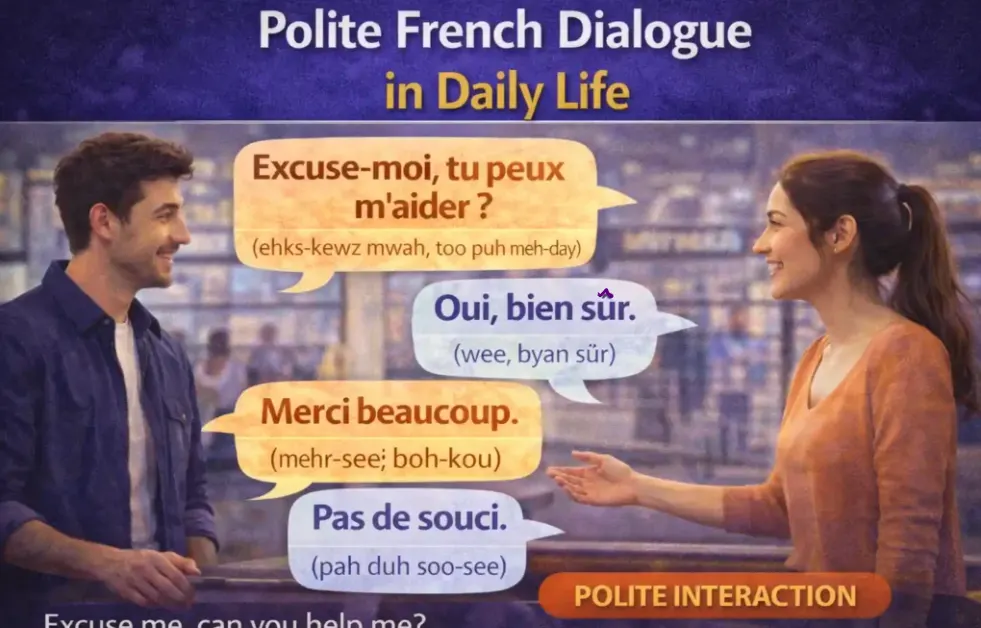
Situation: Asking for help.
French:
A: Excuse-moi, tu peux m’aider ?
B: Oui, bien sûr.
A: Merci beaucoup.
B: Pas de souci.
Transliteration:
A: (ehks-kewz mwah, too puh meh-day)
B: (wee, byan sür)
A: (mehr-see boh-koo)
B: (pah duh soo-see)
English:
A: Excuse me, can you help me?
B: Yes, of course.
A: Thank you very much.
B: No problem.
Simple, polite, natural.
Common Patterns You’ll See in French Dialogues
After exposure, you’ll notice repeated patterns.
- Ça va ? → Ça va.
- Ah bon ? → Ouais.
- Franchement… → opinion
- Bref… → closing
These patterns matter more than individual words.
Learning them makes listening and speaking easier.
Common Mistakes Learners Make With French Dialogues
Avoid these mistakes:
- Memorizing dialogues word for word
- Speaking in full sentences every time
- Ignoring fillers and reactions
- Translating dialogues from English
Instead:
- Learn structures
- Swap words naturally
- Focus on flow, not perfection
How to Practice French Dialogues Effectively
Here’s a simple method:
- Read dialogues out loud
- Practice with different emotions
- Replace words with your own
- Record yourself speaking
Example:
- Replace fatigué with stressé
- Replace ce soir with demain
This turns one dialogue into many.
How French Dialogues Prepare You for Real Conversations
Once you practice French dialogues regularly:
- Conversations feel familiar
- Listening becomes easier
- You respond faster
- Confidence increases
Dialogues are the bridge between studying French and living French.
They prepare you perfectly for the next topic: Asking Questions in French, which keeps dialogues going.
Conclusion
French dialogues show you how the language truly works in real life. They combine sentence starters, fillers, reactions, and expressions into natural exchanges that sound human, not robotic. By studying and practicing French dialogues, you move beyond isolated phrases and start thinking in conversations. With time, these dialogues become second nature, making French communication smoother, more confident, and far more enjoyable.