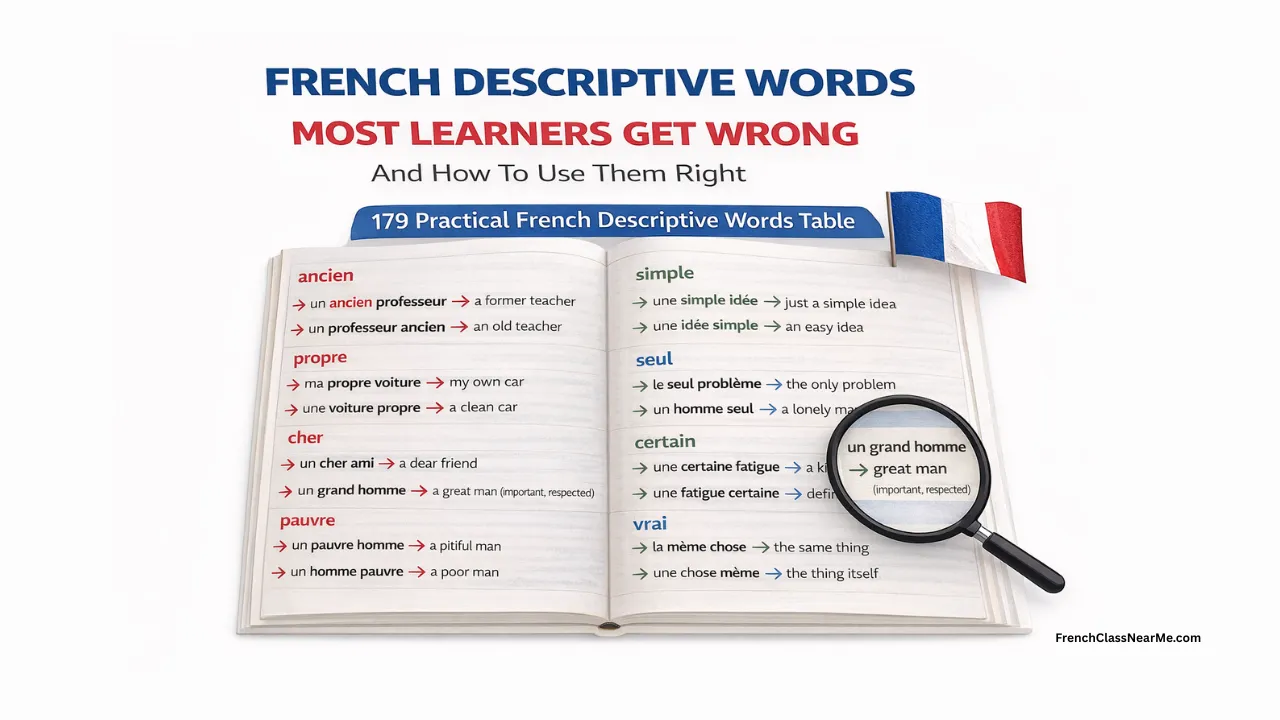
French Descriptive Words Most Learners Get Wrong (And How To Use Them Right)
One of the biggest frustrations for learners is realizing that French descriptive words don’t always mean the same thing in every sentence. Context, position, and tone matter. This guide walks through French descriptive words that are frequently misunderstood and shows how to use them correctly in real communication. It covers common pitfalls, word placement rules, meaning shifts, tone nuances, and includes a comprehensive reference table of 179 words for practical use.
Now that you know what’s coming, let’s start by understanding why these mistakes happen in the first place.
Why French Descriptive Words Confuse Learners So Much
French descriptive words aren’t difficult because they’re complex. They’re difficult because they don’t behave like English adjectives.
Here’s what trips learners up:
- Meaning changes based on position
- Literal translations don’t work
- One English word maps to multiple French words
- Some adjectives sound positive in English but negative in French
- Gender and agreement change everything
For example, English lets you say “a great man” and “a man who is great” without changing meaning. French doesn’t give you that luxury.
That brings us straight to the first major mistake learners make.
French Descriptive Words That Change Meaning Based On Position
This is where most learners mess up badly.
In French, some descriptive words change meaning depending on whether they come before or after the noun.
Common examples learners get wrong
ancien
- un ancien professeur → a former teacher
- un professeur ancien → an old teacher
Before the noun, ancien talks about status or time. After the noun, it talks about age.
propre
- ma propre voiture → my own car
- une voiture propre → a clean car
Before the noun, propre means ownership. After the noun, it describes cleanliness.
cher
- un cher ami → a dear friend
- But do not say un ami cher → an expensive friend
Before the noun, it’s emotional. After the noun, it’s about price.
grand
- un grand homme → a great man (important, respected)
- un homme grand → a tall man
Before the noun, grand describes importance. After the noun, it describes physical size.
pauvre
- un pauvre homme → a pitiful man
- un homme pauvre → a poor man (no money)
Before the noun, it expresses sympathy. After the noun, it’s literal.
simple
- une simple idée → just a simple idea
- une idée simple → an easy idea
Before the noun, it minimizes importance. After the noun, it describes difficulty level.
seul
- le seul problème → the only problem
- un homme seul → a lonely man
Before the noun, it means “only.” After the noun, it means “alone.”
certain
- une certaine fatigue → a kind of tiredness
- une fatigue certaine → definite tiredness
Before the noun, it’s vague. After the noun, it’s strong and factual.
même
- la même chose → the same thing
- une chose même → the thing itself (rare, formal)
Before the noun, it means “same.” After the noun, it adds emphasis.
vrai
- un vrai problème → a real problem
- une histoire vraie → a true story
Before the noun, it adds emphasis. After the noun, it means factual or true.
The mistake learners make is assuming word order is flexible. It’s not.
Now that you understand how position affects meaning, let’s talk about descriptive words that look easy—but lie to you.
French Descriptive Words That Don’t Mean What You Think
Some French descriptive words are straight-up traps because they look like English words.
False friends learners constantly misuse
False friends learners constantly misuse
sensible
- une personne sensible → a sensitive person
- not a sensible person
In French, sensible describes emotional sensitivity, not practicality or good judgment.
actuel
- la situation actuelle → the current situation
- not the actual situation
Actuel refers to what is happening now, not what is real or factual.
sympathique
- un collègue sympathique → a nice or friendly coworker
- not a sympathetic coworker
It describes personality and friendliness, not emotional support.
intelligent
- un enfant intelligent → a smart child
- not automatically wise or insightful
In French, intelligent is neutral and factual, not high praise.
drôle
- un film drôle → a funny movie
- une situation drôle → a strange situation
The meaning depends entirely on context, which often confuses learners.
formidable
- une expérience formidable → a great experience
- not a frightening experience
Despite how it looks, formidable is positive in modern French.
éventuel
- une solution éventuelle → a possible solution
- not an eventual solution
It means potential, not something guaranteed to happen later.
important
- un détail important → an important detail
- not a big or large detail
Important refers to significance, not physical size.
sérieux
- un problème sérieux → a serious problem
- not someone boring or humorless
It describes gravity or importance, not personality.
curieux
- un enfant curieux → a curious child
- une situation curieuse → a strange situation
In French, curieux can mean interested or odd depending on context.
Learners often translate these directly and end up sounding confusing or unintentionally rude.
That leads naturally to another issue: using the wrong descriptive word for people.
French Descriptive Words Used Incorrectly To Describe People
Describing people is where mistakes become noticeable fast.
Words learners misuse with people
- gentil
Means kind or nice, but often sounds childish for adults - joli
Better for women, children, or objects—not grown men - intelligent
Neutral, but overusing it sounds robotic - beau
Physical beauty, not personality
A sentence like “Il est joli” sounds strange unless you’re talking about a child.
So how do you fix that? By learning natural alternatives, which brings us to tone.
French Descriptive Words That Sound Awkward Or Too Strong
English speakers tend to go extreme without realizing it.
Examples of tone problems
- magnifique
Very strong. Sounds dramatic in daily speech - horrible
Often exaggerated - parfait
Used far less casually than “perfect” in English
Native speakers often soften things:
- pas mal instead of excellent
- assez bien instead of parfait
Once tone is under control, grammar becomes the next battlefield.
French Descriptive Words And Gender Agreement Errors
This is where confidence dies for many learners.
Common agreement mistakes
- Forgetting feminine forms
- Mispronouncing silent endings
- Ignoring plural agreement
Example:
- do not say une femme heureux
- Say une femme heureuse.
Agreement isn’t optional. It’s structural.
Now that we’ve handled the mistakes, it’s time to give you something powerful: a complete, clean reference.
179 Practical French Descriptive Words Reference Table
Here is the table you need:
| # | English | Masculine | Feminine | Plural (M/F) | Transliteration |
|---|---|---|---|---|---|
| 1 | big/tall | grand | grande | grands / grandes | grahn |
| 2 | small/short | petit | petite | petits / petites | puh-tee |
| 3 | young | jeune | jeune | jeunes / jeunes | zhuhn |
| 4 | old | vieux | vieille | vieux / vieilles | vyuh |
| 5 | new | nouveau | nouvelle | nouveaux / nouvelles | noo-voh |
| 6 | good | bon | bonne | bons / bonnes | bohn |
| 7 | bad | mauvais | mauvaise | mauvais / mauvaises | moh-veh |
| 8 | beautiful/handsome | beau | belle | beaux / belles | boh |
| 9 | ugly | laid | laide | laids / laides | leh |
| 10 | happy | heureux | heureuse | heureux / heureuses | uh-ruh |
| 11 | sad | triste | triste | tristes / tristes | treest |
| 12 | hot/warm | chaud | chaude | chauds / chaudes | shoh |
| 13 | cold | froid | froide | froids / froides | frwah |
| 14 | fast/quick | rapide | rapide | rapides / rapides | rah-peed |
| 15 | slow | lent | lente | lents / lentes | lahn |
| 16 | strong | fort | forte | forts / fortes | fohr |
| 17 | weak | faible | faible | faibles / faibles | fehbl |
| 18 | rich | riche | riche | riches / riches | reesh |
| 19 | poor | pauvre | pauvre | pauvres / pauvres | pohvr |
| 20 | long | long | longue | longs / longues | lohn |
| 21 | short | court | courte | courts / courtes | koor |
| 22 | wide/broad | large | large | larges / larges | lahrzh |
| 23 | narrow | étroit | étroite | étroits / étroites | ay-trwah |
| 24 | thick | épais | épaisse | épais / épaisses | ay-peh |
| 25 | thin | mince | mince | minces / minces | mans |
| 26 | heavy | lourd | lourde | lourds / lourdes | loor |
| 27 | light (weight) | léger | légère | légers / légères | lay-zhay |
| 28 | hard | dur | dure | durs / dures | door |
| 29 | soft | doux | douce | doux / douces | doo |
| 30 | clean | propre | propre | propres / propres | prohpr |
| 31 | dirty | sale | sale | sales / sales | sahl |
| 32 | dry | sec | sèche | secs / sèches | sek |
| 33 | wet | mouillé | mouillée | mouillés / mouillées | moo-yay |
| 34 | full | plein | pleine | pleins / pleines | plahn |
| 35 | empty | vide | vide | vides / vides | veed |
| 36 | open | ouvert | ouverte | ouverts / ouvertes | oo-vehr |
| 37 | closed | fermé | fermée | fermés / fermées | fehr-may |
| 38 | high/tall | haut | haute | hauts / hautes | oh |
| 39 | low | bas | basse | bas / basses | bah |
| 40 | deep | profond | profonde | profonds / profondes | proh-fohn |
| 41 | shallow | peu profond | peu profonde | peu profonds / peu profondes | puh proh-fohn |
| 42 | true | vrai | vraie | vrais / vraies | vreh |
| 43 | false | faux | fausse | faux / fausses | foh |
| 44 | right/correct | correct | correcte | corrects / correctes | koh-rekt |
| 45 | wrong | faux | fausse | faux / fausses | foh |
| 46 | easy | facile | facile | faciles / faciles | fah-seel |
| 47 | difficult | difficile | difficile | difficiles / difficiles | dee-fee-seel |
| 48 | simple | simple | simple | simples / simples | sam-pl |
| 49 | complex | complexe | complexe | complexes / complexes | kohm-pleks |
| 50 | clear | clair | claire | clairs / claires | klehr |
| 51 | dark | sombre | sombre | sombres / sombres | sohmbr |
| 52 | bright | brillant | brillante | brillants / brillantes | bree-yahn |
| 53 | loud | bruyant | bruyante | bruyants / bruyantes | brwee-yahn |
| 54 | quiet | calme | calme | calmes / calmes | kahlm |
| 55 | silent | silencieux | silencieuse | silencieux / silencieuses | see-lahn-syuh |
| 56 | sweet | sucré | sucrée | sucrés / sucrées | soo-kray |
| 57 | sour | aigre | aigre | aigres / aigres | ehgr |
| 58 | bitter | amer | amère | amers / amères | ah-mehr |
| 59 | salty | salé | salée | salés / salées | sah-lay |
| 60 | spicy | épicé | épicée | épicés / épicées | ay-pee-say |
| 61 | fresh | frais | fraîche | frais / fraîches | freh |
| 62 | rotten | pourri | pourrie | pourris / pourries | poo-ree |
| 63 | raw | cru | crue | crus / crues | kroo |
| 64 | cooked | cuit | cuite | cuits / cuites | kwee |
| 65 | ripe | mûr | mûre | mûrs / mûres | moor |
| 66 | intelligent | intelligent | intelligente | intelligents / intelligentes | an-teh-lee-zhahn |
| 67 | stupid | stupide | stupide | stupides / stupides | stoo-peed |
| 68 | clever | malin | maligne | malins / malignes | mah-lan |
| 69 | wise | sage | sage | sages / sages | sahzh |
| 70 | foolish | fou | folle | fous / folles | foo |
| 71 | crazy | fou | folle | fous / folles | foo |
| 72 | brave | courageux | courageuse | courageux / courageuses | koo-rah-zhuh |
| 73 | cowardly | lâche | lâche | lâches / lâches | lahsh |
| 74 | kind | gentil | gentille | gentils / gentilles | zhahn-tee |
| 75 | cruel | cruel | cruelle | cruels / cruelles | kroo-ehl |
| 76 | generous | généreux | généreuse | généreux / généreuses | zhay-nay-ruh |
| 77 | greedy | avide | avide | avides / avides | ah-veed |
| 78 | honest | honnête | honnête | honnêtes / honnêtes | oh-neht |
| 79 | dishonest | malhonnête | malhonnête | malhonnêtes / malhonnêtes | mah-loh-neht |
| 80 | polite | poli | polie | polis / polies | poh-lee |
| 81 | rude | impoli | impolie | impolis / impolies | am-poh-lee |
| 82 | friendly | amical | amicale | amicaux / amicales | ah-mee-kahl |
| 83 | hostile | hostile | hostile | hostiles / hostiles | oh-steel |
| 84 | shy | timide | timide | timides / timides | tee-meed |
| 85 | confident | confiant | confiante | confiants / confiantes | kohn-fyahn |
| 86 | proud | fier | fière | fiers / fières | fyehr |
| 87 | humble | humble | humble | humbles / humbles | umbl |
| 88 | jealous | jaloux | jalouse | jaloux / jalouses | zhah-loo |
| 89 | patient | patient | patiente | patients / patientes | pah-syahn |
| 90 | impatient | impatient | impatiente | impatients / impatientes | am-pah-syahn |
| 91 | lazy | paresseux | paresseuse | paresseux / paresseuses | pah-reh-suh |
| 92 | hardworking | travailleur | travailleuse | travailleurs / travailleuses | trah-vah-yuhr |
| 93 | serious | sérieux | sérieuse | sérieux / sérieuses | say-ryuh |
| 94 | funny | drôle | drôle | drôles / drôles | drohl |
| 95 | boring | ennuyeux | ennuyeuse | ennuyeux / ennuyeuses | ahn-nwee-yuh |
| 96 | interesting | intéressant | intéressante | intéressants / intéressantes | an-tay-reh-sahn |
| 97 | exciting | passionnant | passionnante | passionnants / passionnantes | pah-syoh-nahn |
| 98 | tired | fatigué | fatiguée | fatigués / fatiguées | fah-tee-gay |
| 99 | energetic | énergique | énergique | énergiques / énergiques | ay-nehr-zheek |
| 100 | healthy | sain | saine | sains / saines | san |
| 101 | sick/ill | malade | malade | malades / malades | mah-lahd |
| 102 | hungry | affamé | affamée | affamés / affamées | ah-fah-may |
| 103 | thirsty | assoiffé | assoiffée | assoiffés / assoiffées | ah-swah-fay |
| 104 | alive | vivant | vivante | vivants / vivantes | vee-vahn |
| 105 | dead | mort | morte | morts / mortes | mohr |
| 106 | married | marié | mariée | mariés / mariées | mah-ryay |
| 107 | single | célibataire | célibataire | célibataires / célibataires | say-lee-bah-tehr |
| 108 | pregnant | enceint | enceinte | enceints / enceintes | ahn-sant |
| 109 | naked | nu | nue | nus / nues | noo |
| 110 | dressed | habillé | habillée | habillés / habillées | ah-bee-yay |
| 111 | famous | célèbre | célèbre | célèbres / célèbres | say-lebr |
| 112 | unknown | inconnu | inconnue | inconnus / inconnues | an-koh-noo |
| 113 | popular | populaire | populaire | populaires / populaires | poh-poo-lehr |
| 114 | rare | rare | rare | rares / rares | rahr |
| 115 | common | commun | commune | communs / communes | koh-mun |
| 116 | normal | normal | normale | normaux / normales | nohr-mahl |
| 117 | strange | étrange | étrange | étranges / étranges | ay-trahnzh |
| 118 | weird | bizarre | bizarre | bizarres / bizarres | bee-zahr |
| 119 | usual | habituel | habituelle | habituels / habituelles | ah-bee-too-ehl |
| 120 | unusual | inhabituel | inhabituelle | inhabituels / inhabituelles | ee-nah-bee-too-ehl |
| 121 | special | spécial | spéciale | spéciaux / spéciales | spay-syahl |
| 122 | ordinary | ordinaire | ordinaire | ordinaires / ordinaires | ohr-dee-nehr |
| 123 | important | important | importante | importants / importantes | am-pohr-tahn |
| 124 | unimportant | sans importance | sans importance | sans importance / sans importance | sahn am-pohr-tahns |
| 125 | necessary | nécessaire | nécessaire | nécessaires / nécessaires | nay-seh-sehr |
| 126 | unnecessary | inutile | inutile | inutiles / inutiles | ee-noo-teel |
| 127 | possible | possible | possible | possibles / possibles | poh-seebl |
| 128 | impossible | impossible | impossible | impossibles / impossibles | am-poh-seebl |
| 129 | certain | certain | certaine | certains / certaines | sehr-tan |
| 130 | uncertain | incertain | incertaine | incertains / incertaines | an-sehr-tan |
| 131 | sure | sûr | sûre | sûrs / sûres | soor |
| 132 | dangerous | dangereux | dangereuse | dangereux / dangereuses | dahn-zhuh-ruh |
| 133 | safe | sûr | sûre | sûrs / sûres | soor |
| 134 | careful | prudent | prudente | prudents / prudentes | proo-dahn |
| 135 | careless | imprudent | imprudente | imprudents / imprudentes | am-proo-dahn |
| 136 | lucky | chanceux | chanceuse | chanceux / chanceuses | shahn-suh |
| 137 | unlucky | malchanceux | malchanceuse | malchanceux / malchanceuses | mahl-shahn-suh |
| 138 | perfect | parfait | parfaite | parfaits / parfaites | pahr-feh |
| 139 | imperfect | imparfait | imparfaite | imparfaits / imparfaites | am-pahr-feh |
| 140 | complete | complet | complète | complets / complètes | kohm-pleh |
| 141 | incomplete | incomplet | incomplète | incomplets / incomplètes | an-kohm-pleh |
| 142 | exact | exact | exacte | exacts / exactes | eg-zahkt |
| 143 | approximate | approximatif | approximative | approximatifs / approximatives | ah-prohk-see-mah-teef |
| 144 | similar | similaire | similaire | similaires / similaires | see-mee-lehr |
| 145 | different | différent | différente | différents / différentes | dee-fay-rahn |
| 146 | same | même | même | mêmes / mêmes | mehm |
| 147 | other | autre | autre | autres / autres | ohtr |
| 148 | only | seul | seule | seuls / seules | suhl |
| 149 | first | premier | première | premiers / premières | pruh-myay |
| 150 | last | dernier | dernière | derniers / dernières | dehr-nyay |
| 151 | next | prochain | prochaine | prochains / prochaines | proh-shan |
| 152 | previous | précédent | précédente | précédents / précédentes | pray-say-dahn |
| 153 | early | tôt | tôt | tôt / tôt | toh |
| 154 | late | tardif | tardive | tardifs / tardives | tahr-deef |
| 155 | recent | récent | récente | récents / récentes | ray-sahn |
| 156 | ancient | ancien | ancienne | anciens / anciennes | ahn-syan |
| 157 | modern | moderne | moderne | modernes / modernes | moh-dehrn |
| 158 | traditional | traditionnel | traditionnelle | traditionnels / traditionnelles | trah-dee-syoh-nehl |
| 159 | natural | naturel | naturelle | naturels / naturelles | nah-too-rehl |
| 160 | artificial | artificiel | artificielle | artificiels / artificielles | ahr-tee-fee-syehl |
| 161 | real | réel | réelle | réels / réelles | ray-ehl |
| 162 | fake | faux | fausse | faux / fausses | foh |
| 163 | original | original | originale | originaux / originales | oh-ree-zhee-nahl |
| 164 | local | local | locale | locaux / locales | loh-kahl |
| 165 | foreign | étranger | étrangère | étrangers / étrangères | ay-trahn-zhay |
| 166 | national | national | nationale | nationaux / nationales | nah-syoh-nahl |
| 167 | international | international | internationale | internationaux / internationales | an-tehr-nah-syoh-nahl |
| 168 | public | public | publique | publics / publiques | poo-bleek |
| 169 | private | privé | privée | privés / privées | pree-vay |
| 170 | free (no cost) | gratuit | gratuite | gratuits / gratuites | grah-twee |
| 171 | expensive | cher | chère | chers / chères | shehr |
| 172 | cheap | bon marché | bon marché | bon marché / bon marché | bohn mahr-shay |
| 173 | delicious | délicieux | délicieuse | délicieux / délicieuses | day-lee-syuh |
| 174 | disgusting | dégoûtant | dégoûtante | dégoûtants / dégoûtantes | day-goo-tahn |
| 175 | giant/huge | gigantesque | gigantesque | gigantesques / gigantesques | zhee-gahn-tesk |
| 176 | tiny | minuscule | minuscule | minuscules / minuscules | mee-noos-kool |
| 177 | comfortable | confortable | confortable | confortables / confortables | kohn-fohr-tahbl |
| 178 | uncomfortable | inconfortable | inconfortable | inconfortables / inconfortables | an-kohn-fohr-tahbl |
| 179 | nice/pleasant | sympathique | sympathique | sympathiques / sympathiques | sam-pah-teek |
FAQs
What Makes French Descriptive Words Confusing For Learners
French descriptive words confuse learners because meaning depends on position, context, and tone rather than direct translation. A word can shift meaning based on whether it appears before or after a noun. English does not work this way, so learners apply English logic and get unexpected results in French conversations and writing.
Why Do Some French Adjectives Change Meaning Based On Position
Many descriptive adjectives in French change meaning depending on placement. When placed before the noun, they often express emotion, importance, or subjectivity. When placed after the noun, they usually describe a literal or physical quality. Ignoring this rule leads to misunderstandings even when grammar looks correct.
Are French Descriptive Words Always Placed After Nouns
No. While many French descriptive words come after the noun, some appear before it, and others can appear in both positions with different meanings. Learning which adjectives shift meaning is more important than memorizing a single placement rule. This flexibility is what makes French expressive but tricky.
What Is The Most Common Mistake With French Adjective Placement
The most common mistake is assuming word order does not affect meaning. Learners often believe moving an adjective only changes style. In French, it can completely change the message. This is why phrases like un grand homme and un homme grand are not interchangeable.
How Does Context Affect French Descriptive Words
Context determines whether a descriptive word sounds natural, exaggerated, or even rude. Some adjectives are strong and emotional, while others are neutral. Without context, learners overuse words that sound dramatic or unnatural in daily speech. Native speakers rely heavily on tone and situation when choosing adjectives.
Why Do English Translations Fail With French Descriptive Words
English translations fail because one English adjective often maps to multiple French words. Each French word carries specific nuance. Translating directly ignores tone, position, and register. This leads learners to choose technically correct words that sound wrong in real conversation.
What Are False Friends In French Descriptive Vocabulary
False friends are French words that look like English words but mean something different. Learners trust familiarity and misuse them confidently. Words like actuel or sensible feel obvious but produce incorrect meanings. These errors are subtle but immediately noticeable to native speakers.
Why Is Sensible A Dangerous French Descriptive Word
Sensible means sensitive in French, not practical or reasonable. Learners often describe people as sensible intending praise, but accidentally describe them as emotionally sensitive. This mistake changes the personality being described and can confuse or misrepresent someone entirely.
Does Actuel Mean Actual In French
No. Actuel means current or present, not actual. Saying la situation actuelle refers to what is happening now. Learners who use it to mean “real” or “true” apply English logic and end up with sentences that sound incorrect or misleading.
What Does Sympathique Really Mean In French
Sympathique means friendly, nice, or pleasant. It does not mean sympathetic or emotionally supportive. Learners often misuse it when describing serious situations. In French, it focuses on likability, not compassion, which changes the emotional tone of the sentence.
Why Does Grand Confuse So Many Learners
Grand changes meaning based on placement. Before the noun, it often means great or important. After the noun, it usually means tall or physically large. Learners frequently mix these meanings and accidentally describe physical traits when they intend to express respect or admiration.
How Does Pauvre Change Meaning In French Sentences
Before a noun, pauvre expresses sympathy or pity. After the noun, it means poor in a financial sense. Learners who ignore placement risk sounding judgmental or emotionally inappropriate without realizing it. This small shift has a strong emotional impact.
What Is The Difference Between Simple And Simple In French
Simple before a noun minimizes importance. After the noun, it describes difficulty or complexity. Learners often use it casually without realizing they are changing meaning. This leads to confusion when describing ideas, tasks, or explanations.
Why Is Cher Not Just About Price
Cher before a noun expresses emotional closeness. After the noun, it refers to cost. Learners who treat it as a price adjective only miss its emotional usage. Understanding this distinction helps express affection naturally without sounding transactional.
How Does Seul Affect Meaning When Describing People
Seul before a noun means only. After the noun, it means alone or lonely. Learners often confuse exclusivity with emotional isolation. This can completely change the emotional weight of a sentence and lead to unintended meanings.
What Does Certain Mean When Placed Before A Noun
Before a noun, certain introduces vagueness or approximation. It softens the statement. After the noun, it strengthens certainty. Learners often reverse these meanings and unintentionally weaken or exaggerate their message.
Why Is Même Tricky In French Descriptions
Même before a noun means same. After the noun, it adds emphasis, often meaning “itself.” Learners rarely encounter the post-noun form and misinterpret sentences that use it for emphasis or formality.
How Does Vrai Change Meaning In French
Before a noun, vrai adds emotional emphasis. After the noun, it means factual or true. Learners who ignore placement can unintentionally exaggerate or understate seriousness, especially in storytelling or explanations.
Why Do French Descriptive Words Sound Too Strong In English Speakers’ Speech
English speakers tend to use extreme adjectives casually. In French, strong adjectives carry more weight. Words like magnifique or parfait sound dramatic in daily conversation. Native speakers often prefer softer expressions to maintain balance and realism.
What Are Softer Alternatives Native Speakers Prefer
Native speakers often use phrases like pas mal or assez bien instead of strong praise. These expressions sound natural and understated. Learners who adopt these patterns immediately sound more fluent and culturally aware.
Why Is Gender Agreement Critical With French Adjectives
Gender agreement is structural in French. Ignoring it makes sentences sound broken. Adjectives must match the noun’s gender and number. Even when pronunciation changes are subtle, written mistakes are obvious and signal lack of mastery.
What Are The Most Common Gender Agreement Errors
Common errors include forgetting feminine endings, mispronouncing silent consonants, and ignoring plural forms. These mistakes accumulate and reduce clarity. Consistent agreement is essential for sounding accurate and confident.
Do All French Descriptive Words Change In The Feminine
No. Some adjectives remain unchanged, while others follow predictable patterns. Learners struggle when they assume uniform rules. Recognizing common feminine endings helps reduce hesitation and improve fluency.
Why Do Silent Letters Matter In French Adjectives
Silent letters often appear in written agreement even when pronunciation stays the same. Learners overlook them because they don’t hear them. However, written French relies heavily on these markers for clarity and correctness.
How Can Learners Practice French Descriptive Words Effectively
Practice should focus on full phrases, not isolated words. Seeing adjectives in context helps learners remember placement, agreement, and tone. Repetition with variation builds confidence faster than memorizing lists.
Should Learners Memorize French Descriptive Words In Lists
Lists alone are ineffective. Without context, learners forget usage rules. Combining vocabulary with example sentences leads to stronger retention and fewer mistakes.
Why Are French Adjectives Taught Poorly In Textbooks
Many textbooks simplify rules and avoid nuance. They prioritize structure over real usage. This creates learners who understand grammar but struggle in real conversation where tone and position matter.
How Does Spoken French Change Descriptive Word Usage
Spoken French favors simplicity and understatement. Learners who speak like they write often sound unnatural. Listening to real conversations reveals how descriptive words are softened or shortened in daily speech.
Can One English Adjective Translate To Several French Words
Yes. English adjectives are broader. French uses more specific terms. Choosing the right word depends on context, tone, and intent. This is why translation tools often fail with descriptive language.
Why Do Learners Sound Robotic When Using French Adjectives
Overusing neutral adjectives like intelligent or intéressant makes speech flat. Native speakers vary descriptive language based on emotion and context. Learning alternatives improves natural flow.
How Can Learners Avoid Overusing Strong Adjectives
By observing how natives speak. Strong adjectives are reserved for emphasis. Everyday speech uses moderation. Adopting this habit improves credibility and fluency.
Are French Descriptive Words Formal Or Informal
Some are neutral, others lean formal or informal. Learners often mix registers. Understanding register prevents awkward phrasing in professional or casual situations.
Why Does Word Order Matter More In French Than English
French relies on structure to convey nuance. Word order carries meaning, not just style. English is more flexible, which misleads learners into careless placement.
How Can Learners Tell If An Adjective Is Subjective Or Literal
Subjective adjectives often appear before nouns and express opinion or emotion. Literal adjectives usually come after nouns and describe objective traits. Recognizing this pattern improves comprehension.
What Role Does Tone Play In French Descriptive Language
Tone determines whether a sentence sounds polite, harsh, or exaggerated. The same adjective can feel warm or cold depending on context. Tone awareness separates fluent speakers from learners.
Why Do Native Speakers Rarely Correct Adjective Mistakes
Native speakers usually understand intent and let mistakes pass. However, they notice them immediately. This creates a false sense of correctness for learners who are not being corrected.
Can Incorrect Descriptive Words Change Social Meaning
Yes. A poorly chosen adjective can change politeness level, emotional tone, or intention. These errors affect how speakers are perceived socially and professionally.
How Important Is Practice With Real Sentences
It is essential. Real sentences reveal how descriptive words behave. Abstract rules do not prepare learners for live communication.
Should Learners Focus On Spoken Or Written Usage First
Both matter, but spoken usage helps internalize natural patterns faster. Writing reinforces accuracy. Combining both produces the best results.
Why Do Learners Hesitate When Using French Adjectives
Uncertainty about agreement and placement causes hesitation. Structured exposure and repetition reduce this fear over time.
How Does Exposure Improve Adjective Accuracy
Repeated exposure trains intuition. Learners begin to feel when something sounds wrong before thinking about rules.
What Is The Fastest Way To Improve Descriptive Accuracy
Studying common mistake patterns is faster than memorizing rules. Correcting predictable errors yields immediate improvement.
Are French Descriptive Words Harder Than Verbs
They are different, not harder. Verbs follow patterns. Adjectives rely more on nuance and intuition, which takes time to develop.
Why Do Learners Translate Emotion Instead Of Meaning
Learners translate feelings they want to express instead of the structure required. French demands precision between emotion and description.
How Can Learners Build Confidence With Descriptive Language
Confidence grows from correct repetition. Seeing successful usage reinforces trust in one’s instinct.
Does Mastering French Descriptive Words Improve Fluency
Yes. Accurate descriptive language makes speech sound natural, expressive, and controlled. It is a key marker of advanced fluency.
When Should Learners Start Focusing On Adjective Nuance
As early as possible. Waiting too long reinforces bad habits that are harder to unlearn.
Why Are French Descriptive Words Worth Mastering
They shape meaning, emotion, and clarity. Mastery transforms basic communication into confident expression.
How Does A Reference Table Help Learners
A structured table provides quick clarity on forms, agreement, and usage. It reduces guesswork and builds consistency.
What Should Learners Focus On After Learning The Basics
They should focus on placement, tone, and context. These elements turn knowledge into real communication.