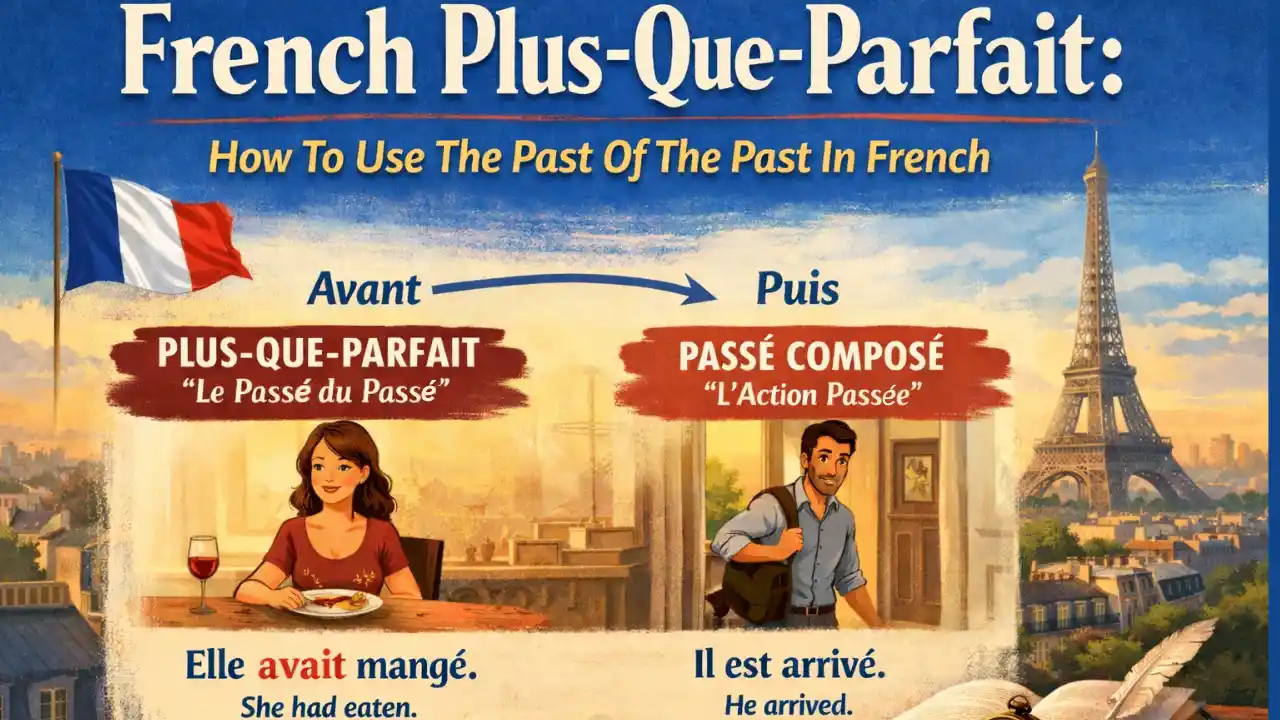
Sometimes, when telling a story, you need to talk about something that happened before another past action. Maybe you arrived somewhere, but something had already happened earlier. That is exactly when the French plus-que-parfait becomes useful.
In simple terms, the plus que parfait is one of the French tenses that is part of the indicative mood and allows you to express the past of the past. It describes an action that was already completed before another event occurred. Once you understand how the plus-que-parfait works, your French storytelling becomes clearer, more precise, and much more natural.
Now that you know why it matters, let’s break it down step by step so you can use the plus-que-parfait tense in French confidently.
What Is The French Plus-Que-Parfait?
The French plus-que-parfait is a compound tense used to describe an action that happened before another action in the past.
Think of it like the English tense “had done,” “had eaten,” or “had gone.”
Example:
J’avais mangé avant de partir.
I had eaten before leaving.
In this sentence:
manger (to eat) happened first
partir (to leave) happened later
That earlier action uses the plus que parfait French tense.
Another example:
Elle avait terminé son travail quand je suis arrivé.
She had finished her work when I arrived.
Her finishing the work happened before the arrival.
This is the main job of the plus-que-parfait in French grammar: placing one action further back in the past.
Why The Plus-Que-Parfait Is Important
Many learners underestimate the French plus que parfait, but it plays a major role in storytelling and explanations.
Without it, your timeline becomes confusing.
Imagine saying:
Je suis arrivé. Elle a terminé son travail.
This simply says:
I arrived. She finished her work.
But it does not clearly explain which action happened first.
Now look at the improved version:
Je suis arrivé. Elle avait terminé son travail.
Now the meaning is clear:
She had already finished before the arrival.
That clarity is exactly why the plus que parfait tense French learners study becomes essential when narrating events.
How To Form The Plus-Que-Parfait In French
The plus-que-parfait is built using two parts:
- The imparfait of an auxiliary verb
- The past participle of the main verb
Formula:
Subject + Imparfait Of Avoir / Être + Past Participle
Example:
J’avais parlé.
I had spoken.
Here is the breakdown:
j’ = subject
avais = imparfait of avoir
parlé = past participle
This structure is the foundation of French plus que parfait conjugation.
Auxiliary Verbs Used In Plus-Que-Parfait
Just like other French compound tenses, the plus-que-parfait uses either:
Avoir
or
Être
Most verbs use avoir.
Example:
J’avais compris.
I had understood.
Nous avions fini.
We had finished.
However, verbs of movement and reflexive verbs use être.
Example:
Elle était partie.
She had left.
Ils étaient arrivés.
They had arrived.
Understanding which auxiliary verb to use is crucial when forming the plus que parfait French tense correctly.
Conjugation Of Avoir In The Imparfait
Since avoir is the most common auxiliary verb, you must know its imparfait forms.
Imparfait of Avoir:
J’avais
Tu avais
Il / Elle avait
Nous avions
Vous aviez
Ils / Elles avaient
Examples:
J’avais terminé.
I had finished.
Tu avais oublié ton téléphone.
You had forgotten your phone.
Nous avions gagné le match.
We had won the match.
These forms appear constantly when using the plus que parfait French structure.
Conjugation Of Être In The Imparfait
The second auxiliary verb used in plus-que-parfait conjugation is être.
Imparfait of Être:
J’étais
Tu étais
Il / Elle était
Nous étions
Vous étiez
Ils / Elles étaient
Examples:
Elle était arrivée tôt.
She had arrived early.
Nous étions partis avant la pluie.
We had left before the rain.
Ils étaient restés à la maison.
They had stayed at home.
Whenever a verb normally takes être in the passé composé, it will also take être in the plus que parfait tense in French.
Past Participles In The Plus-Que-Parfait
After the auxiliary verb, you add the past participle of the main verb.
Examples:
parler → parlé
finir → fini
vendre → vendu
voir → vu
prendre → pris
Examples in sentences:
J’avais vu ce film.
I had seen that movie.
Elle avait pris le train.
She had taken the train.
Nous avions vendu la voiture.
We had sold the car.
The past participle never changes when used with avoir, except in special cases with direct objects.
With être, however, agreement is required.
Agreement With Être In Plus-Que-Parfait
When the auxiliary verb is être, the past participle must agree with the subject.
Example:
Elle était arrivée.
She had arrived.
Ils étaient partis.
They had left.
Elles étaient tombées.
They had fallen.
Notice the endings:
arrivé → arrivée
parti → partis
tombé → tombées
This agreement rule applies to all French compound tenses, including the plus que parfait.
Negative Sentences In Plus-Que-Parfait
Making a negative sentence in the plus-que-parfait French tense is simple.
The structure is:
Subject + ne + auxiliary (imparfait) + pas + past participle
Example:
Je n’avais pas compris.
I had not understood.
Elle n’était pas venue.
She had not come.
Nous n’avions pas terminé.
We had not finished.
Notice that ne and pas surround the auxiliary verb.
This rule stays consistent across all plus que parfait French sentences.
Asking Questions In Plus-Que-Parfait
To ask questions in the French plus que parfait, you can use three methods.
1. Intonation
Tu avais fini ?
Had you finished?
2. Est-ce que
Est-ce que tu avais fini ?
Had you finished?
3. Inversion
Avais-tu fini ?
Had you finished?
All three structures are correct when forming questions with the plus-que-parfait tense.
When To Use The Plus-Que-Parfait
Understanding when to use the French plus que parfait is essential for fluency.
Here are the most common situations.
1. An Action Before Another Past Action
Example:
J’ai mangé parce que j’avais faim.
I ate because I had been hungry.
The hunger existed before the eating.
2. In Storytelling
When narrating events, the plus que parfait French tense helps organize the timeline.
Example:
Quand je suis arrivé au cinéma, le film avait déjà commencé.
When I arrived at the cinema, the movie had already started.
3. Explaining Causes
Example:
Il était fatigué parce qu’il avait travaillé toute la nuit.
He was tired because he had worked all night.
The work happened before the fatigue.
Plus-Que-Parfait Vs Passé Composé
Many learners confuse these two tenses.
The passé composé describes completed actions in the past.
The plus-que-parfait describes actions completed before another past action.
Example:
J’ai mangé.
I ate.
J’avais mangé avant de partir.
I had eaten before leaving.
The second sentence gives a clearer timeline.
Understanding this difference helps learners master French past tenses more effectively.
Plus-Que-Parfait Vs Imparfait
The imparfait describes ongoing or habitual past actions.
Example:
Je mangeais quand il est arrivé.
I was eating when he arrived.
But the plus-que-parfait shows an earlier completed action.
Example:
J’avais mangé quand il est arrivé.
I had eaten when he arrived.
The meal was already finished before the arrival.
This distinction becomes important when building accurate French narrative structures.
Reflexive Verbs In Plus-Que-Parfait
Reflexive verbs always use être.
Structure:
Subject + être (imparfait) + reflexive verb past participle
Example:
Je m’étais levé tôt.
I had gotten up early.
Elle s’était préparée rapidement.
She had prepared herself quickly.
Nous nous étions rencontrés avant.
We had met before.
Notice again that agreement occurs because être is used.
Common Plus-Que-Parfait Examples
Let’s look at practical sentences using the French plus que parfait tense.
J’avais oublié ton anniversaire.
I had forgotten your birthday.
Elle avait appris le français à l’école.
She had learned French at school.
Nous avions déjà visité Paris.
We had already visited Paris.
Ils avaient perdu leurs clés.
They had lost their keys.
Tu avais choisi la mauvaise route.
You had chosen the wrong road.
These examples show how naturally the plus que parfait French tense appears in everyday communication.
Signal Words Often Used With Plus-Que-Parfait
Certain expressions frequently appear with the French plus que parfait.
déjà — already
avant — before
après — after
parce que — because
quand — when
Example:
Elle avait déjà quitté la maison quand je suis arrivé.
She had already left the house when I arrived.
These markers help indicate that an action occurred earlier in the timeline.
A Short Story Using Plus-Que-Parfait
To really see the plus que parfait in French grammar in action, look at this short narrative.
Quand je suis arrivé à la gare, le train était déjà parti. J’avais mal compris l’horaire et j’avais quitté la maison trop tard. Heureusement, un ami m’avait appelé plus tôt pour me dire qu’il y avait un autre train une heure plus tard.
English meaning:
When I arrived at the station, the train had already left. I had misunderstood the schedule and had left home too late. Luckily, a friend had called me earlier to say there was another train one hour later.
This example clearly shows how the plus-que-parfait organizes past events.
Mistakes Learners Often Make
Many students struggle with the French plus que parfait because of small but important errors.
Using Passé Composé Instead
Incorrect:
Quand je suis arrivé, il a déjà mangé.
Correct:
Quand je suis arrivé, il avait déjà mangé.
Forgetting Agreement With Être
Incorrect:
Elle était arrivé.
Correct:
Elle était arrivée.
Using Present Auxiliary Instead Of Imparfait
Incorrect:
J’ai mangé.
Correct for plus-que-parfait:
J’avais mangé.
Avoiding these mistakes will make your plus que parfait French sentences sound natural and correct.
How To Practice The Plus-Que-Parfait
If you want to master the plus que parfait in French, practice with storytelling.
Step 1
Write two past events.
Example:
I arrived at the restaurant.
My friend finished eating.
Step 2
Identify the earlier action.
Friend finished eating.
Step 3
Put the earlier action in plus-que-parfait.
Quand je suis arrivé au restaurant, mon ami avait déjà fini de manger.
Practice this structure repeatedly to build confidence with the plus que parfait French tense.
Frequently Asked Questions About French Plus-Que-Parfait
Many learners still have questions about how the French plus-que-parfait works in real conversations. The answers below will help clarify the most common doubts.
What Is The Plus-Que-Parfait In French?
The plus-que-parfait is a French past tense used to describe an action that happened before another action in the past. It is similar to the English structure “had done.” For example: J’avais terminé avant son arrivée means I had finished before his arrival. It helps clarify the order of events when telling stories or explaining past situations.
When Should I Use The Plus-Que-Parfait In French?
You use the plus-que-parfait when one past action happened earlier than another past action. For example: Elle avait déjà mangé quand je suis arrivé. This means she had already eaten before I arrived. The tense makes the timeline of events clearer and avoids confusion.
How Do You Form The French Plus-Que-Parfait?
The plus-que-parfait is formed using the imparfait of the auxiliary verb (avoir or être) followed by the past participle of the main verb. For example: J’avais parlé means I had spoken. The structure is simple: Subject + auxiliary in imparfait + past participle.
Which Auxiliary Verbs Are Used In The Plus-Que-Parfait?
The plus-que-parfait uses the auxiliary verbs avoir or être, just like the passé composé. Most verbs use avoir, such as j’avais compris. However, movement verbs and reflexive verbs use être, such as elle était arrivée. Knowing which verbs use être is essential.
What Is The Difference Between Passé Composé And Plus-Que-Parfait?
The passé composé describes a completed past action, while the plus-que-parfait describes an action completed before another past action. For example: J’ai mangé means I ate. But J’avais mangé avant de partir means I had eaten before leaving. The second sentence shows the earlier action clearly.
How Do You Conjugate Avoir In The Plus-Que-Parfait?
To use verbs with avoir, you need the imparfait forms: j’avais, tu avais, il avait, nous avions, vous aviez, ils avaient. Then add the past participle. Example: Nous avions terminé le travail means We had finished the work. This pattern is used with most French verbs.
How Do You Conjugate Être In The Plus-Que-Parfait?
When verbs require être, you use the imparfait forms: j’étais, tu étais, il était, nous étions, vous étiez, ils étaient. Example: Ils étaient partis avant midi. This means They had left before noon. This structure is common with movement and reflexive verbs.
Does The Past Participle Agree In Plus-Que-Parfait?
Yes, agreement depends on the auxiliary verb. When être is used, the past participle agrees with the subject in gender and number. Example: Elle était arrivée. With avoir, agreement usually does not occur unless a direct object appears before the verb.
How Do You Make Negative Sentences In Plus-Que-Parfait?
To form a negative sentence, place ne before the auxiliary verb and pas after it. For example: Je n’avais pas compris. This means I had not understood. The negative structure remains the same as in other French compound tenses.
How Do You Ask Questions In Plus-Que-Parfait?
Questions in the plus-que-parfait can be asked using intonation, est-ce que, or inversion. For example: Avais-tu fini ? means Had you finished? Another option is Est-ce que tu avais compris ?. These forms are used depending on formality.
What Is An Example Of Plus-Que-Parfait In A Sentence?
A clear example is: Elle avait déjà quitté la maison quand je suis arrivé. This means She had already left the house when I arrived. The leaving happened first, and the arrival happened later.
Why Is The Plus-Que-Parfait Important In French?
The plus-que-parfait helps clarify the order of past events. Without it, listeners may not understand which action happened first. For example: Il était fatigué parce qu’il avait travaillé toute la nuit. The tense explains the cause of the fatigue.
What Are Common Signal Words For Plus-Que-Parfait?
Common words used with the plus-que-parfait include déjà, avant, après, and quand. Example: Elle avait déjà terminé quand je suis arrivé. These expressions help indicate that the action happened earlier in the past.
Can Reflexive Verbs Be Used In Plus-Que-Parfait?
Yes, reflexive verbs use être in the plus-que-parfait. For example: Je m’étais levé tôt. This means I had gotten up early. Because être is used, the past participle agrees with the subject.
Is The Plus-Que-Parfait Used In Spoken French?
Yes, the plus-que-parfait is used frequently in spoken French, especially when telling stories or explaining past events. It helps listeners understand the sequence of actions clearly.
How Is Plus-Que-Parfait Different From Imparfait?
The imparfait describes ongoing or habitual past actions. The plus-que-parfait describes completed actions that happened earlier in the past. Example: Je mangeais quand il est arrivé versus J’avais mangé quand il est arrivé.
Can The Plus-Que-Parfait Be Used In Stories?
Yes. The plus-que-parfait is often used to describe background events that happened before the main story events. It helps writers and speakers structure narratives clearly.
What Is The Structure Of Plus-Que-Parfait?
The structure is: Subject + auxiliary verb in imparfait + past participle. Example: Nous avions compris la situation. This means We had understood the situation. Once the structure is learned, forming the tense becomes easier.
Do All French Verbs Use Avoir In Plus-Que-Parfait?
No. Most verbs use avoir, but some verbs use être, including verbs of movement and reflexive verbs. These verbs follow the same auxiliary rules used in the passé composé.
What Are Some Common Examples Of Plus-Que-Parfait?
Examples include: J’avais oublié mes clés, Elle avait appris le français, and Nous avions déjà visité Paris. These sentences all show actions completed before another past event.
How Do You Recognize Plus-Que-Parfait In A Sentence?
You can recognize the plus-que-parfait by spotting the imparfait of avoir or être followed by a past participle. Words like avait, avaient, or étaient are common indicators.
Is The Plus-Que-Parfait Hard To Learn?
Many learners find it easier once they understand the structure. Since it follows the same pattern as other compound tenses, the main challenge is remembering the imparfait forms of the auxiliary verbs.
Can The Plus-Que-Parfait Be Used With Time Expressions?
Yes. Time expressions like avant, déjà, or après often appear with the plus-que-parfait. Example: Il avait déjà quitté le bureau avant mon arrivée. These expressions help clarify the timeline.
Is The Plus-Que-Parfait Similar To English Past Perfect?
Yes. The plus-que-parfait corresponds closely to the English past perfect tense. Example: I had finished translates to j’avais fini. Both tenses describe an earlier past action.
What Is The Most Common Mistake With Plus-Que-Parfait?
A common mistake is using the passé composé instead of the plus-que-parfait. For example: Quand je suis arrivé, il a déjà mangé is incorrect. The correct version is Quand je suis arrivé, il avait déjà mangé.
Can The Plus-Que-Parfait Be Used Alone?
Yes, but it usually appears with another past tense to clarify the timeline. When used alone, the surrounding context usually explains the sequence of events.
Why Do French Stories Use Plus-Que-Parfait?
French narratives often use the plus-que-parfait to provide background details that happened before the main events. This helps readers understand the story more clearly.
Is The Plus-Que-Parfait Used In Formal Writing?
Yes. The plus-que-parfait appears frequently in formal writing, literature, and academic texts. Writers use it to explain earlier events that influenced the narrative.
How Can I Practice The Plus-Que-Parfait?
A good method is to write short stories using two past actions. Identify the earlier action and place it in the plus-que-parfait. Practicing this repeatedly helps reinforce the structure.
How Long Does It Take To Master The Plus-Que-Parfait?
With regular practice, most learners become comfortable using the plus-que-parfait within a few weeks. The key is practicing storytelling and understanding the sequence of past events.
Final Thoughts
The French plus que parfait might look complicated at first, but it becomes simple once you understand the structure and the timeline it creates.
Remember three key ideas:
It uses the imparfait of avoir or être.
It includes a past participle.
It describes an action that happened before another past action.
Once you start using the plus que parfait in French conversations, your storytelling becomes clearer and more sophisticated. You can explain causes, describe sequences of events, and build narratives that sound far more natural.