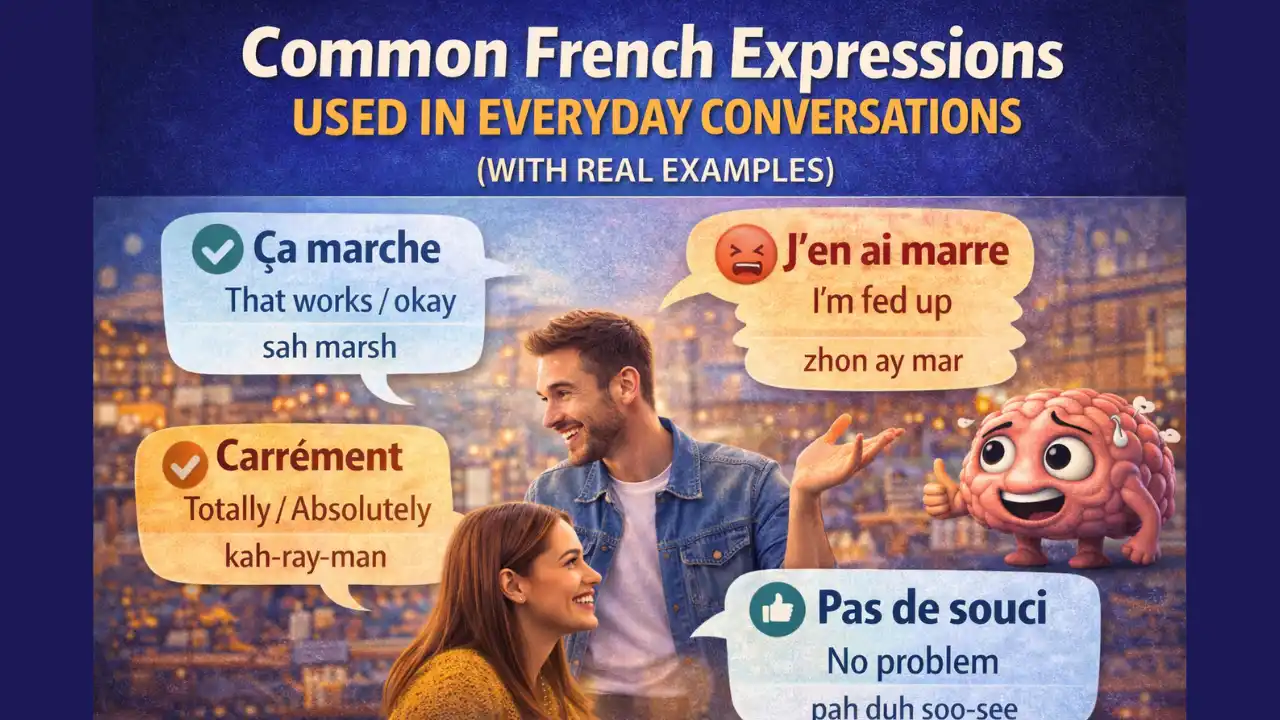
At some point, every French learner hits the same wall: you know the grammar, you know the words, but real conversations still feel uncomfortable. Native speakers talk fast, react casually, and use phrases you never learned in class. That’s where common French expressions come in. In this guide, you’ll discover the everyday expressions French speakers actually use, what they really mean, how to pronounce them, and when to use them naturally so your French sounds human, not robotic.
What Are Common French Expressions and Why They Matter
Common French expressions are fixed phrases native speakers use automatically in daily conversations. They don’t always translate word for word, and that’s exactly why learners struggle with them.
These expressions help you:
- React quickly without overthinking
- Sound relaxed and confident
- Follow conversations more easily
- Avoid overly formal, textbook French
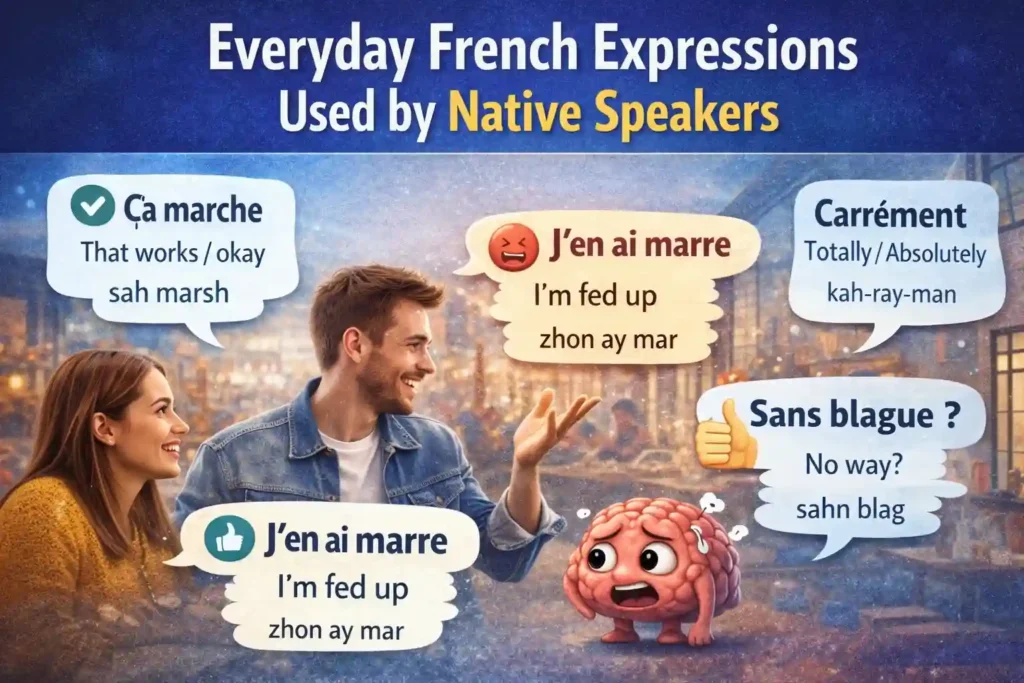
For example, instead of carefully saying Oui, je suis d’accord, a native speaker might simply say Carrément.
Learning expressions as complete units is one of the fastest ways to improve conversational French.
How French Expressions Are Used in Real Life (Not Textbooks)
In real conversations, French expressions are often:
- Short
- Emotional
- Context-driven
- Used as reactions, not full sentences
They often replace long explanations.
For example:
- Ça marche replaces “Okay, that works”
- J’en ai marre replaces “I’m tired of this”
- Pas de souci replaces “No problem”
These expressions are essential building blocks for French conversations and prepare you for understanding real spoken French.
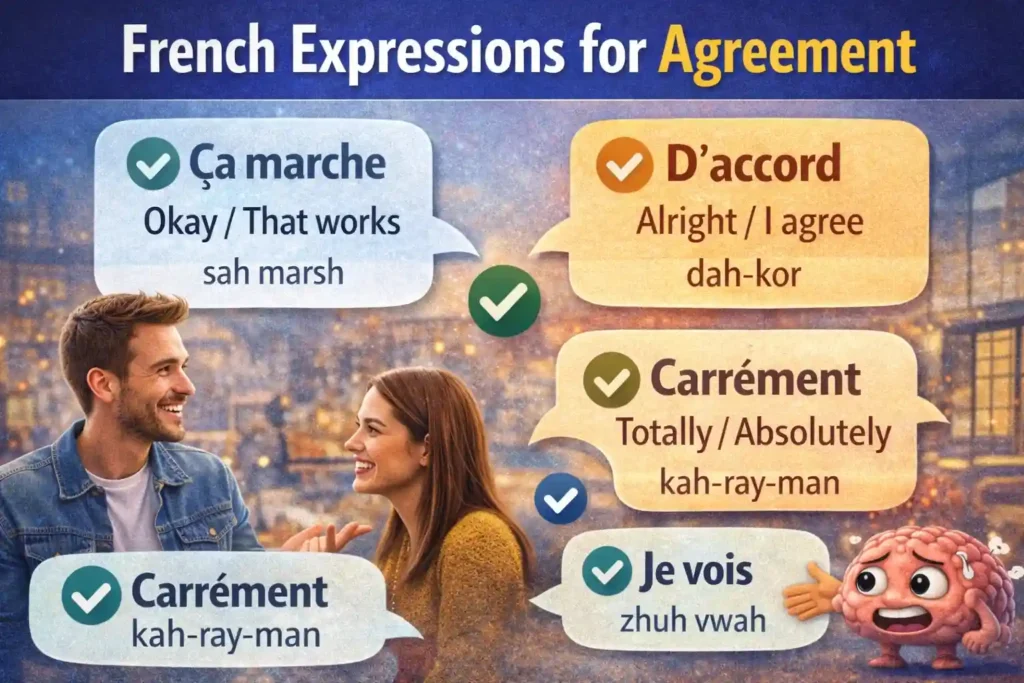
Everyday French Expressions for Agreement and Understanding
These expressions are used constantly when reacting to someone.
| French Expression | Pronunciation | Meaning |
|---|---|---|
| Ça marche | sah marsh | Okay / That works |
| D’accord | dah-kor | Alright / I agree |
| Carrément | kah-ray-man | Totally / Absolutely |
| Je vois | zhuh vwah | I see |
| C’est clair | say klair | That’s clear / Exactly |
Real-life example
Friend: On se retrouve à 18h ?
(ohn suh ruh-troov ah dee-zeet eur)
You: Ça marche.
(sah marsh)
This sounds far more natural than a full sentence.
French Expressions for Hesitation and Uncertainty
French speakers rarely answer instantly. They hesitate, and they show it.
| Expression | Pronunciation | Meaning |
|---|---|---|
| Bof | bof | Meh / Not really |
| Ça dépend | sah day-pahn | It depends |
| Peut-être | puh-et etr | Maybe |
| Pas vraiment | pah vray-mahn | Not really |
| Je ne sais pas | zhuh nuh say pah | I don’t know |
Real-life example
Tu aimes ce film ?
(too em suh feelm)
Bof… pas vraiment.
(bof… pah vray-mahn)
Short. Honest. Natural.
Common French Expressions to Show Emotions and Feelings
Emotion plays a huge role in spoken French, and these expressions are everywhere.
| Expression | Pronunciation | Meaning |
|---|---|---|
| J’en ai marre | zhon ay mar | I’m fed up |
| Ça me saoule | sah muh sool | It annoys me |
| Trop bien | troh byan | So good / Awesome |
| Trop nul | troh nül | So bad |
| Ça fait plaisir | sah fay pleh-zeer | That’s nice to hear |
Real-life example
J’ai enfin fini le projet.
(zhay ahn-feen fee-nee luh proh-zhay)
Trop bien !
(troh byan)
This emotional layer is what makes real French sound alive.
French Expressions Used to React in Conversations
Reactions are the heart of conversation. Without them, speech feels robotic.
| Expression | Pronunciation | Use |
|---|---|---|
| Ah bon ? | ah bohn | Really? |
| Sérieux ? | say-ree-uh | Seriously? |
| Sans blague ? | sahn blag | No way? |
| Pas possible ! | pah poh-seebl | No way! |
| Tu rigoles ? | too ree-gohl | Are you kidding? |
Real-life example
Il a quitté son boulot.
(eel ah kee-tay sohn boo-loh)
Sans blague ?
(sahn blag)
These expressions keep conversations dynamic and natural.
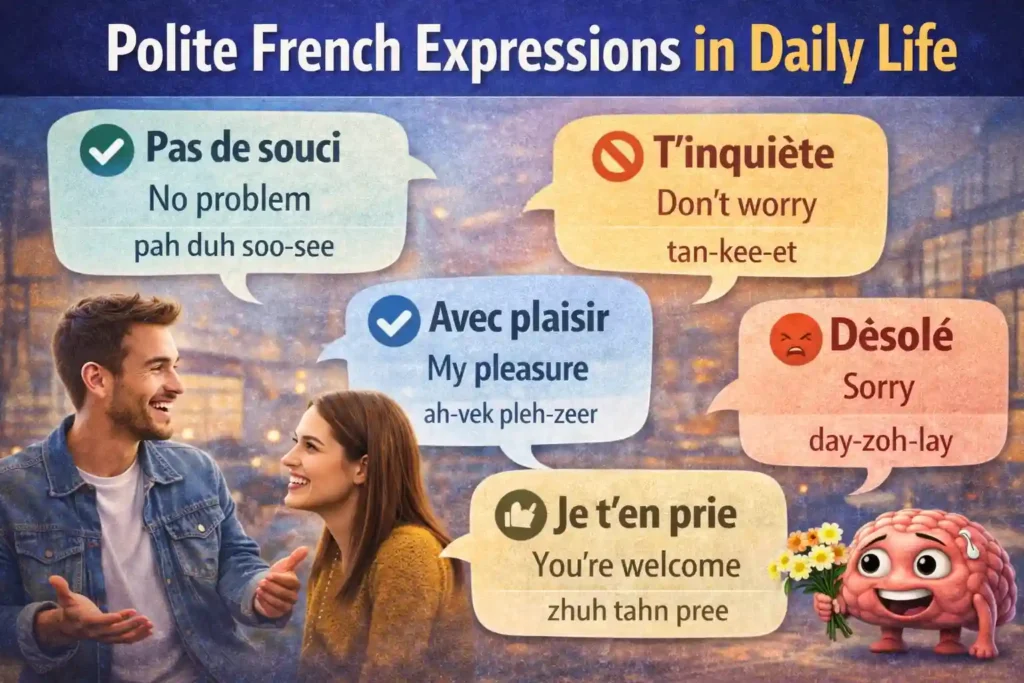
Common French Expressions for Politeness and Social Flow
French conversations rely heavily on politeness and soft responses.
| Expression | Pronunciation | Meaning |
|---|---|---|
| Pas de souci | pah duh soo-see | No problem |
| T’inquiète | tan-kee-et | Don’t worry |
| Avec plaisir | ah-vek pleh-zeer | My pleasure |
| Je t’en prie | zhuh tahn pree | You’re welcome |
| Désolé | day-zoh-lay | Sorry |
Real-life example
Merci pour ton aide.
(mehr-see poor tohn ed)
Pas de souci.
(pah duh soo-see)
Simple expressions like these make you sound calm and confident.
French Expressions That Help You Keep Talking Naturally
These expressions help you think while speaking, which is essential for beginners.
| Expression | Pronunciation | Use |
|---|---|---|
| En fait | ahn fet | Actually |
| Disons que | dee-zohn kuh | Let’s say |
| À vrai dire | ah vray deer | To be honest |
| Du coup | doo koo | So / As a result |
| Bref | bref | In short |
Real-life example
En fait, je ne suis pas sûr.
(ahn fet, zhuh nuh swee pah sür)
These expressions naturally lead into the next article on French sentence starters.
Why You Should Learn Expressions Instead of Translating
One of the biggest mistakes learners make is translating word for word.
Expressions don’t work that way:
- Ça marche does not mean “It walks”
- J’en ai marre does not mean “I have enough of it”
They must be learned as meaning blocks. This prepares you for thinking directly in French instead of translating.
How to Practice Common French Expressions Daily
A simple daily routine works best:
- Choose 3 expressions per day
- Say them out loud with pronunciation
- Use them in personal sentences
- Listen for them in real conversations
Example practice:
- Ça marche when making plans
- Bof when reacting to opinions
- Pas de souci when responding politely
Consistency beats memorization.
Common Mistakes Learners Make With French Expressions
Watch out for these:
- Overusing one expression repeatedly
- Using expressions in the wrong emotional context
- Translating expressions literally
- Avoiding expressions out of fear
These issues will be addressed later in the French conversation mistakes article.
Conclusion
Common French expressions are the foundation of natural, confident conversation. They allow you to react quickly, express emotion, and follow real speech without overthinking. By learning expressions as complete units—with pronunciation, context, and real-life examples—you move closer to how native speakers actually talk. Mastering common French expressions is essential if your goal is French conversations that feel smooth, natural, and genuinely human.

)