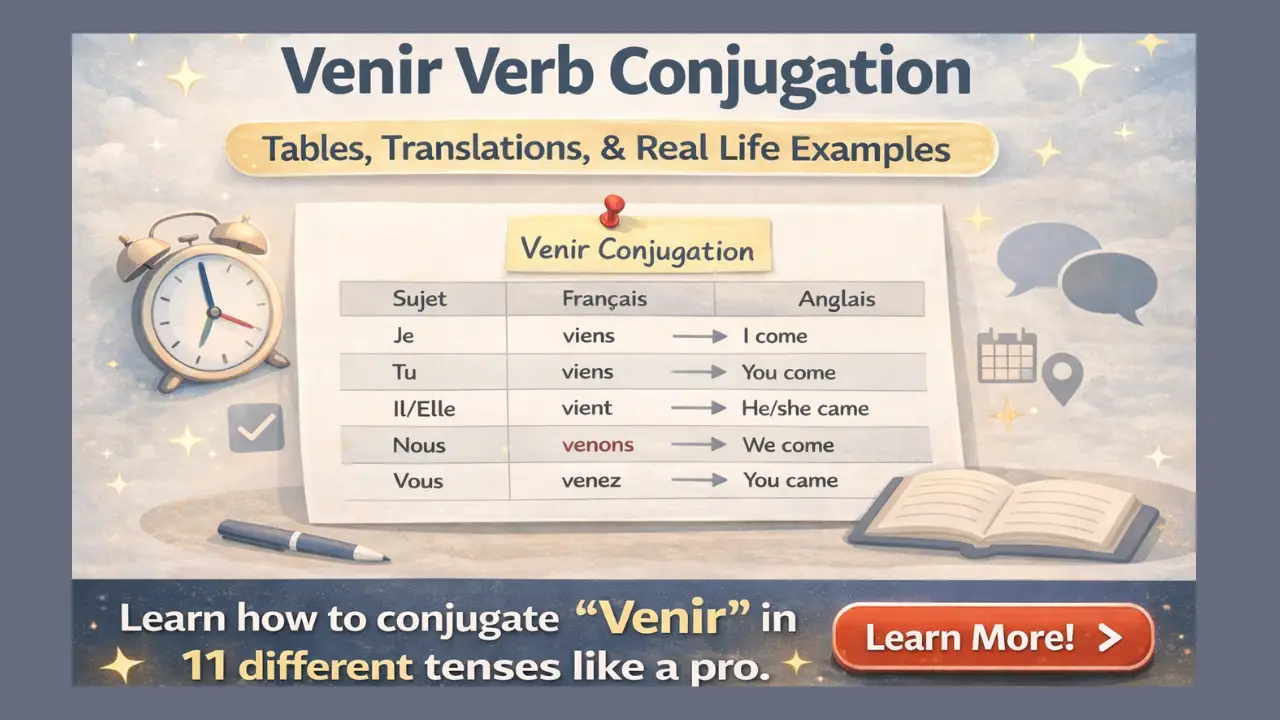
If you’re searching for revenir verb conjugation, you’re dealing with a core French verb that expresses returning, coming back, and repetition in everyday speech. Revenir appears constantly in conversations, stories, and explanations, which makes mastering its conjugation essential. This guide walks through every tense and mood of revenir, explains how each one is used, and provides clear translations and real-life examples that reflect how English actually works.
Venir Verb Conjugation Tables With Translations & Real Life Examples
Let’s start by understanding how revenir behaves.
What You Need To Know Before Conjugating Revenir
Revenir means to come back / to return. It belongs to the venir verb family, follows the same stem patterns, and uses être in compound tenses. It is one of DR MRS VANDERTRAMP verbs. Its past participle revenu agrees in gender and number with the subject.
Indicative Mood
The indicative mood is used to express facts, real actions, habits, and events presented as certain.
Present Tense (Présent)
The present tense describes someone returning now, returning regularly, or a general truth. In English, it usually translates as “come back / return” or “am/is/are coming back.”
| Subject | Conjugation | English Translation |
|---|---|---|
| Je | reviens | I come back / I am coming back |
| Tu | reviens | you come back / you are coming back |
| Il / Elle / On | revient | he / she comes back |
| Nous | revenons | we come back / we are coming back |
| Vous | revenez | you come back / you are coming back |
| Ils / Elles | reviennent | they come back / they are coming back |
Examples:
- Je reviens demain. → I’m coming back tomorrow.
- Elle revient souvent ici. → She often comes back here.
- Ils reviennent tard. → They are coming back late.
Now that the present is clear, let’s see how French talks about returning in the past.
Imperfect Tense (Imparfait)
The imperfect tense describes ongoing or habitual returns in the past or provides background context. In English, it often becomes “was coming back” or “used to come back.”
| Subject | Conjugation | English Translation |
|---|---|---|
| Je | revenais | I was coming back / I used to come back |
| Tu | revenais | you were coming back |
| Il / Elle / On | revenait | he / she was coming back |
| Nous | revenions | we were coming back |
| Vous | reveniez | you were coming back |
| Ils / Elles | revenaient | they were coming back |
Examples:
- Je revenais toujours ici. → I used to come back here.
- Elle revenait tard le soir. → She was coming back late at night.
- Ils revenaient chaque été. → They came back every summer.
To express a completed return, French uses the passé composé.
Passé Composé
The passé composé expresses a completed return with a clear endpoint. Since revenir uses être, the past participle revenu must agree. In English, this translates as “came back” or “have come back.”
| Subject | Conjugation | English Translation |
|---|---|---|
| Je | suis revenu(e) | I came back / I have come back |
| Tu | es revenu(e) | you came back |
| Il / Elle / On | est revenu(e) | he / she came back |
| Nous | sommes revenu(e)s | we came back |
| Vous | êtes revenu(e)(s) | you came back |
| Ils / Elles | sont revenu(e)s | they came back |
Examples:
- Elle est revenue hier. → She came back yesterday.
- Nous sommes revenus tôt. → We came back early.
- Ils sont revenus ensemble. → They came back together.
When a return happened before another past action, French uses the plus-que-parfait.
Plus-Que-Parfait
The plus-que-parfait shows that someone had already come back before another past event. In English, it usually translates as “had come back.”
| Subject | Conjugation | English Translation |
|---|---|---|
| Je | étais revenu(e) | I had come back |
| Tu | étais revenu(e) | you had come back |
| Il / Elle / On | était revenu(e) | he / she had come back |
| Nous | étions revenu(e)s | we had come back |
| Vous | étiez revenu(e)(s) | you had come back |
| Ils / Elles | étaient revenu(e)s | they had come back |
Examples:
- J’étais revenu avant toi. → I had come back before you.
- Elle était revenue trop tôt. → She had come back too early.
- Nous étions revenus exprès. → We had come back on purpose.
Some tenses are mainly useful for reading rather than speaking.
Passé Simple (Rare – Literary)
The passé simple is not used in spoken French. You will mainly see it in novels and formal writing, where it replaces the passé composé.
| Subject | Conjugation | English Translation |
|---|---|---|
| Je | revins | I came back |
| Tu | revins | you came back |
| Il / Elle / On | revint | he / she came back |
| Nous | revînmes | we came back |
| Vous | revîntes | you came back |
| Ils / Elles | revinrent | they came back |
Examples:
- Il revint au village. → He came back to the village.
- Elle revint seule. → She came back alone.
- Ils revinrent tard. → They came back late.
French also allows you to talk about returning in the future.
Simple Future (Futur Simple)
The future tense expresses actions that will happen later. Revenir uses the stem reviendr-, the same stem used in the conditional.
| Subject | Conjugation | English Translation |
|---|---|---|
| Je | reviendrai | I will come back |
| Tu | reviendras | you will come back |
| Il / Elle / On | reviendra | he / she will come back |
| Nous | reviendrons | we will come back |
| Vous | reviendrez | you will come back |
| Ils / Elles | reviendront | they will come back |
Examples:
- Je reviendrai demain. → I will come back tomorrow.
- Elle reviendra plus tard. → She will come back later.
- Nous reviendrons ensemble. → We will come back together.
Subjunctive Mood
The subjunctive is used to express necessity, desire, doubt, emotion, or judgment, especially when talking about someone returning.
Present Subjunctive
In English, this structure usually becomes “for someone to come back” or “that someone should come back.”
| Subject | Conjugation | English Translation |
|---|---|---|
| Que je | revienne | for me to come back / that I should come back |
| Que tu | reviennes | for you to come back / that you should come back |
| Qu’il / elle / on | revienne | for him/her to come back / that he/she should come back |
| Que nous | revenions | for us to come back / that we should come back |
| Que vous | reveniez | for you to come back / that you should come back |
| Qu’ils / elles | reviennent | for them to come back / that they should come back |
Examples:
- Il faut que je revienne. → I need to come back.
- Je veux qu’elle revienne. → I want her to come back.
- Bien qu’ils reviennent tard… → Although they come back late…
Past Subjunctive
The past subjunctive is used when the return happened before the main verb. In English, this often becomes “to have come back.”
| Subject | Conjugation | English Translation |
|---|---|---|
| Que je | sois revenu(e) | for me to have come back |
| Que tu | sois revenu(e) | for you to have come back |
| Qu’il / elle / on | soit revenu(e) | for him/her to have come back |
| Que nous | soyons revenu(e)s | for us to have come back |
| Que vous | soyez revenu(e)(s) | for you to have come back |
| Qu’ils / elles | soient revenu(e)s | for them to have come back |
Examples:
- Je regrette qu’il soit revenu. → I regret that he came back.
- Bien qu’elle soit revenue… → Although she came back…
- Je suis content qu’ils soient revenus. → I’m glad they came back.
Conditional Mood
The conditional expresses hypothetical returns, polite suggestions, or imagined situations.
Present Conditional
| Subject | Conjugation | English Translation |
|---|---|---|
| Je | reviendrais | I would come back |
| Tu | reviendrais | you would come back |
| Il / Elle / On | reviendrait | he / she would come back |
| Nous | reviendrions | we would come back |
| Vous | reviendriez | you would come back |
| Ils / Elles | reviendraient | they would come back |
Examples:
- Je reviendrais si je pouvais. → I would come back if I could.
- Elle reviendrait avec toi. → She would come back with you.
- Nous reviendrions plus tôt. → We would come back earlier.
Imperative Mood
The imperative is used to give instructions, encouragement, or orders related to returning.
Present Imperative
| Form | Conjugation | English Translation |
|---|---|---|
| (Tu) | reviens | come back |
| (Nous) | revenons | let’s come back |
| (Vous) | revenez | come back (formal/plural) |
Examples:
- Reviens ici. → Come back here.
- Revenons plus tard. → Let’s come back later.
- Revenez demain. → Come back tomorrow.
Final Takeaway
The revenir verb conjugation is essential for expressing return, repetition, and continuity in French. Once each tense is connected to its real meaning and natural English translation, revenir becomes easy to recognize, easy to use, and incredibly useful in everyday communication.