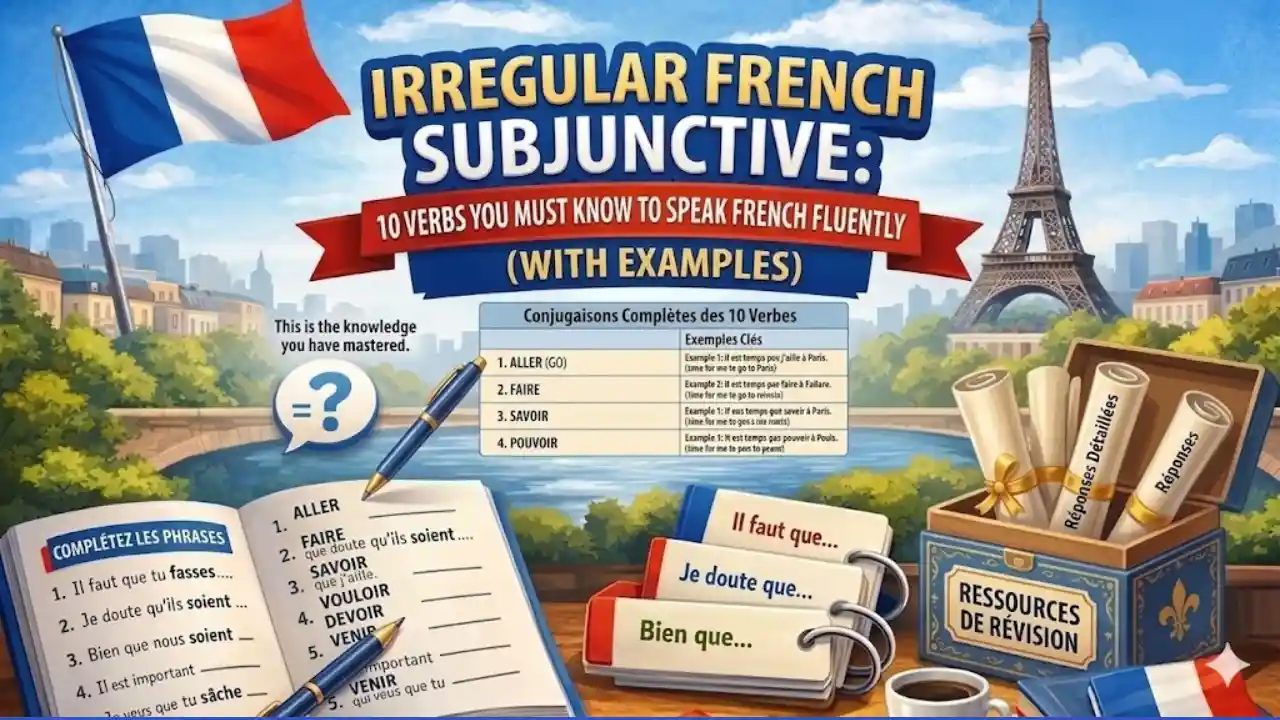
Irregular French Subjunctive: 10 Verbs You Must Know To Speak French Fluently
Many French learners think the subjunctive is complicated. In reality, the biggest challenge usually comes from irregular French subjunctive verbs. Regular verbs follow a predictable pattern, but a few important verbs change their forms completely.
If you are new to French subjunctive, you may want to start with our complete guide to French Subjunctive: Complete Guide For Beginners.
Fortunately, you do not need to memorize dozens of rare verbs. If you master a small group of essential ones, you will already understand a large portion of spoken and written French.
In this guide, you will learn 10 essential irregular French subjunctive verbs, their conjugations, and practical examples showing how they appear in real communication.
What Makes A French Subjunctive Verb Irregular?
Most French verbs form the subjunctive using the third-person plural present tense. After removing -ent, you add the subjunctive endings:
e
es
e
ions
iez
ent
For example:
parler → ils parlent → que je parle
However, some verbs do not follow this pattern. Their stems change or their forms must simply be memorized. These are known as irregular French subjunctive verbs.
Now let’s examine the verbs every serious learner should know.
1. Aller (Que J’aille)
The verb aller is extremely common in French because it expresses movement, plans, and future intentions.
Subjunctive Conjugation
que j’aille
que tu ailles
qu’il / elle aille
que nous allions
que vous alliez
qu’ils / elles aillent
Examples
Il faut que tu ailles au bureau demain.
You must go to the office tomorrow.
Je veux que nous allions en France cet été.
I want us to go to France this summer.
Bien qu’il aille souvent là-bas, il ne connaît personne.
Although he often goes there, he knows no one.
2. Avoir (Que J’aie)
The verb avoir is essential because it appears both as a main verb and as an auxiliary verb in many French tenses.
Subjunctive Conjugation
que j’aie
que tu aies
qu’il / elle ait
que nous ayons
que vous ayez
qu’ils / elles aient
Examples
Il faut que j’aie plus de courage.
I must have more courage.
Je doute qu’il ait la solution.
I doubt that he has the solution.
Bien que nous ayons peu de temps, nous allons essayer.
Although we have little time, we will try.
3. Être (Que Je Sois)
The verb être is one of the most important verbs in French, so its subjunctive form is used frequently.
Subjunctive Conjugation
que je sois
que tu sois
qu’il / elle soit
que nous soyons
que vous soyez
qu’ils / elles soient
Examples
Il faut que je sois prêt avant midi.
I must be ready before noon.
Je veux que vous soyez attentifs.
I want you to be attentive.
Bien qu’il soit fatigué, il continue de travailler.
Although he is tired, he keeps working.
4. Faire (Que Je Fasse)
The verb faire is used to express actions, tasks, and activities.
Subjunctive Conjugation
que je fasse
que tu fasses
qu’il / elle fasse
que nous fassions
que vous fassiez
qu’ils / elles fassent
Examples
Il faut que tu fasses attention.
You must pay attention.
Je veux que nous fassions un effort.
I want us to make an effort.
Bien qu’elle fasse beaucoup d’erreurs, elle progresse.
Although she makes many mistakes, she is improving.
5. Falloir (Qu’il Faille)
The verb falloir is always used in an impersonal form and commonly appears in the expression il faut que, which triggers the subjunctive.
Subjunctive Form
qu’il faille
Examples
Il faut qu’il faille attendre un peu.
It is necessary to wait a little.
Je doute qu’il faille autant d’argent.
I doubt that so much money is necessary.
Bien qu’il faille du temps, nous allons réussir.
Although it takes time, we will succeed.
6. Pleuvoir (Qu’il Pleuve)
The verb pleuvoir describes weather conditions and is also used impersonally.
Subjunctive Form
qu’il pleuve
Examples
Je doute qu’il pleuve aujourd’hui.
I doubt that it will rain today.
Bien qu’il pleuve, ils continuent leur promenade.
Although it is raining, they continue their walk.
Il est possible qu’il pleuve ce soir.
It is possible that it will rain tonight.
7. Pouvoir (Que Je Puisse)
The verb pouvoir expresses ability or possibility.
Subjunctive Conjugation
que je puisse
que tu puisses
qu’il / elle puisse
que nous puissions
que vous puissiez
qu’ils / elles puissent
Examples
Je veux que tu puisses réussir.
I want you to succeed.
Il est important que nous puissions parler librement.
It is important that we can speak freely.
Bien qu’il puisse venir, il préfère rester chez lui.
Although he can come, he prefers to stay home.
8. Savoir (Que Je Sache)
The verb savoir expresses knowledge or awareness.
Subjunctive Conjugation
que je sache
que tu saches
qu’il / elle sache
que nous sachions
que vous sachiez
qu’ils / elles sachent
Examples
Je veux que tu saches la vérité.
I want you to know the truth.
Il faut que nous sachions quoi faire.
We must know what to do.
Bien qu’il sache la réponse, il ne parle pas.
Although he knows the answer, he does not speak.
9. Valoir (Que Je Vaille)
The verb valoir means “to be worth” or “to have value.”
Subjunctive Conjugation
que je vaille
que tu vailles
qu’il / elle vaille
que nous valions
que vous valiez
qu’ils / elles vaillent
Examples
Je doute que cela vaille la peine.
I doubt that it is worth the effort.
Il faut que ce travail vaille le temps investi.
This work must be worth the time invested.
Bien que ce projet vaille beaucoup d’argent, il reste risqué.
Although this project is worth a lot of money, it remains risky.
10. Vouloir (Que Je Veuille)
Finally, the verb vouloir expresses desire or intention, which often requires the subjunctive.
Subjunctive Conjugation
que je veuille
que tu veuilles
qu’il / elle veuille
que nous voulions
que vous vouliez
qu’ils / elles veuillent
Examples
Je veux que tu veuilles apprendre.
I want you to want to learn.
Il faut que nous voulions réussir.
We must want to succeed.
Bien qu’il veuille partir, il reste encore.
Although he wants to leave, he stays a little longer.
FAQs
The following frequently asked questions will help you better understand how the irregular French subjunctive works and how to use these verbs correctly in real French sentences.
What Is The Irregular French Subjunctive In French?
The irregular French subjunctive refers to verbs whose subjunctive forms do not follow the standard formation rule. Normally, the subjunctive uses the ils present tense stem, but some verbs change completely. Common examples include être, avoir, aller, and faire. Because these verbs appear frequently in French conversations, learning their subjunctive forms helps you speak more naturally and understand advanced sentences more easily.
Why Are Some French Subjunctive Verbs Irregular?
Some verbs are irregular because they come from very old verb forms in the history of the French language. Over time, their conjugations evolved differently from regular patterns. As a result, verbs like être, avoir, and pouvoir developed unique subjunctive stems. These irregular forms remained because they are used so frequently in everyday communication.
How Do You Form The Regular French Subjunctive?
To form the regular subjunctive, start with the third-person plural present tense of the verb. Remove the ending -ent, then add the subjunctive endings e, es, e, ions, iez, ent. For example, parler → ils parlent → que je parle. However, irregular verbs change their stems and must be memorized individually.
How Many Irregular French Subjunctive Verbs Exist?
There are many irregular verbs in French, but only a small number appear frequently in everyday communication. Most learners focus on a core group of verbs such as être, avoir, aller, faire, pouvoir, savoir, vouloir, valoir, falloir, and pleuvoir. Mastering these verbs already allows you to understand most subjunctive sentences in real conversations.
Which Verbs Are Most Common In The Irregular French Subjunctive?
Some verbs appear constantly in the subjunctive because they are used with expressions of necessity, doubt, or desire. The most common ones include être, avoir, aller, faire, pouvoir, savoir, vouloir, valoir, falloir, and pleuvoir. Learning these verbs first gives you a strong foundation for understanding the irregular French subjunctive.
Why Is Être Important In The French Subjunctive?
The verb être is one of the most important verbs in French. Its subjunctive forms such as que je sois and que nous soyons appear frequently after expressions like il faut que or bien que. Because of its high frequency, mastering the subjunctive of être greatly improves your ability to understand advanced French sentences.
How Is Avoir Conjugated In The Subjunctive?
The subjunctive forms of avoir are que j’aie, que tu aies, qu’il ait, que nous ayons, que vous ayez, qu’ils aient. These forms are commonly used in expressions such as il faut que tu aies patience or je doute qu’il ait raison. Because avoir is also an auxiliary verb, its subjunctive form is very important.
Why Is Aller Irregular In The Subjunctive?
The verb aller changes its stem in the subjunctive, which makes it irregular. Its forms include que j’aille, que tu ailles, qu’il aille, que nous allions, que vous alliez, qu’ils aillent. Since aller is frequently used when discussing plans or movement, its subjunctive form appears often in everyday French.
How Is Faire Used In The Subjunctive?
The verb faire becomes que je fasse, que tu fasses, qu’il fasse, que nous fassions, que vous fassiez, qu’ils fassent in the subjunctive. It appears commonly after expressions like il faut que or je veux que. Because faire is used in many everyday expressions, its subjunctive form is essential to learn.
Why Does Falloir Always Use The Subjunctive?
The verb falloir is almost always used in the structure il faut que, which automatically requires the subjunctive. Because falloir is impersonal, it only appears in the form qu’il faille in the subjunctive. This verb is extremely common when expressing necessity or obligation.
What Makes Pleuvoir An Irregular Subjunctive Verb?
The verb pleuvoir is an impersonal verb that describes weather conditions. In the subjunctive, it appears as qu’il pleuve. Although it is not as common as other verbs, it is still important when expressing uncertainty about weather or conditions.
How Do You Use Pouvoir In The Subjunctive?
The subjunctive forms of pouvoir are que je puisse, que tu puisses, qu’il puisse, que nous puissions, que vous puissiez, qu’ils puissent. This verb often appears in sentences expressing possibility or permission. For example, je veux que tu puisses réussir means “I want you to be able to succeed.”
Why Is Savoir Irregular In The Subjunctive?
The verb savoir uses a different stem in the subjunctive. Its forms include que je sache, que tu saches, qu’il sache, que nous sachions, que vous sachiez, qu’ils sachent. Because it expresses knowledge or awareness, it frequently appears in sentences expressing doubt or emotion.
What Does Valoir Mean In The Subjunctive?
The verb valoir means “to be worth.” In the subjunctive, its forms include que je vaille, que tu vailles, qu’il vaille, que nous valions, que vous valiez, qu’ils vaillent. This verb is often used in expressions such as je doute que cela vaille la peine, meaning “I doubt that it is worth the effort.”
How Is Vouloir Conjugated In The Subjunctive?
The subjunctive of vouloir is que je veuille, que tu veuilles, qu’il veuille, que nous voulions, que vous vouliez, qu’ils veuillent. Since vouloir expresses desire or intention, it commonly triggers the subjunctive in dependent clauses.
When Should You Use The French Subjunctive?
The French subjunctive is used after expressions that show doubt, emotion, necessity, or desire. Examples include il faut que, je veux que, bien que, and pour que. When these expressions introduce a clause, the verb that follows is usually in the subjunctive.
What Are The Most Common Subjunctive Triggers In French?
Some of the most common subjunctive triggers include il faut que, je veux que, je doute que, bien que, pour que, avant que, and il est important que. These expressions express necessity, doubt, or purpose, which is why the subjunctive is required.
Is The Subjunctive Used Often In Spoken French?
Yes, the subjunctive appears frequently in spoken French, especially after expressions like il faut que and je veux que. Native speakers use these structures naturally in everyday conversation, which is why learning the irregular forms helps you sound more fluent.
How Can You Memorize Irregular French Subjunctive Verbs?
One effective way to memorize irregular verbs is to practice them through example sentences rather than isolated lists. Repeating sentences that include expressions like il faut que or je veux que helps reinforce both the verb form and its context.
What Is The Difference Between Indicative And Subjunctive?
The indicative describes facts and certainty, while the subjunctive expresses uncertainty, emotion, or necessity. For example, il sait que tu viens uses the indicative because it expresses certainty. However, je doute que tu viennes uses the subjunctive because it expresses doubt.
Are Irregular Subjunctive Verbs Difficult To Learn?
At first, irregular verbs may seem difficult because their stems change. However, once you practice them regularly and see them in real sentences, they become easier to recognize. Most learners only need to focus on a small group of commonly used verbs.
Can Beginners Learn The Irregular French Subjunctive?
Yes, beginners can start learning the irregular subjunctive early if they focus on the most common verbs. Instead of memorizing many rare verbs, concentrating on verbs like être, avoir, aller, and faire helps build a strong foundation quickly.
Why Is The Subjunctive Important For Fluency?
The subjunctive is essential for expressing emotions, doubts, wishes, and obligations. Native speakers use it naturally in many daily conversations. Mastering irregular subjunctive verbs therefore helps learners communicate more naturally and sound more fluent.
Do Native French Speakers Always Use The Subjunctive Correctly?
In formal French, the subjunctive is used correctly according to grammatical rules. However, in casual conversation, some speakers simplify structures or avoid complex forms. Even so, understanding the subjunctive remains important for proper comprehension.
What Is The Best Way To Practice The Irregular French Subjunctive?
The best way to practice is to read French texts, listen to conversations, and create your own example sentences using common triggers such as il faut que or je veux que. Regular exposure helps you recognize the forms quickly and use them naturally in speech.
Final Thoughts
Learning the irregular French subjunctive becomes much easier when you focus on the verbs that appear most often in real conversations. Instead of trying to memorize dozens of rare forms, concentrating on these ten verbs will already give you a strong foundation.
Once you start recognizing these verbs in expressions such as il faut que, je veux que, and bien que, the subjunctive will begin to feel natural. With practice, these forms will no longer seem like complex grammar rules but simply another way French expresses ideas and emotions.