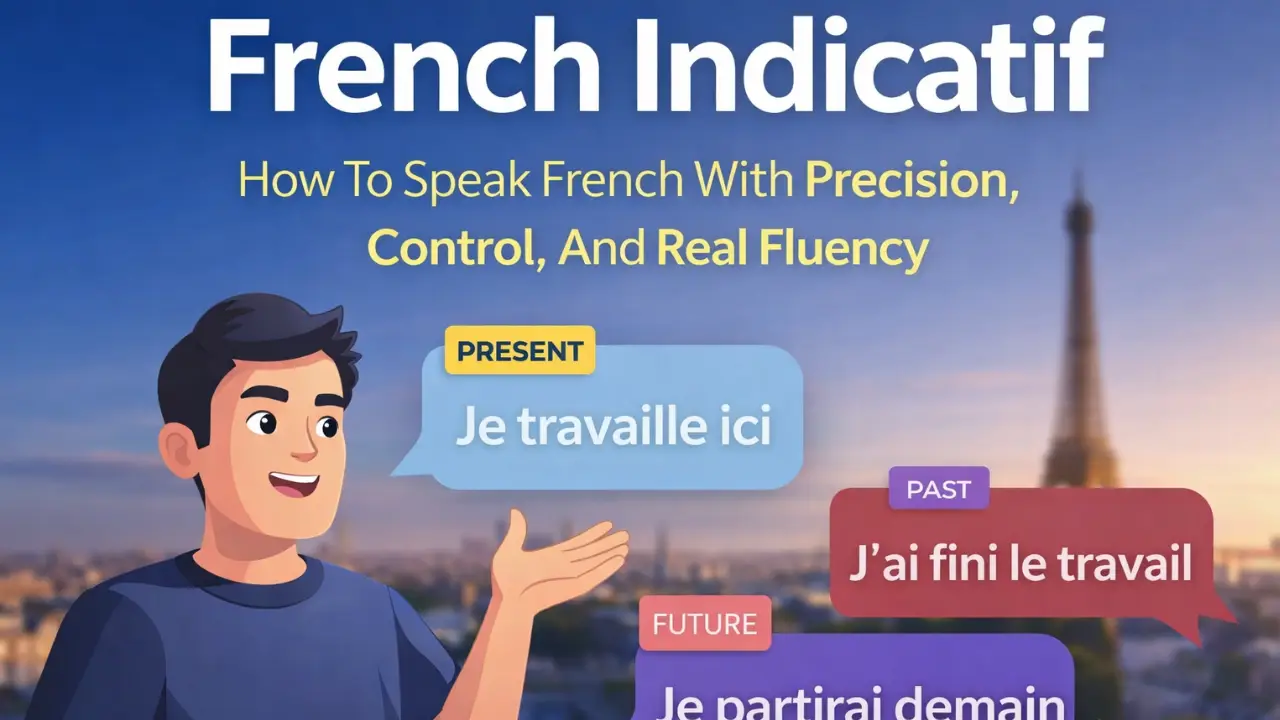
French Indicatif: How To Speak French With Precision, Control, And Real Fluency
Most learners sound unsure in French because they don’t control the French indicatif, the mood that anchors what is real across present, past, and future. When this system is weak, your sentences feel flat and your stories fall apart. In this guide, you’ll learn how the indicatif actually works in modern French, which tenses matter for real fluency, which ones you can ignore for speaking, and how to practice it the smart way so your French sounds clear and confident.
What The French Indicatif Is And Why It Controls Your Fluency
The indicatif is the mood of facts and perceived reality. You use it when you present something as true in your mind: actions, events, routines, observations, causes, and results. It is the default mode of communication in French. If you cannot move comfortably between present, past, and future in the indicatif, you cannot tell clear stories, explain sequences of events, or talk naturally about plans.
Examples of indicatif in real use
Je sais qu’il vient (I know he is coming)
Je pense qu’elle a raison (I think she is right)
Il est clair qu’ils ont compris (It’s clear they understood)
When you frame something as real, you are in indicatif.
The Standard French Indicatif Tenses You Need For Real Fluency
These are the core morphological tenses of the indicatif you need to control to speak and understand French naturally.
Le Présent
Used for what is true now, habits, general truths, and near-future context.
Je travaille ici (I work here / I’m working here)
Il mange souvent tard (He often eats late)
Nous habitons à Lyon (We live in Lyon)
Tu comprends le problème (You understand the problem)
Elles arrivent bientôt (They are arriving soon)
L’Imparfait
Used for background descriptions, habits in the past, and ongoing past situations.
Je travaillais tard avant (I used to work late before)
Il faisait froid ce jour-là (It was cold that day)
Nous parlions souvent ensemble (We used to talk often)
Tu regardais la télé (You were watching TV)
Elles vivaient à Paris (They used to live in Paris)
Le Passé Composé
Used for completed past actions and events that move the story forward.
J’ai fini le travail (I finished the work)
Il a mangé trop vite (He ate too fast)
Nous avons regardé le film (We watched the movie)
Tu as oublié ton sac (You forgot your bag)
Elles sont parties tôt (They left early)
Le Plus-Que-Parfait
Used for an action that happened before another past moment.
J’avais déjà mangé quand il est arrivé (I had already eaten when he arrived)
Elle avait fini avant midi (She had finished before noon)
Nous avions quitté la ville avant l’orage (We had left the city before the storm)
Tu avais compris le problème (You had understood the problem)
Ils avaient réservé la table (They had booked the table)
Le Futur Simple
Used for decisions, promises, predictions, and future facts.
Je partirai demain (I will leave tomorrow)
Il finira le travail ce soir (He will finish the work tonight)
Nous verrons plus tard (We will see later)
Tu comprendras avec le temps (You will understand with time)
Elles viendront demain (They will come tomorrow)
Le Futur Antérieur
Used for actions that will be completed before another future moment or to express certainty about completion.
J’aurai fini avant ce soir (I will have finished before tonight)
Quand tu arriveras, j’aurai mangé (When you arrive, I will have eaten)
Ils auront terminé avant lundi (They will have finished before Monday)
Nous aurons quitté la ville demain matin (We will have left the city tomorrow morning)
Tu auras compris d’ici là (You will have understood by then)
Passé Simple And Passé Antérieur: Indicatif Tenses You Don’t Need For Speaking
Passé simple and passé antérieur belong to the indicatif system, but they are literary tenses. They appear mainly in novels, historical writing, and formal narration. Native speakers do not use them in everyday conversation.
Passé simple examples
Il entra dans la pièce (He entered the room)
Elle vit la vérité (She saw the truth)
Passé antérieur examples
Quand il eut fini, il sortit (When he had finished, he went out)
Après qu’elle eut parlé, tout changea (After she had spoken, everything changed)
In spoken French, these are replaced by
• passé composé instead of passé simple
• plus-que-parfait instead of passé antérieur
If your goal is fluency, learn these two mainly for reading comfort, not for speaking.
Passé Récent And Futur Proche: Not Standard Indicatif Tenses, But Core To Real French
Passé récent and futur proche are not standard morphological tenses of the indicatif. They are periphrastic constructions built with semi-auxiliary verbs in the present tense. However, they are functionally part of how modern French expresses time in the indicatif system because they anchor actions relative to the present moment.
They are formed with
• venir de + infinitif (passé récent)
• aller + infinitif (futur proche)
They use present-tense forms of venir and aller to locate actions close to “now,” instead of specific tense endings.
Le Passé Récent (Immediate Past Construction)
Used for actions that just happened.
Je viens de manger (I just ate)
Elle vient de sortir (She just went out)
Nous venons de finir (We just finished)
Tu viens de comprendre (You just understood)
Ils viennent d’arriver (They just arrived)
Why it matters
Passé récent expresses temporal proximity. It anchors the action directly to the present moment of speaking. This is why native speakers use it constantly in conversation instead of passé composé when the action is very recent.
Le Futur Proche (Near Future Construction)
Used for actions that are imminent or already planned.
Je vais partir (I’m going to leave)
Elle va étudier ce soir (She is going to study tonight)
Nous allons appeler le médecin (We’re going to call the doctor)
Tu vas comprendre bientôt (You’re going to understand soon)
Ils vont signer le contrat (They are going to sign the contract)
Why it matters
Futur proche expresses imminence and strong intention. Unlike futur simple, it presents the future as close and almost certain from the present viewpoint. In spoken French, futur proche often replaces futur simple for planned actions.
Indicatif Vs Subjonctif: The Clean Rule That Stops Mistakes
Indicatif states reality as you see it.
Subjonctif expresses doubt, emotion, desire, or uncertainty.
Je sais qu’il vient (indicatif, fact for you)
Je veux qu’il vienne (subjonctif, desire)
Je pense qu’elle a raison (indicatif, treated as true)
Je doute qu’elle ait raison (subjonctif, doubt)
If you present something as real, use indicatif.
How To Practice The French Indicatif Without Wasting Time
Most learners fail because they practice randomly. You need structured practice that forces you to move across time and combine tenses the way real French works.
Step 1: Build Daily Time Awareness With Core Tenses
Write five sentences every day using présent, passé composé, and futur simple about your real life.
This forces your brain to link meaning to time instead of memorizing forms.
Example practice
Je travaille ce matin.
J’ai fini le rapport hier.
Je finirai le reste demain.
Step 2: Learn To Contrast Past Actions And Background
Retell yesterday using passé composé for actions and imparfait for background.
This teaches you how French separates events from context.
Example practice
Aujourd’hui, j’ai travaillé tard. Avant, je finissais plus tôt.
Hier, il a plu. Il faisait froid.
Step 3: Practice Past Sequences With Plus-Que-Parfait
Describe one past action that happened before another.
This trains your sense of time depth in French.
Example practice
J’avais déjà mangé quand il est arrivé.
Nous avions quitté la maison avant la pluie.
Step 4: Combine Future Layers With Futur Simple And Futur Antérieur
Talk about what you will do and what will already be done before another future moment.
This gives your future speech precision.
Example practice
Je finirai le travail. J’aurai terminé avant midi.
Ils partiront demain. Ils auront réservé l’hôtel avant.
Step 5: Train Your Eye To Recognize Indicatif Patterns
Read short French texts and underline every indicatif verb.
This builds unconscious recognition of tense patterns and usage in context.
Step 6: Speak Out Loud And Fix Weak Tenses Immediately
Speak about your day, yesterday, and tomorrow every day.
When you hesitate, that tense is weak. Drill that tense the same day until the hesitation disappears.
Why Mastering The Indicatif Makes Your French Sound Adult
Beginners stay stuck in the present and avoid complex time structures. Fluent speakers move freely between present, layered past, and structured future. When you control the indicatif system, you can narrate events, explain causes, describe changes over time, and make precise plans. This is what makes your French sound natural instead of translated.
FAQs
What Is The French Indicatif Used For In Daily Speech?
The French indicatif is used to express facts, habits, real events, and actions you treat as true. I use it to describe what is happening now, what already happened, and what will happen. It lets me speak about reality clearly without sounding unsure or emotional.
Why Is The Indicatif So Important For Speaking French Fluently?
If I don’t control the indicatif, I can’t explain my day, tell stories, or talk about plans naturally. The indicatif structures time in French. Once I move smoothly between present, past, and future, my French stops sounding basic and starts sounding confident and natural.
How Do I Know When To Use The Indicatif Instead Of The Subjonctif?
I use the indicatif when I present something as real or true in my mind. If I express doubt, emotion, desire, or uncertainty, I switch to the subjonctif. When I state facts, observations, or conclusions, I stay in the indicatif.
Which Indicatif Tenses Matter Most For Conversation?
The most useful indicatif tenses for speaking are présent, passé composé, imparfait, plus-que-parfait, futur simple, and futur antérieur. These allow me to talk about now, before, background in the past, actions before another past event, the future, and actions completed before a future point.
Can I Speak French Fluently Without Learning Passé Simple?
Yes, I can speak fluent French without using passé simple. In real conversation, native speakers use passé composé instead. Passé simple mainly appears in books and formal writing. I only need to recognize it when reading, not produce it when speaking.
Do I Need Passé Antérieur To Speak French Naturally?
No, I don’t need passé antérieur to speak French naturally. In spoken French, plus-que-parfait replaces it. Passé antérieur appears almost only in literary writing. Learning plus-que-parfait gives me everything I need to express past-before-past situations in real speech.
Why Do Learners Confuse Passé Composé And Imparfait?
Learners confuse them because both talk about the past. Passé composé focuses on completed actions that move the story forward, while imparfait describes background, habits, or ongoing situations in the past. If I mix them up, my listener gets confused about what actually happened.
How Do I Use Plus-Que-Parfait In Real Conversation?
I use plus-que-parfait when one past action happened before another past moment. It helps me explain sequences clearly. For example, I can show that I had already done something before another event occurred, which makes my storytelling precise and easy to follow.
When Should I Use Futur Simple Instead Of Futur Proche?
I use futur simple for decisions, promises, predictions, and future facts. Futur proche is better for plans and actions that feel close and already decided. Using futur simple makes my French sound more deliberate and confident when I talk about what will happen.
What Does Futur Antérieur Add To My French?
Futur antérieur lets me talk about actions that will be completed before another future moment. It adds precision when I describe deadlines, conditions, or sequences in the future. Using it correctly makes my French sound structured and shows strong control of time relationships.
Is Passé Récent Part Of The French Indicatif?
Passé récent is not a standard morphological indicatif tense, but it is built using the indicatif and functions inside the indicatif system in real speech. I use it to talk about actions that just happened, which makes my French sound natural and time-accurate.
Is Futur Proche Technically An Indicatif Tense?
Futur proche is a periphrastic construction built with the present tense of aller. It is not a standard indicatif tense, but it operates within the indicatif system to express near or planned future actions. Native speakers rely on it heavily in daily conversation.
Why Are Passé Récent And Futur Proche So Common In Spoken French?
They anchor actions close to the present moment. Passé récent shows something just happened, while futur proche shows something is about to happen or already planned. These forms match how people think about time in real life, so they dominate natural conversation.
How Can I Stop Translating Tenses From English?
I stop translating by linking French tenses to situations instead of English forms. I think in terms of completed actions, background past, past-before-past, planned future, and future completion. This helps me choose the right tense based on meaning, not English grammar.
Why Does My French Sound Flat Even When My Vocabulary Is Good?
My French sounds flat when I stay stuck in one tense, usually the present. Real French moves across time. Once I use passé composé, imparfait, plus-que-parfait, and future tenses naturally, my speech becomes dynamic and sounds like real communication instead of basic sentences.
How Long Does It Take To Control The Indicatif Well?
If I practice daily with real sentences, I can feel progress in a few weeks. Real control comes from using the tenses in context, not memorizing charts. Speaking, writing short daily summaries, and retelling past and future events speeds up mastery significantly.
What Is The Best Way To Practice Indicatif Tenses Together?
The best way is to tell short stories about my day, yesterday, and tomorrow in one flow. This forces me to combine present, past, and future naturally. Mixing tenses in real sentences trains my brain to switch forms the way native speakers do.
Should I Memorize All Verb Tables To Learn The Indicatif?
Memorizing tables alone is inefficient. I should learn key verb patterns and then use them in sentences about my life. Regular use in context makes conjugations automatic, while pure memorization fades quickly and doesn’t improve real speaking ability.
How Do I Know If A Tense Is Weak For Me?
A tense is weak if I hesitate, pause, or avoid it when speaking. If I keep switching back to the present tense instead of using past or future forms, that tense needs focused practice. Hesitation is a clear signal of what to train next.
Can I Mix Indicatif Tenses In One Short Story?
Yes, I should mix indicatif tenses in one story to sound natural. Real French moves between present, past, and future smoothly. Practicing short narratives with multiple tenses helps me develop flow and prevents my speech from sounding stiff or unnatural.
Why Does Mastering Indicatif Make Other Moods Easier?
Once I control time in French, learning other moods becomes simpler. The subjunctive, conditional, and other forms build on the same tense logic. When my indicatif foundation is strong, I can focus on meaning instead of struggling with basic structure.
What Is The Fastest Way To Improve My Past Tense Accuracy?
The fastest way is to practice contrasting passé composé and imparfait daily. I describe actions with passé composé and background with imparfait. This contrast trains my intuition and removes guesswork when I talk about past events in real conversations.
How Can I Practice Indicatif Without Getting Bored?
I practice using my real life: what I did, what I’m doing, and what I will do. Talking about personal experiences keeps practice meaningful. Short daily speaking drills and quick written summaries prevent boredom and build consistency.
Does Using The Indicatif Correctly Make Me Sound More Native?
Yes, using the indicatif correctly makes my French sound structured and adult. Native speakers expect clear time references. When I control present, layered past, and future forms, my French feels natural and confident instead of hesitant or overly simple.
Final Take On The French Indicatif
The indicatif is not a theory topic. It is the operating system of French communication. If you master présent, imparfait, passé composé, plus-que-parfait, futur simple, futur antérieur, and you use passé récent and futur proche correctly as periphrastic constructions anchored in the indicatif, you can handle real French with clarity and confidence. Once this system is solid, every other mood becomes easier to learn and use.