Learning French can feel slow at the beginning, but French Futur Proche changes that experience because it gives you immediate access to future talk from your first days of learning. In this guide, you will learn how French Futur Proche works, how to use French Futur Proche conjugation correctly, when to use French Futur Proche in real conversations, how French Futur Proche compares to futur simple, and how to practice French Futur Proche with examples and exercises so you can speak naturally in everyday situations.
Why The French Futur Proche Is The Fastest Way To Start Speaking About The Future
Many beginners struggle to express anything beyond the present tense, which limits how useful their French feels in real life. You may be able to say what you are doing now, but conversations rarely stay in the present. People talk about what they plan to do later, what they are about to do, and what they have already decided. French Futur Proche removes this limitation by giving you a simple way to talk about near-future actions without learning complicated verb endings.
Another reason French Futur Proche accelerates speaking confidence is that it mirrors how English speakers naturally express the future using “going to.” This similarity reduces mental translation. When you say “I am going to call her,” you are already thinking in the same structure that French uses with futur proche. This familiarity lowers friction and allows you to start speaking sooner instead of waiting to master advanced grammar.
French Futur Proche also appears constantly in spoken French, which means that understanding it improves listening comprehension at the same time as speaking ability. Once learners realize how often they hear “je vais,” “on va,” and “ils vont” in real conversations, the tense becomes a practical survival tool. Now that the benefits are clear, the next step is to understand what French Futur Proche actually means in everyday language.
What The French Futur Proche Really Means In Everyday English
French Futur Proche AKA the near future in English, is the tense used to describe actions that are going to happen soon or actions that have already been decided. It focuses on intention and immediacy rather than distant plans. This is why it feels natural in casual conversation and daily speech.
In everyday English, futur proche matches phrases like “going to” and “about to.” When you say “I am going to eat,” you are not making a distant prediction. You are expressing a plan that is about to happen. French expresses this same idea using “aller” in the present tense followed by an infinitive verb. This parallel structure helps beginners grasp the meaning quickly.
This tense is also useful for describing actions that feel certain because the decision has already been made. For example, saying “I am going to study tonight” communicates commitment. In French, “je vais étudier ce soir” carries the same sense of intention. Once you understand the meaning, the next step is learning how to form French Futur Proche correctly in all situations.
How To Form The French Futur Proche Step By Step
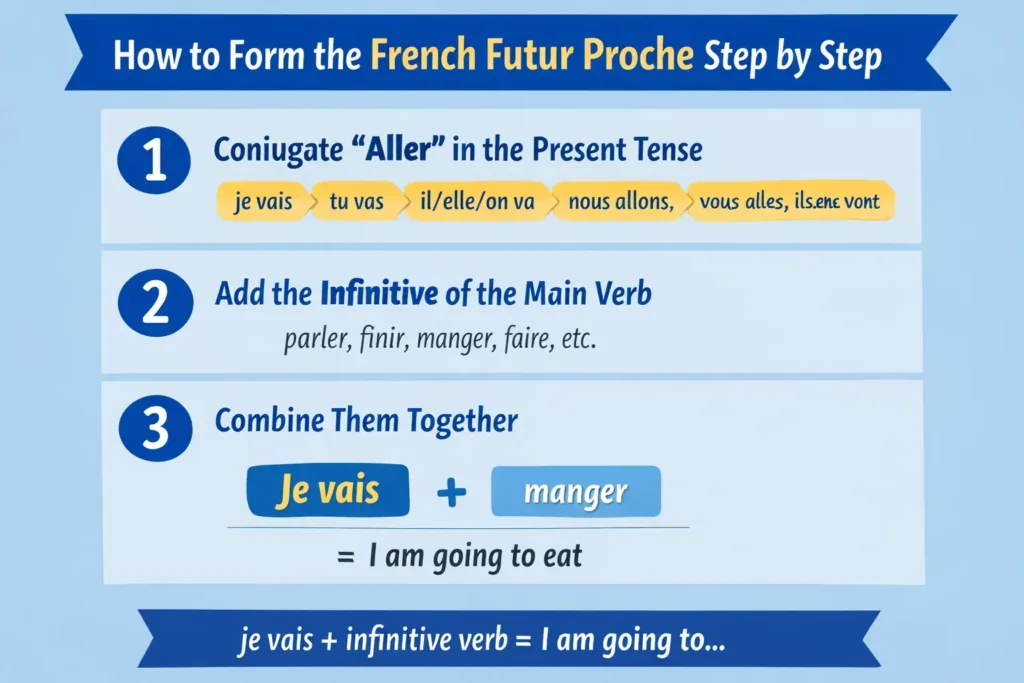
The structure of French Futur Proche is consistent and predictable. You conjugate the verb “aller” in the present tense to match the subject, then add the infinitive form of the main verb. This two-part structure works with every verb in French, which is why futur proche is often taught before other future forms.
The present tense forms of “aller” are je vais, tu vas, il va, elle va, on va, nous allons, vous allez, ils vont, and elles vont. Memorizing these forms is essential because they appear not only in futur proche but also in many common expressions in spoken French.
After selecting the correct form of “aller,” you add the infinitive of the main verb. For example, “je vais parler,” “tu vas travailler,” and “nous allons étudier.” The main verb never changes in futur proche, which removes a major source of confusion for beginners. This predictable structure becomes even clearer when applied to different verb groups.
French Futur Proche Conjugation With Regular Verbs
Regular verbs are divided into three groups in French, and futur proche treats them all the same way. The only verb that changes is “aller.” The main verb stays in the infinitive regardless of the subject. This simplicity allows learners to use a wide range of vocabulary without memorizing additional conjugation rules.
French Futur Proche With ER Verbs
ER verbs are the most common verbs in French, which makes futur proche especially powerful with this group. Verbs like parler, manger, étudier, regarder, and travailler appear in daily conversation. You can say “je vais parler avec mon collègue,” “tu vas manger plus tard,” and “nous allons étudier ce soir.” Because ER verbs are so frequent, using futur proche with them quickly expands your speaking range.
French Futur Proche With IR Verbs
IR verbs such as finir, choisir, grandir, and réfléchir also follow the same futur proche pattern. You simply place the infinitive after the correct form of “aller.” Examples include “je vais finir mon travail,” “tu vas choisir un restaurant,” and “ils vont réfléchir à la décision.” This consistency allows learners to focus on vocabulary instead of grammar complexity.
French Futur Proche With RE Verbs
RE verbs like vendre, attendre, répondre, and entendre work the same way. You can say “je vais vendre ma voiture,” “nous allons attendre ici,” and “elle va répondre demain.” Even though RE verbs can be tricky in other tenses, futur proche removes that difficulty by keeping the verb in its base form. With regular verbs covered, it is time to see how futur proche handles common irregular verbs that appear constantly in real conversations.
French Futur Proche With Common Irregular Verbs
Many high-frequency verbs in French are irregular in other tenses, which can feel intimidating for beginners. However, futur proche simplifies these verbs because they remain in the infinitive after “aller.” Verbs such as être, avoir, faire, prendre, venir, and aller itself follow the same futur proche structure.
You can say “je vais être prêt,” “tu vas avoir besoin d’aide,” “elle va faire ses devoirs,” and “nous allons prendre le bus.” Even though these verbs require special conjugation rules in other tenses, futur proche allows you to use them immediately without memorizing complex forms. This simplicity encourages learners to speak sooner and more confidently. Once you feel comfortable forming futur proche, it helps to see how it appears in real-life situations.
French Futur Proche Examples In Real Life Situations
French Futur Proche appears constantly in everyday situations such as making plans, discussing schedules, and describing immediate actions. You might say “je vais appeler ma mère ce soir,” “on va regarder un film après le dîner,” or “ils vont partir bientôt.” These examples reflect how people naturally speak when talking about what is about to happen.
In workplace contexts, you may hear “je vais envoyer l’email,” “on va commencer la réunion,” or “ils vont arriver à l’heure.” In social settings, futur proche appears in phrases like “je vais te rappeler,” “on va se voir demain,” and “je vais commander à manger.” Seeing these examples in practical contexts makes it easier to remember when to use futur proche. Practicing these patterns leads naturally into exercises you can do on your own.
French Futur Proche Exercises You Can Do Without A Teacher
Practicing futur proche does not require formal lessons. One effective exercise is to write a short daily plan in French using futur proche. For example, write three sentences about what you are going to do today. This reinforces structure and vocabulary at the same time.
Another useful exercise is speaking practice. Say your plans out loud using futur proche, such as “je vais travailler,” “je vais faire du sport,” and “je vais appeler un ami.” Speaking activates memory more strongly than silent reading. Writing short paragraphs about weekend plans also helps internalize the structure. Over time, futur proche becomes automatic. As you gain confidence, you may start to wonder how futur proche compares to futur simple, which is often introduced later.
French Futur Proche Vs Futur Simple Explained For Beginners
Futur proche and futur simple both refer to the future, but they serve different purposes. Futur proche emphasizes immediacy and intention, while futur simple often sounds more formal or distant. Understanding the difference helps you choose the right tense for the situation.
When Futur Proche Sounds More Natural
Futur proche is best used for near-future actions and plans that are already decided. Saying “je vais partir maintenant” sounds natural because the action is about to happen. It also fits well in casual conversation, such as “on va manger ensemble ce soir.”
When Futur Simple Is The Better Choice
Futur simple is often used for long-term plans, predictions, and formal writing. Saying “je partirai l’année prochaine” feels more appropriate for a distant future event. In formal contexts such as writing or announcements, futur simple may sound more polished.
Side By Side Comparison With Examples
You might say “je vais étudier ce soir” for tonight’s plan, but “j’étudierai le français pendant plusieurs années” for a long-term goal. Seeing both forms side by side clarifies how timing and tone influence tense choice. Understanding this contrast helps you avoid mixing tenses incorrectly. With that distinction in mind, it becomes easier to avoid common errors.
The Most Common French Futur Proche Mistakes And How To Fix Them
One frequent mistake is conjugating the second verb instead of leaving it in the infinitive. Saying “je vais mange” instead of “je vais manger” breaks the futur proche structure. Another common error is using the wrong form of “aller,” such as “je va” instead of “je vais.” These mistakes usually come from rushing or guessing instead of following the structure carefully.
Some learners forget to include “aller” entirely and try to express the future using only the main verb, which removes the futur proche tense. Others mix futur proche and futur simple in the same sentence, which creates confusion. Fixing these errors requires slowing down and checking that “aller” is conjugated correctly and that the main verb remains in the infinitive. As these mistakes fade, your sentences become clearer and more natural, which prepares you to use futur proche flexibly in questions and negatives.
How To Ask Questions And Make Negatives With French Futur Proche
Asking questions with futur proche can be done in three main ways. You can use rising intonation, add “est-ce que” at the beginning of the sentence, or use inversion for more formal speech. Each method allows you to ask about future plans naturally and clearly.
Forming negatives in futur proche involves placing “ne” before the conjugated form of “aller” and “pas” after it. The main verb stays in the infinitive. For example, “je ne vais pas sortir ce soir” shows how the negative wraps around “vais.” Mastering these forms expands your ability to interact in real conversations. With these tools, it becomes easier to notice how native speakers rely on futur proche in everyday speech.
How Native Speakers Actually Use The French Futur Proche In Conversation
Native speakers frequently use futur proche in casual conversation because it feels immediate and personal. Phrases like “on va voir,” “je vais te dire,” and “ils vont arriver bientôt” appear constantly in spoken French. These expressions show how futur proche blends naturally into daily communication.
Hearing and using these expressions helps learners move away from textbook French and toward more authentic speech. The more exposure you have to real usage, the easier it becomes to produce similar structures yourself. With that exposure, consistent practice becomes more natural and less forced.
How To Practice The French Futur Proche Without Feeling Overwhelmed
The most effective practice strategy is short, consistent exposure rather than long study sessions. Speaking a few futur proche sentences each day, writing short plans, and mentally translating your intentions into French builds confidence gradually. This steady approach prevents burnout and helps the structure become automatic over time.
A Simple 7 Day Study Plan To Master The French Futur Proche
On the first day, memorize the present tense of “aller.” On the second day, practice futur proche with regular verbs. On the third day, focus on irregular verbs. On the fourth day, write short paragraphs about your daily plans. On the fifth day, speak your plans out loud. On the sixth day, combine futur proche with present tense sentences. On the seventh day, review common mistakes and practice questions and negatives. This simple plan builds momentum without overwhelming you.
How Long It Takes To Get Comfortable With The French Futur Proche
Most learners begin to feel comfortable using futur proche within one to two weeks of daily practice. Because the structure is consistent, progress happens quickly compared to more complex tenses. The more you use futur proche in real situations, the faster it becomes second nature.
How Mastering The French Futur Proche Speeds Up Your Overall French Fluency
Mastering futur proche expands your ability to talk about the future, which makes conversations feel more complete. Because futur proche appears frequently in spoken French, understanding it improves listening comprehension as well. This combination of speaking and listening gains accelerates overall fluency and keeps learners motivated.
Who Should Learn The French Futur Proche First And Why
Beginners benefit most from learning futur proche early because it unlocks real communication quickly. Travelers, students, and casual learners all gain practical value from being able to talk about plans and intentions without complex grammar rules. Even intermediate learners benefit from revisiting futur proche to improve naturalness and accuracy.
How To Combine The French Futur Proche With Other Basic Tenses
Combining futur proche with the present tense allows you to describe what you are doing now and what you are about to do next. For example, “je travaille maintenant et je vais sortir plus tard” shows how both tenses work together naturally. This combination creates smoother, more complete communication.
FAQs
What Is Futur Proche In French And When Should You Use It?
Futur proche in French is used when you’re about to do something or when the action is planned in the near future. You form it with aller (present) + infinitive. For example: Je vais étudier ce soir (I am going to study tonight). I use futur proche when the action feels close, certain, and already decided.
How Do You Form The Futur Proche In French Step By Step?
You form futur proche in French using three parts: the subject, the present tense of aller, and the infinitive verb. Example: Tu vas manger (You are going to eat). I always remind students that you never conjugate the second verb. Only aller changes. The main verb stays in its base form.
What Is The Difference Between Futur Proche And Futur Simple?
Futur proche talks about actions that will happen soon or are already planned. Futur simple talks about the more distant future or predictions. Example: Je vais voyager demain (I’m going to travel tomorrow) vs Je voyagerai un jour en France (I will travel to France one day). You use futur proche when the future feels close and real.
When Should You Use Futur Proche Instead Of Present Tense?
You use futur proche when the action hasn’t started yet but is clearly about to happen. The present tense can also express near future in French, but futur proche adds clarity and intention. Example: Je pars dans cinq minutes (I’m leaving in five minutes) vs Je vais partir dans cinq minutes (I’m going to leave in five minutes). Futur proche sounds more deliberate.
Can You Use Time Expressions With Futur Proche In French?
Yes, futur proche works perfectly with time words like ce soir, demain, tout à l’heure, bientôt. Example: Nous allons sortir ce soir (We are going to go out tonight). I always tell students that time expressions make futur proche sound natural and precise. They help the listener clearly picture when the action will happen.
Is Futur Proche Used In Spoken French More Than Written French?
Yes. Futur proche is extremely common in spoken French. Native speakers use it all the time in daily conversations because it sounds natural and direct. Example: Je vais t’appeler plus tard (I’m going to call you later). In formal writing, futur simple is more common, but futur proche is still correct when talking about near, planned actions.
Can You Use Futur Proche With All Verbs In French?
Yes, futur proche works with all verbs, including regular verbs, irregular verbs, and reflexive verbs. Example: Je vais me lever tôt (I’m going to get up early). I teach students to focus only on conjugating aller correctly. The main verb never changes, no matter how irregular it is in other tenses.
How Do You Use Futur Proche With Reflexive Verbs?
You place the reflexive pronoun before aller. Example: Je vais me reposer (I’m going to rest). Many beginners put the pronoun before the main verb, which is wrong. The structure stays tight: subject + reflexive pronoun + aller + infinitive. Once you lock this pattern in your head, reflexive futur proche becomes easy.
What Is A Common Mistake Learners Make With Futur Proche?
The biggest mistake is conjugating the main verb instead of aller. Wrong: Je vais mange ❌. Correct: Je vais manger (I am going to eat). Another mistake is forgetting the infinitive form. I always drill this: only aller changes; the main verb never changes. Fix this and your French instantly improves.
Can You Ask Questions Using Futur Proche In French?
Yes. You can form questions by intonation or inversion. Example: Tu vas venir ? (Are you going to come?) or Vas-tu venir ? (Are you going to come?). In spoken French, rising intonation is more common. Futur proche works perfectly in questions when you’re asking about near plans or intentions.
How Do You Make Negative Sentences With Futur Proche?
You place ne…pas around aller. Example: Je ne vais pas sortir ce soir (I’m not going to go out tonight). Many learners put the negation around the main verb, which is wrong. Always wrap ne…pas around the conjugated form of aller. That’s the rule you need to lock in.
Is Futur Proche The Same As “Going To” In English?
Yes, futur proche is the French equivalent of “going to” in English. Example: Je vais apprendre le français (I’m going to learn French). Both express intention and near future. I often tell students to think in English first, then mirror the structure in French. This mental shortcut helps you speak faster and more naturally.
Can You Use Futur Proche To Express Plans And Intentions?
Yes. Futur proche is perfect for plans you’ve already decided. Example: Je vais changer de travail (I’m going to change jobs). It shows intention, not just possibility. When you use futur proche, you sound more committed to the action. This makes your French sound confident and purposeful instead of vague.
What Is The Difference Between Futur Proche And Passé Récent?
Futur proche talks about what is about to happen. Passé récent talks about what just happened. Example: Je vais manger (I’m going to eat) vs Je viens de manger (I just ate). I teach them together because both use a helper verb + infinitive. This parallel structure makes them easy to learn as a pair.
How Do You Form The Passé Récent In French?
You form passé récent with venir de + infinitive in the present tense. Example: Je viens de finir (I have just finished). Only venir is conjugated. The main verb stays in the infinitive. This tense is great for talking about very recent past actions, often things that happened moments ago.
Can You Use Futur Proche And Passé Récent In The Same Sentence?
Yes, and it sounds very natural. Example: Je viens de manger et je vais travailler (I just ate and I’m going to work). This structure lets you show what just happened and what’s about to happen. I use this combo a lot in real conversation because it mirrors how we naturally talk about time.
How Do You Teach Futur Proche To A Beginner Effectively?
Start with aller in the present tense. Drill it until it’s automatic. Then add one infinitive at a time. Example: Je vais parler (I’m going to speak). I keep sentences short and practical. No grammar overload. Once the student can build five simple futur proche sentences, confidence jumps fast.
Is Futur Proche Used For Predictions In French?
Yes, when the prediction is based on what you see now. Example: Il va pleuvoir (It’s going to rain). If you see dark clouds, futur proche feels natural. For abstract predictions about the distant future, futur simple sounds better. The key difference is evidence and immediacy. Futur proche feels grounded in the present moment.
Can You Combine Futur Proche With Modal Verbs Like Pouvoir Or Devoir?
Yes. Example: Je vais devoir partir (I’m going to have to leave) or Je vais pouvoir t’aider (I’m going to be able to help you). The structure stays the same: conjugate aller, then use the infinitive of the modal verb, then the second verb. This stacking is normal in French.
What Are Some Real-Life Examples Of Futur Proche In Daily Speech?
You hear futur proche everywhere in daily French. Examples: On va voir (We’re going to see), Je vais te rappeler (I’m going to call you back), On va manger (We’re going to eat). These short phrases appear constantly in conversations. If you master futur proche, your spoken French will sound instantly more natural.
Is Futur Proche Considered Formal Or Informal?
Futur proche is neutral. It’s common in everyday speech and acceptable in writing when talking about near future plans. In very formal writing, futur simple is often preferred, but futur proche is not wrong. I teach students to use futur proche freely when speaking and when writing informal messages, emails, and messages to friends.
How Do You Avoid Confusing Futur Proche With Present Tense?
Focus on intention. If the action is about to happen but hasn’t started, use futur proche. Example: Je mange (I’m eating) vs Je vais manger (I’m going to eat). The present tense describes what is happening now. Futur proche describes what is about to happen next. That mindset keeps them separate in your head.
Can Futur Proche Be Used With Adverbs Like “Probably” Or “Maybe”?
Yes. Example: Je vais probablement partir demain (I’m probably going to leave tomorrow). You can soften futur proche with adverbs to show uncertainty. This is useful when you’re not 100% sure about your plan. Futur proche doesn’t always mean certainty; the adverb changes the strength of your intention.
How Do You Practice Futur Proche To Speak Faster?
Build daily mini-sentences out loud. Example: Je vais lire. Je vais écrire. Je vais travailler. I tell students to say 10 futur proche sentences every morning. Speed comes from repetition, not from reading rules. The more you build these sentences aloud, the more automatic your French future talk becomes.
What Is The Most Natural Way To Talk About Near Future In French?
The most natural way is futur proche. Native speakers rarely overthink tense choice in daily speech. Example: Je vais te dire un truc (I’m going to tell you something). If you use futur proche often, your French will sound less textbook and more real. This is one of the fastest ways to level up your spoken French.
Can Futur Proche Be Used In Storytelling?
Yes, especially in spoken stories. Example: Et là, je vais tomber… (And then, I’m going to fall…). This creates immediacy and drama. It pulls the listener into the moment. I encourage students to experiment with futur proche when telling short stories or personal experiences to make their French sound alive.
How Does Futur Proche Compare To English Future With “Will”?
Futur proche is closer to “going to” than “will.” Example: Je vais partir (I’m going to leave). “Will” in English often matches futur simple in French: Je partirai (I will leave). If you map “going to” to futur proche and “will” to futur simple, you’ll choose the right tense more easily.
What Is The Best Way To Remember Futur Proche And Passé Récent Together?
Learn them as a pair. Futur proche: aller + infinitive. Passé récent: venir de + infinitive. Example: Je viens de manger, je vais travailler (I just ate, I’m going to work). This mental pairing helps you talk about what just happened and what’s about to happen without thinking too hard.
Final Thoughts On Learning The French Futur Proche With Confidence
French Futur Proche is one of the most practical tools for beginners because it unlocks natural future expression quickly. By understanding its meaning, mastering its simple structure, practicing with real-life examples and exercises, and using it daily in conversation, you build confidence faster than with more complex tenses. Over time, French Futur Proche becomes a reliable foundation that supports clear, natural communication as your French continues to grow.