One of the biggest differences between classroom French and real spoken French isn’t vocabulary or grammar—it’s what happens between sentences. Native speakers hesitate, react, think out loud, and signal emotions while speaking, and they do it effortlessly. That’s where French fillers come in. In this guide, you’ll learn the small words and sounds French speakers use to buy time, soften responses, and keep conversations flowing naturally, even when they don’t know exactly what to say yet.

What Are French Fillers and Why They Matter
French fillers are short words or sounds used during speech to:
- Gain thinking time
- Signal hesitation or transition
- Soften statements
- Keep the listener engaged
They don’t add meaning in a grammatical sense, but they add flow and humanity to conversations.
Without fillers, speech feels:
- Abrupt
- Overly formal
- Rehearsed
With fillers, speech feels:
- Natural
- Relaxed
- Spontaneous
This is why learners who avoid fillers often sound robotic, even when their French is correct.
Why Native Speakers Use Fillers Constantly
Native speakers don’t pause in silence when they think. Silence can feel awkward in conversation, so fillers act as verbal bridges.
Fillers allow speakers to:
- Hold the floor while thinking
- Show they haven’t finished speaking
- Avoid long, uncomfortable pauses
For example, instead of stopping completely, a native speaker might say:
- Euh…
- Alors…
- Ben…
This signals: “I’m thinking, don’t interrupt.”
The Most Common French Fillers You’ll Hear Every Day
These are the fillers you’ll hear constantly in everyday French conversations.
| French Filler | Pronunciation | Typical Use |
|---|---|---|
| Euh | uh | Hesitating, thinking |
| Ben | behn | Casual reaction |
| Alors | ah-lohr | Starting or transitioning |
| Bon | bohn | Changing topic or concluding |
| Du coup | doo koo | Explaining a result |
Real-life example
Euh… je ne sais pas trop.
(uh… zhuh nuh say pah troh)
→ “Uh… I’m not really sure.”
These fillers are essential for real conversational rhythm.
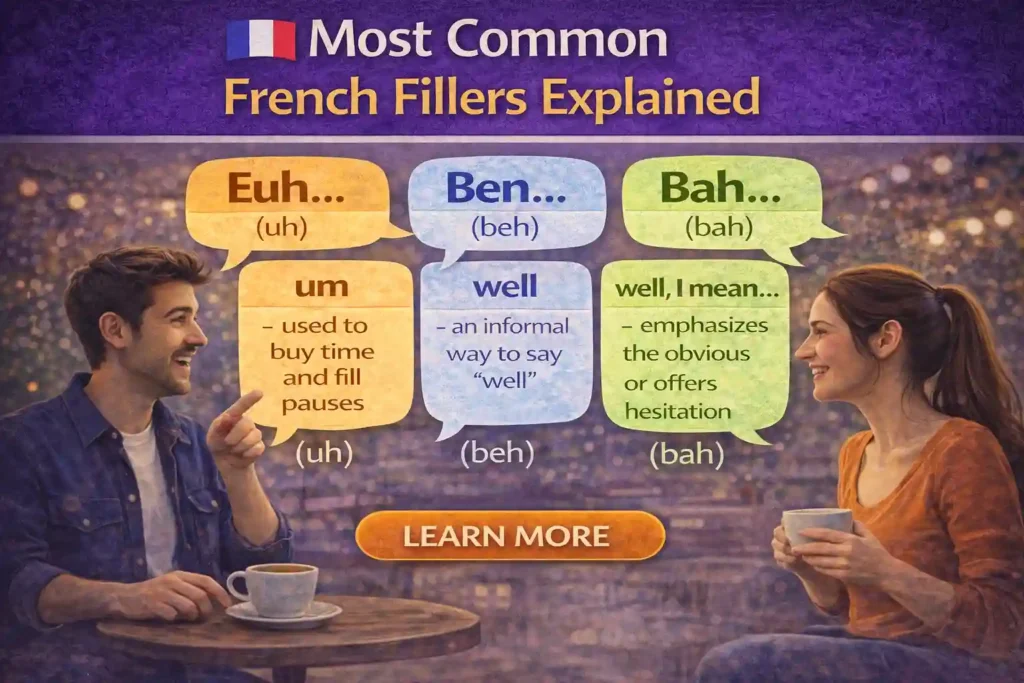
French Fillers Used to Buy Time While Thinking
These fillers are especially useful for beginners who need a moment to organize their thoughts.
| Filler | Pronunciation | Meaning / Function |
|---|---|---|
| Euh | uh | Thinking |
| Voyons | vwah-yohn | Let’s see |
| Attends | ah-tahn | Wait |
| Ben… alors | behn… ah-lohr | Well then |
Real-life example
Alors… je dirais que oui.
(ah-lohr… zhuh dee-ray kuh wee)
Using these fillers allows you to think without stopping the conversation.
French Fillers That Show Reactions and Emotions
Fillers are also used to react emotionally, not just to think.
| Filler | Pronunciation | Emotion |
|---|---|---|
| Ah | ah | Realization |
| Oh | oh | Surprise |
| Bah | bah | Indifference |
| Hein | eh(n) | Seeking confirmation |
| Ben voyons | behn vwah-yohn | Mild disbelief |
Real-life example
Ah, d’accord.
(ah, dah-kor)
→ “Oh, okay.”
These fillers connect directly to French conversational reactions, which is the next article in your sequence.
Casual Fillers Used in Spoken French
Spoken French relies heavily on casual fillers that would never appear in textbooks.
| Filler | Pronunciation | Use |
|---|---|---|
| Genre | zhahn-ruh | Like |
| Tu vois | too vwah | You see |
| Tu sais | too say | You know |
| Bref | bref | In short |
| En gros | ahn groh | Basically |
Real-life example
Genre, il est parti sans prévenir.
(zhahn-ruh, eel ay par-tee sahn preh-vuh-neer)
These fillers make your French sound modern and conversational.
Du Coup: The Filler Learners Hear Everywhere
Du coup deserves special attention because learners hear it constantly.
- Literal meaning: “as a result”
- Spoken meaning: “so”, “then”, “because of that”
Examples
Il pleuvait, du coup je suis resté chez moi.
(eel pluh-veh, doo koo zhuh swee reh-stay shay mwah)
Even though teachers often discourage overusing it, native speakers use it all the time.
Bon: The Most Versatile French Filler
Bon is one of the most flexible fillers in French.
It can mean:
- “Well…” (starting)
- “Alright” (agreement)
- “So…” (conclusion)
Examples
Bon, on y va ?
(bohn, ohn ee vah)
Bon, on verra plus tard.
(bohn, ohn veh-rah ploo tar)
Understanding bon alone improves your listening comprehension dramatically.
When NOT to Use French Fillers
Fillers are natural in speech, but context matters.
Avoid fillers when:
- Writing formal emails
- Giving presentations
- Taking exams
- Writing academic texts
Example:
- Spoken: Euh… je pense que…
- Written: Je pense que…
Knowing when to remove fillers is just as important as knowing when to use them.
Common Mistakes Learners Make With French Fillers
Avoid these common errors:
- Overusing one filler repeatedly
- Inserting fillers into every sentence
- Using casual fillers in formal situations
- Translating English fillers directly
Example mistake:
- Using actually → actuellement
Correct: - En fait
Fillers must be learned in context, not translated.
How to Practice French Fillers Naturally
A simple daily practice method:
- Pick 2–3 fillers
- Listen for them in videos or podcasts
- Use them in short spoken sentences
- Practice aloud, not silently
Example practice:
- Alors… je crois que…
- Euh… attends une seconde.
- Du coup, j’ai changé d’avis.
The goal is comfort, not perfection.
How French Fillers Prepare You for Real Conversations
Once fillers become natural:
- You hesitate less
- You speak longer
- You sound calmer
- Conversations flow more easily
They act as the glue between sentence starters, reactions, and full dialogues.
This is why French fillers sit exactly here in your content sequence.
Conclusion
French fillers may seem small, but they play a massive role in how natural your speech sounds. They help you think while speaking, react emotionally, and avoid awkward silence. By mastering French fillers, you move away from rigid, textbook French and closer to the rhythm and flow of real conversations. Combined with sentence starters and expressions, fillers make speaking French feel easier, smoother, and far more human.