French Direct Object Pronoun: The Simple Trick Most Learners Miss
The french direct object pronoun is one of those grammar topics that feels confusing until it finally clicks. If you’ve ever asked yourself what it replaces, where it goes, or why French puts it before the verb, you’re not alone. In this guide, you’ll clearly understand how french direct object pronouns work, see practical examples, learn correct placement, and avoid the mistakes that slow most learners down.
What Is A French Direct Object Pronoun
To begin with, a french direct object pronoun replaces a noun that receives the action of the verb directly. Its role is simple: avoid repetition and make speech sound natural.
In plain terms:
- A direct object answers “what?” or “who?”
- There is no “to” or “for” involved
- The pronoun replaces that object entirely
For example, “Je regarde le film” becomes “Je le regarde.” Once this idea is clear, everything else becomes much easier to follow.
The French Direct Object Pronoun Simple Trick Most Learners Miss
Stop thinking about pronouns. Start thinking about the verb’s question. Most learners try to memorize lists and rules. That’s why they get stuck. Native speakers don’t do that. They do one thing:
They ask the verb a question.
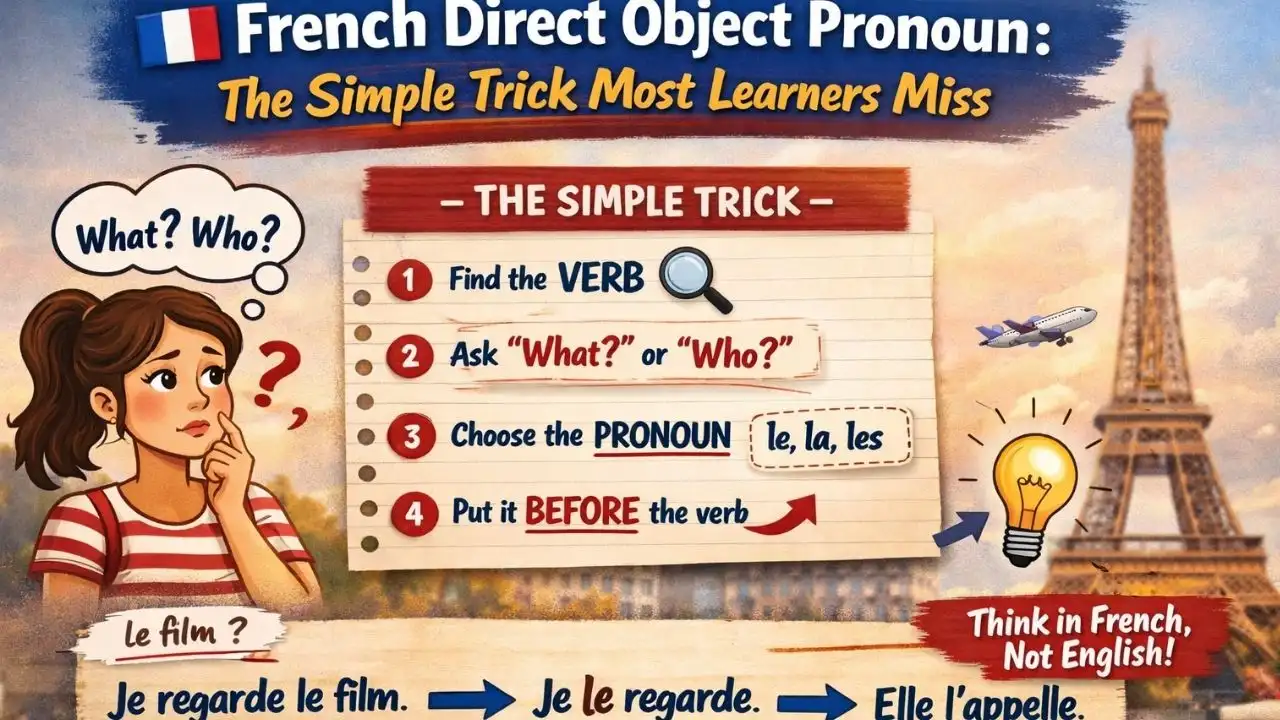
Here’s the trick, step by step:
- Find the verb
- Ask “what?” or “who?” right after the verb
- If there’s a clear answer with no “to” or “for,” that’s your direct object
- Replace that object with the pronoun
- Put it before the verb
Example:
- Je regarde le film → What do I watch? The film → Je le regarde
- Elle appelle Marie → Who does she call? Marie → Elle **l’**appelle
That’s it.
No overthinking.
No grammar gymnastics.
No memorizing random rules.
Learners fail because they translate from English. Learners succeed when they follow the verb’s logic.
Once you train yourself to always ask that one question, french direct object pronouns stop being “grammar” and start becoming automatic.
Now that you know what a direct object pronoun is, the next step is learning the actual forms.
French Direct Object Pronouns List Explained Simply
That brings us to the french direct object pronouns list, which is refreshingly short. You only need seven forms:
- me / m’ → me
- te / t’ → you (informal)
- le / l’ → him, it (masculine)
- la / l’ → her, it (feminine)
- nous → us
- vous → you (formal or plural)
- les → them
Here’s what really matters:
- Le and la depend on gender
- Les covers all plurals
- L’ appears before vowels or silent H
Once these forms are familiar, you’re ready to see how they work in real sentences.
French Direct Object Pronouns Examples In Real Sentences
This is where things start to click. Examples show the pattern clearly:
- Je vois le film → Je le vois
- Elle écoute la musique → Elle **l’**écoute
- Nous appelons nos amis → Nous les appelons
- Tu invites Marie → Tu **l’**invites
What’s happening every time is consistent:
- The object is identified
- The object is removed
- The pronoun moves before the verb
Once you expect this movement, French sentence structure stops feeling random.
Naturally, this leads to the big question most learners ask next: placement.
Where To Place The French Direct Object Pronoun
Here’s the rule that saves the most time: the french direct object pronoun goes before the verb. Almost always.
This applies to:
- Simple present sentences
- Negative sentences
- Questions
Examples:
- Je le mange
- Je ne la vois pas
- Tu les connais ?
You don’t move the pronoun around. It stays locked to the verb. Once this becomes automatic, your sentences start sounding French instead of translated English.
At this point, many learners hit another wall: mixing up direct and indirect pronouns.
Direct And Indirect Object Pronouns French Compared
This confusion disappears once you ask the right question.
Use this test:
- Ask “what?” or “who?” → direct object
- Ask “to whom?” or “for whom?” → indirect object
Examples:
- Je regarde le film → direct
- Je parle à Marie → indirect
If the verb needs à or pour, it’s not a direct object. Once you stop guessing and start testing, pronoun choice becomes logical instead of stressful.
With that clarity in place, practice becomes far more effective.
French Direct Object Pronoun Exercises That Actually Help
Most learners practice the wrong way. The best exercises follow a simple thinking process:
- Identify the verb
- Ask “what?” or “who?”
- Remove the object
- Replace it with the correct pronoun
- Say the sentence out loud
Speaking is key here. Pronouns live in flow, not worksheets. The more you say them, the faster your brain locks in the structure.
Frequently Asked Questions About French Direct Object Pronoun
Here are answers to a few questions you may have:
Why Are French Direct Object Pronouns Important
They are important because native French speakers use them constantly. Without them, sentences sound repetitive and unnatural. Mastering french direct object pronouns helps you understand spoken French better and makes your own speech clearer and more fluent.
How Do I Identify A Direct Object In French
To identify a direct object, ask “what?” or “who?” right after the verb. If the answer comes directly without “to” or “for,” it’s a direct object. This simple test solves most confusion before choosing a pronoun.
What Are The French Direct Object Pronouns
The main french direct object pronouns are me, te, le, la, nous, vous, and les. They replace people or things. Le and la depend on gender, while les works for all plural nouns regardless of gender.
Does Gender Matter With French Direct Object Pronouns
Yes, gender matters for singular objects. Masculine nouns use le, feminine nouns use la. When the noun starts with a vowel or silent H, both become l’. Plural nouns always use les.
Where Does The French Direct Object Pronoun Go
The french direct object pronoun usually goes before the verb. This rule applies in statements, questions, and negative sentences. Learning this placement early prevents one of the most common long-term learner mistakes.
Why Does French Put The Pronoun Before The Verb
French places object pronouns before the verb to signal what is being replaced early in the sentence. While this feels backward for English speakers, it becomes natural with repetition and exposure.
Can A French Direct Object Pronoun Replace A Person
Yes, it can replace a person or a thing. For example, “Je vois Marie” becomes “Je la vois.” The rules are the same whether the object is human or not.
How Do French Direct Object Pronouns Work In Negative Sentences
In negative sentences, the pronoun still comes before the verb. The negation words wrap around the verb, not the pronoun. This keeps placement consistent and predictable once learned.
Are French Direct Object Pronouns Used In Questions
Yes, they are used the same way as in statements. The pronoun stays before the verb. Only the intonation or word order of the question changes, not the pronoun position.
What Is The Difference Between Direct And Indirect Object Pronouns
Direct object pronouns replace nouns without “to” or “for.” Indirect object pronouns replace nouns introduced by “to” or “for.” Asking the right question helps you choose correctly every time.
How Do I Avoid Mixing Up Direct And Indirect Pronouns
Always test the verb. Ask if the action goes directly to the object. If the verb requires “à” or “pour,” it’s indirect. This habit removes guesswork and builds confidence.
Do French Direct Object Pronouns Change In Past Tense
The pronoun itself doesn’t change, but in compound tenses, the past participle may agree with the pronoun. Beginners should focus first on correct placement before worrying about agreement rules.
Are French Direct Object Pronouns Hard For Beginners
They feel hard at first because English places objects after the verb. Once learners stop translating word-for-word and start following French structure, pronouns become much easier to use naturally.
Should I Learn Pronouns Before Grammar
Yes, learning pronouns early helps you understand real French faster. Grammar rules make more sense once you recognize pronouns in sentences you hear and read every day.
Can I Skip French Direct Object Pronouns As A Beginner
You can skip them briefly, but not for long. Avoiding them slows your progress because native speakers use them constantly. Learning them early prevents confusion later.
How Can I Practice French Direct Object Pronouns Daily
Rewrite simple sentences by replacing the object with a pronoun. Say the new sentence out loud. Short daily practice builds automatic placement faster than long study sessions.
Are French Direct Object Pronouns Used In Spoken French
Yes, they are used constantly in spoken French. In fact, they appear more often in speech than in writing, which is why listening practice is essential.
Why Do French Direct Object Pronouns Sound Confusing
They sound confusing at first because they are short and unstressed. With listening practice, your ear learns to recognize them naturally in fast speech.
How Long Does It Take To Learn French Direct Object Pronouns
Most learners understand the basics within a few days. Feeling comfortable using them correctly usually takes a few weeks of regular exposure and speaking practice.
Do Native Speakers Think About These Pronouns
No, native speakers use them automatically. The goal is not memorization, but repetition until usage becomes instinctive.
Are There Tricks To Remember Pronoun Placement
Yes. Always think “pronoun + verb” as one unit. Treat them as glued together. This mental shortcut makes placement easier.
Can French Direct Object Pronouns Replace Objects And Ideas
Yes, they can replace physical objects, people, and abstract ideas. If the noun answers “what” or “who,” it can usually be replaced.
What Is The Most Common Mistake With French Direct Object Pronouns
The most common mistake is placing the pronoun after the verb, copying English structure. Fixing this early is critical for fluency.
Should I Learn Pronouns With Examples Or Rules
Examples work better than rules. Seeing and hearing pronouns in real sentences helps your brain absorb the pattern naturally.
Are French Direct Object Pronouns Used In Commands
Yes, but placement changes in affirmative commands. This is an advanced topic, so beginners should first master standard placement.
Can One Sentence Have Multiple Pronouns
Yes, French can stack pronouns. This becomes easier once you fully understand single pronoun placement.
Why Do French Pronouns Seem Short And Vague
They are designed to be quick and efficient. French relies on context, so pronouns don’t need to be long or explicit.
Is Memorizing The Pronoun List Enough
No. Memorization helps, but usage matters more. Pronouns must be practiced in full sentences to stick.
Do French Direct Object Pronouns Affect Accent
Yes, using them correctly improves rhythm and flow, making your French sound more natural and less robotic.
Are Pronouns Used Differently In Canadian French
The rules are the same in Canadian and European French. Usage frequency may vary, but grammar stays consistent.
Can I Learn Pronouns Without Learning Gender
Not really. Gender determines le or la. Learning noun gender alongside pronouns saves time later.
What Happens If I Use The Wrong Pronoun
People usually still understand you, but repeated errors make speech sound unnatural. Correct usage builds credibility.
Are French Direct Object Pronouns Used In Writing
Yes, they are used heavily in writing, especially in formal and academic French.
Should I Practice Pronouns With Speaking Or Writing
Both help, but speaking is more important. Pronouns are about flow, not spelling.
Why Do Learners Fear French Pronouns
They fear them because they try to translate instead of follow French logic. Once logic replaces translation, fear disappears.
Are Pronouns The Same In All Tenses
Placement stays consistent in most tenses, which actually makes learning easier once you see the pattern.
How Do I Know When To Use Les
Use les whenever the object is plural, regardless of gender. This is one of the simplest rules.
Can Pronouns Replace Long Phrases
Yes, they can replace entire noun phrases, not just single words. This keeps sentences concise.
Do French Children Learn Pronouns Early
Yes, children use pronouns naturally from a young age. This shows they are core to the language, not advanced grammar.
Should I Master Pronouns Before Speaking
No. Speak while learning them. Mistakes are part of the process.
Why Are Pronouns Essential For Fluency
Without pronouns, speech sounds repetitive and unnatural. Mastering them is a major step toward real fluency.
Can I Learn Pronouns Through Listening Only
Listening helps a lot, but combining listening with active practice works best.
How Do I Know I’ve Mastered French Direct Object Pronouns
When you use them without stopping to think, and you understand them instantly when listening, you’ve mastered them.
What Is The Best Way To Review Pronouns
Review them inside sentences, not in isolation. Context makes them stick.
Are French Direct Object Pronouns Worth The Effort
Absolutely. They unlock smoother speech, better comprehension, and more natural French overall.
Conclusion
The french direct object pronoun becomes easy once you stop translating and start spotting actions and objects. Learn what it replaces, memorize the short list, and lock in placement before the verb. With clear examples, smooth transitions, and steady practice, this topic stops being confusing and starts feeling natural.