Speaking French can feel frustrating when your sentences are correct, yet something still sounds off. You pause too much, your responses feel stiff, and conversations don’t flow the way you expect. In this guide, you’ll learn how French conversations really work in everyday situations and why native speakers sound so effortless. We’ll break down the habits that make speech feel natural, the small adjustments that remove stiffness, and practical techniques you can apply immediately to speak French with confidence instead of sounding robotic.
Why Your French Sounds Correct but Still Feels Awkward
Most learners think their problem is grammar. It’s not.
You can conjugate verbs perfectly and still sound unnatural because real French conversations don’t follow classroom logic. They follow rhythm, reaction, and intent. This is why learners who rely heavily on textbooks struggle with common French expressions used in real conversations
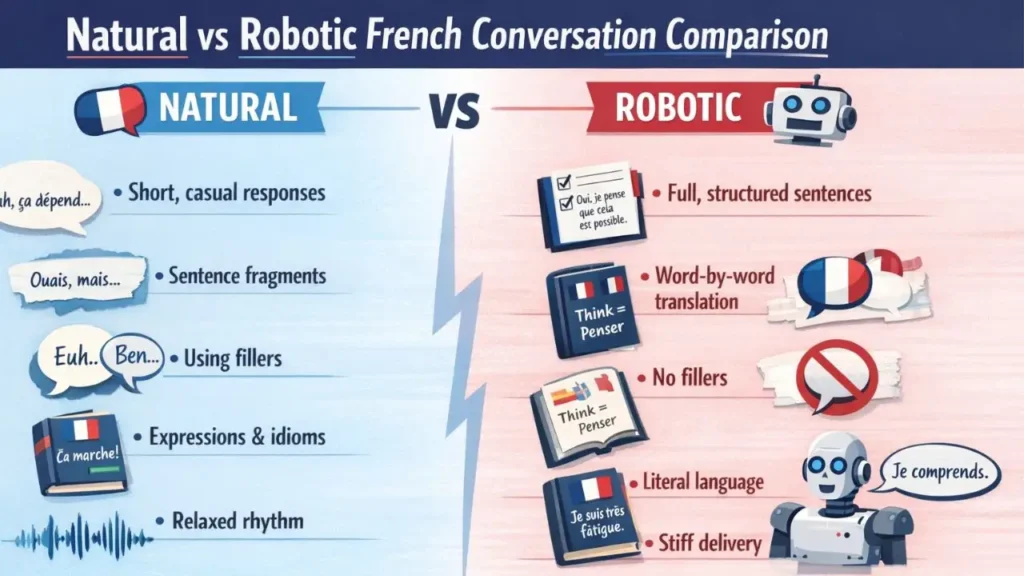
Here’s what usually creates that robotic feel:
- Thinking in English first, then translating
- Speaking in full, carefully structured sentences
- Overexplaining simple ideas
- Pausing too long to “get it right”
- Avoiding fillers because they seem like mistakes
Native speakers don’t do this. They focus on keeping the exchange alive, not sounding perfect. Understanding this mental shift is the first step toward sounding natural.
That brings us to how real French conversations are actually structured.
How Real French Conversations Actually Work in Daily Life
Real French conversations are fast, reactive, and imperfect. Native speakers interrupt themselves, change direction mid-sentence, and respond with fragments constantly.
Instead of long explanations, you’ll hear:
- Short reactions
- Partial sentences
- Emotional responses
- Simple confirmations or disagreements
This is why studying French dialogues used in real life is far more effective than memorizing textbook conversations
Trying to sound “complete” all the time slows you down and makes your speech feel stiff. Once you accept that real conversation is messy, you can start speaking more freely.
The next thing to fix is how you start your sentences.
Sentence Starters That Instantly Make You Sound More Natural
One of the fastest ways to sound human in French is to stop starting every sentence with je.
Native speakers rely heavily on French sentence starters to:
- Buy thinking time
- Soften opinions
- Signal emotion or attitude
- Create rhythm
Here are some of the most common ones:
| Sentence Starter | Natural Use |
|---|---|
| En fait… | Correcting or clarifying |
| Franchement… | Giving an honest opinion |
| À vrai dire… | Being transparent |
| Disons que… | Softening a statement |
| Tu vois… | Checking understanding |
| Honnêtement… | Expressing sincerity |
Compare:
- Je ne suis pas d’accord.
- En fait, je ne suis pas trop d’accord.
The second sounds calmer and more conversational. Once your openings improve, the next habit to break is overexplaining.

How to Respond Naturally Without Overexplaining Everything
Many learners feel they must prove they understand. Native speakers don’t expect that.
In real French conversations:
- Short responses are normal
- Silence is filled with reactions
- Less explanation creates better flow
Instead of long confirmations, natives often rely on French conversational reactions
Examples:
- Oui, je vois.
- Exactement.
- C’est clair.
If the conversation is moving forward, you don’t need to restate everything. This naturally improves rhythm and confidence.
And rhythm matters more than you think.
Why Rhythm Matters More Than Perfect Grammar
French is a rhythmic language. Sounding natural depends more on flow than flawless grammar.
Robotic speech often comes from:
- Pronouncing every word too carefully
- Pausing between words unnaturally
- Speaking too slowly out of fear
Examples you’ll hear daily:
- Je ne sais pas → J’sais pas
- Tu es là → T’es là
You don’t need to force informal speech, but you do need exposure. Rhythm becomes much easier once you allow yourself to use fillers.
French Fillers That Keep Conversations Flowing Naturally
Fillers are not mistakes. They are conversation tools.
Without them, speech feels abrupt. With them, it feels alive.
Common French fillers used in conversation include
| Filler | When to Use It |
|---|---|
| Euh… | Thinking or hesitating |
| Ben… | Casual reaction |
| Alors… | Starting an explanation |
| Bon… | Changing direction |
| Du coup… | Explaining a result |
Using fillers keeps you engaged while thinking and reduces pressure. This makes expressing opinions feel more natural.
How Native Speakers Express Opinions Without Sounding Rigid
French conversations favor nuance. Opinions are rarely blunt.
Native speakers rely heavily on French idiomatic phrases to soften meaning
Instead of:
- C’est mauvais.
You’ll hear:
- Perso, j’ai pas trop aimé.
This invites conversation instead of shutting it down. Softer opinions lead naturally to follow-up questions.
Asking Questions That Keep French Conversations Alive
Conversations die when only one person talks.
Natural French conversations rely on quick, simple reactions:
- Ah oui ?
- Pourquoi ?
- Comment ça ?
- Tu penses ?
Learning how to ask natural questions in French keeps conversations moving
You don’t need complex grammar. Engagement matters more than structure.
All of this becomes much easier once you stop translating.
Stop Translating and Start Thinking in Meaning Blocks
Translation kills flow.
Instead of translating word by word, learn French expressions as meaning blocks
Examples:
- Ça marche
- Pas de souci
- J’en ai marre
These chunks let you respond instantly without hesitation. Once this clicks, practice becomes far more effective.
How to Practice French Conversations in Real Situations
To sound natural, practice must reflect real life.
Focus on:
- Greetings and small talk
- Reactions and opinions
- Follow-up questions
- Ending conversations naturally
Guided French conversation practice helps learners bridge theory and real speech
Listening matters just as much as speaking. Real conversations train your brain automatically.
How Confidence Actually Develops in French Conversations
Confidence doesn’t come from knowing everything. It comes from knowing enough to keep going.
Native speakers don’t expect perfection. They expect effort and clarity. Understanding common French conversation mistakes helps remove fear
Mistakes won’t ruin conversations. Silence will.
Conclusion
French conversations don’t require perfect grammar or advanced vocabulary to feel natural. What truly matters is flow, rhythm, and real interaction. By using natural sentence starters, embracing fillers, reacting instead of overexplaining, and thinking in meaning blocks, French conversations become smoother and more confident. With consistent exposure and practice, you’ll stop sounding robotic and start speaking French in a way that feels natural, relaxed, and genuinely yours.