You can know hundreds of French words and still sound distant in conversation if you don’t react naturally. Real conversations are built on quick responses, emotional signals, and small words that show interest, surprise, or agreement. That’s where French conversational reactions come in. In this guide, you’ll learn how French speakers actually react in everyday situations, what those reactions really mean, and how to use them naturally so your conversations feel human instead of rehearsed.
French Sentence Starters That Make You Sound Natural Instantly
French Dialogues Used in Real Conversations (With Examples)
What Are French Conversational Reactions
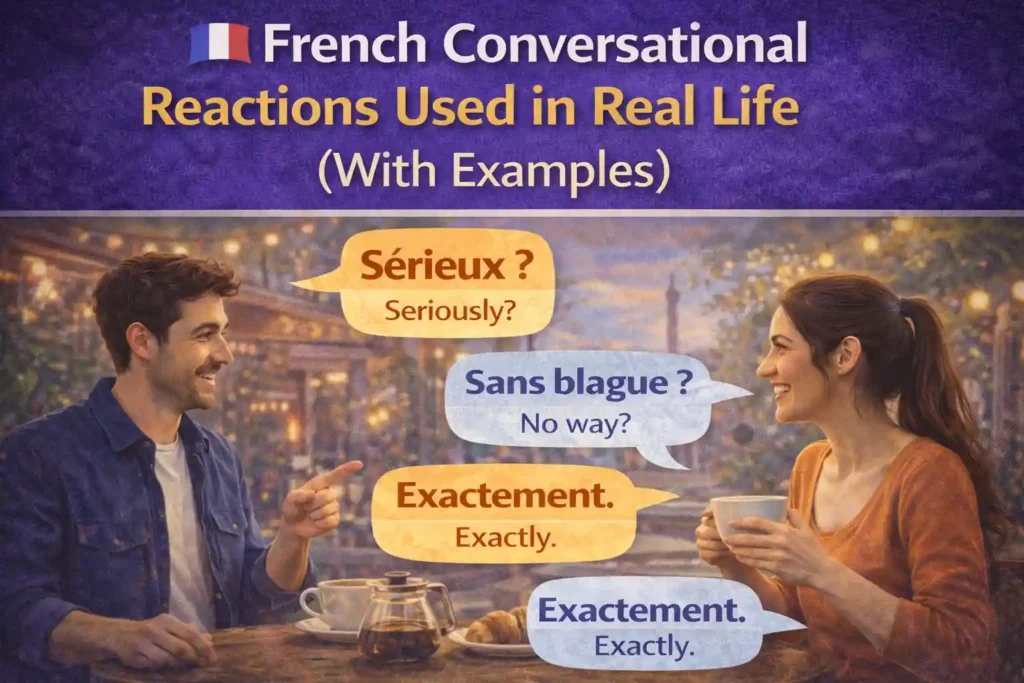
French conversational reactions are short expressions used to respond instantly to what someone says. They often stand alone and don’t follow full sentence structure.
They are used to:
- Show interest
- Express surprise
- Signal agreement or doubt
- Encourage the other person to continue
Without reactions, conversations feel flat and one-sided.
Compare:
Without reactions:
Oui. Je comprends.
With reactions:
Ah oui ? D’accord… je vois.
The second sounds far more natural.
Why Reactions Matter More Than Perfect Sentences
Native speakers don’t expect long answers all the time. They expect feedback.
Reactions tell the other person:
- “I’m listening”
- “I’m following you”
- “That surprised me”
- “I agree / I don’t agree”
Learners who skip reactions often sound:
- Robotic
- Disinterested
- Overly formal
This is why French conversational reactions are essential for fluency.
The Most Common French Reactions You’ll Hear Every Day
These are reactions you’ll hear constantly in real conversations.
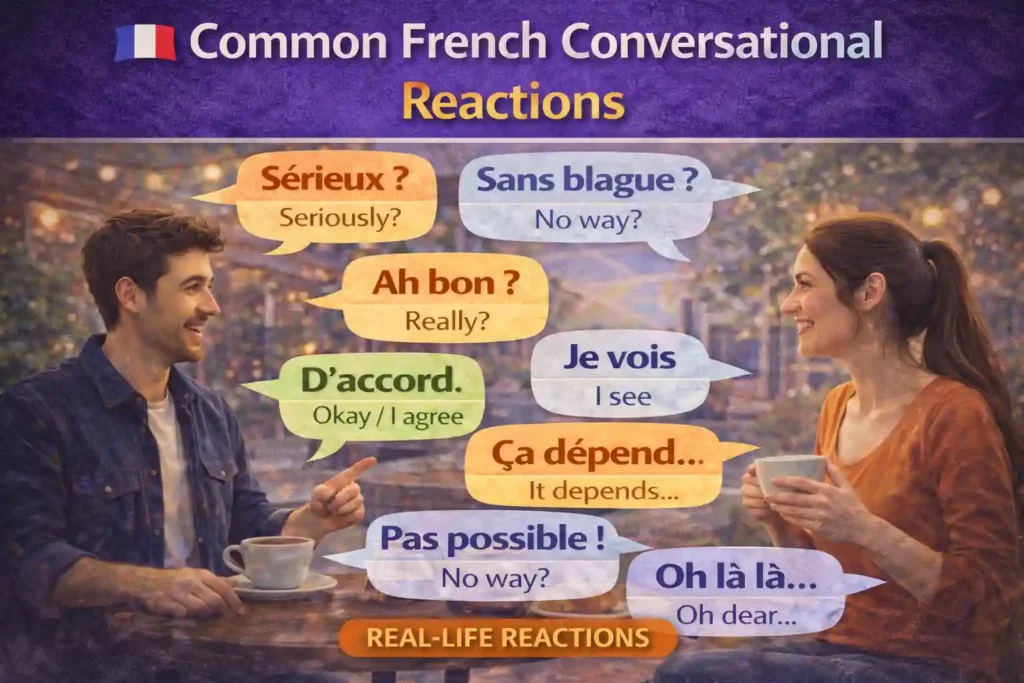
| French Reaction | Pronunciation | Meaning |
|---|---|---|
| Ah oui ? | ah wee | Oh really? |
| D’accord | dah-kor | Okay / I agree |
| Je vois | zhuh vwah | I see |
| Sérieux ? | say-ree-uh | Seriously? |
| Pas possible ! | pah poh-see-bl | No way! |
Real-life example
Il a quitté son travail.
(eel ah kee-tay sohn trah-vy)
Ah oui ? Sérieux ?
(ah wee? say-ree-uh)
This is how real reactions stack naturally.
French Reactions for Showing Surprise
Surprise reactions are extremely common in spoken French.
| Reaction | Pronunciation | Use |
|---|---|---|
| Ah bon ? | ah bohn | Really? |
| Sans blague ? | sahn blag | No way? |
| Sérieux ? | say-ree-uh | Seriously? |
| Pas possible ! | pah poh-see-bl | That’s impossible! |
Example
Elle a gagné à la loterie.
(el ah gah-nyay ah lah lo-tuh-ree)
Sans blague !
(sahn blag)
These reactions replace long sentences like “That’s unbelievable.”
French Reactions for Agreement and Understanding
Agreement reactions show you’re aligned without repeating the same idea.
| Reaction | Pronunciation | Meaning |
|---|---|---|
| Oui | wee | Yes |
| Exactement | eg-zak-tuh-mahn | Exactly |
| C’est clair | say klair | That’s clear |
| Tout à fait | too tah feh | Absolutely |
| Carrément | kah-ray-mahn | Totally |
Example
Il faut partir plus tôt.
(eel foh par-teer ploo toh)
Exactement.
(eg-zak-tuh-mahn)
Short, confident, natural.
French Reactions for Doubt or Hesitation
Not all reactions show agreement. These express uncertainty politely.
| Reaction | Pronunciation | Use |
|---|---|---|
| Bof | bof | Meh |
| Je ne sais pas | zhuh nuh say pah | I don’t know |
| Peut-être | puh-et etr | Maybe |
| Pas sûr | pah sûr | Not sure |
| Ça dépend | sah day-pahn | It depends |
Example
On part demain ?
(ohn par duh-mahn)
Bof… ça dépend.
(bof… sah day-pahn)
This is far more natural than overexplaining.
Emotional French Reactions in Conversation
French reactions often carry emotion.
| Reaction | Pronunciation | Emotion |
|---|---|---|
| Oh là là | oh lah lah | Frustration / surprise |
| Mince | mahnss | Mild frustration |
| Tant mieux | tahn myuh | That’s great |
| Dommage | doh-mahj | That’s a shame |
| Bravo | brah-voh | Well done |
Example
J’ai raté le train.
(zhay rah-tay luh trahn)
Oh là là… dommage.
(oh lah lah… doh-mahj)
These emotional signals make conversations feel alive.
Combining Reactions With Sentence Starters
In real speech, reactions are often combined with sentence starters.
Examples:
- Ah oui… en fait, je ne savais pas.
- D’accord, mais franchement, c’est compliqué.
- Bof… à vrai dire, je ne suis pas convaincu.
This shows how reactions, fillers, and starters work together, not separately.
Common Mistakes Learners Make With French Reactions
Avoid these errors:
- Responding only with full sentences
- Using English reactions translated into French
- Overusing the same reaction repeatedly
- Avoiding reactions entirely
Example mistake:
- Do not say Vraiment ? in every situation
Better: - Mix ah bon ?, sérieux ?, sans blague ?
Variation is key.
How to Practice French Conversational Reactions
Simple daily practice:
- Listen to short dialogues
- Pause and repeat reactions out loud
- Practice reacting without forming full sentences
- Record yourself responding quickly
Exercise:
- Hear a statement
- React with only 1–2 words
This trains instinct, not translation.
How Reactions Make French Dialogues Flow
Once reactions become automatic:
- Conversations feel faster
- You interrupt naturally (in a good way)
- Listening improves
- Speaking feels less stressful
This is why reactions are the glue between fillers, dialogues, and real conversation.
They prepare you perfectly for the next topic in your sequence.
Conclusion
French conversational reactions are the heartbeat of real communication. They allow you to show interest, express emotion, and stay engaged without overthinking grammar. By mastering French conversational reactions, you stop sounding like a learner who waits to speak and start sounding like someone who truly participates. Combined with sentence starters, fillers, and dialogues, reactions turn French into a living, flowing language you can actually enjoy using.

)