
DR MRS VANDERTRAMP Verbs: The Only List You’ll Ever Need (With Examples & Mistakes To Avoid)
DR MRS VANDERTRAMP is one of the easiest ways to make learning French feel less confusing, especially when you’re trying to understand how its passé composé works. Many learners struggle with knowing when to use être instead of avoir as the auxiliary verb, and that confusion can slow you down. But this simple mnemonic gives you a clear, structured way to remember the verbs that follow this special rule, and once you master it, your past tense sentences instantly become more accurate and natural.

Let’s walk through this concept together in a friendly, step-by-step way—just like a teacher explaining it personally to you.
What Is DR MRS VANDERTRAMP?
DR MRS VANDERTRAMP is a mnemonic that groups together 17 French verbs that use être in the passé composé. These verbs are special because they reflect movement, direction, or a change of state. Instead of pairing with “avoir,” they pair with “être,” which means that you must add agreement based on gender and number. Once you grasp this rule, your understanding of French grammar becomes more structured and intuitive.
#1 Mistake Students Make With DR MRS VANDERTRAMP Verbs
The most common mistake students make with DR MRS VANDERTRAMP verbs is assuming that these verbs always use être in the passé composé. That half-truth causes endless errors. Yes, these verbs use être when they show movement or a change of state. But six of them can switch to avoir when there is a direct object. When students ignore this, they end up forming sentences that sound wrong to native speakers and lose marks in tests.
Here’s what the mistake looks like:
Wrong:
J’ai sorti.
This sounds incomplete because sortir here shows movement and needs être.
Correct:
Je suis sorti.
I went out.
But now look at this:
Correct with avoir:
J’ai sorti le chien.
I took the dog out.
Same verb. Different meaning. Different auxiliary. That’s where most learners get trapped.
Another common error is mixing both ideas in the same sentence:
Wrong:
Je suis sorti le chien.
This is incorrect because once sortir takes a direct object (le chien), it switches to avoir.
Correct:
J’ai sorti le chien.
Here’s another pair students often mess up:
Wrong:
Elle a monté au deuxième étage.
Correct:
Elle est montée au deuxième étage.
She went up to the second floor.
But:
Correct with avoir:
Elle a monté les valises.
She carried the suitcases upstairs.
The simple rule most students ignore:
If the verb shows you moving, use être.
If the verb shows you doing something to something, use avoir.
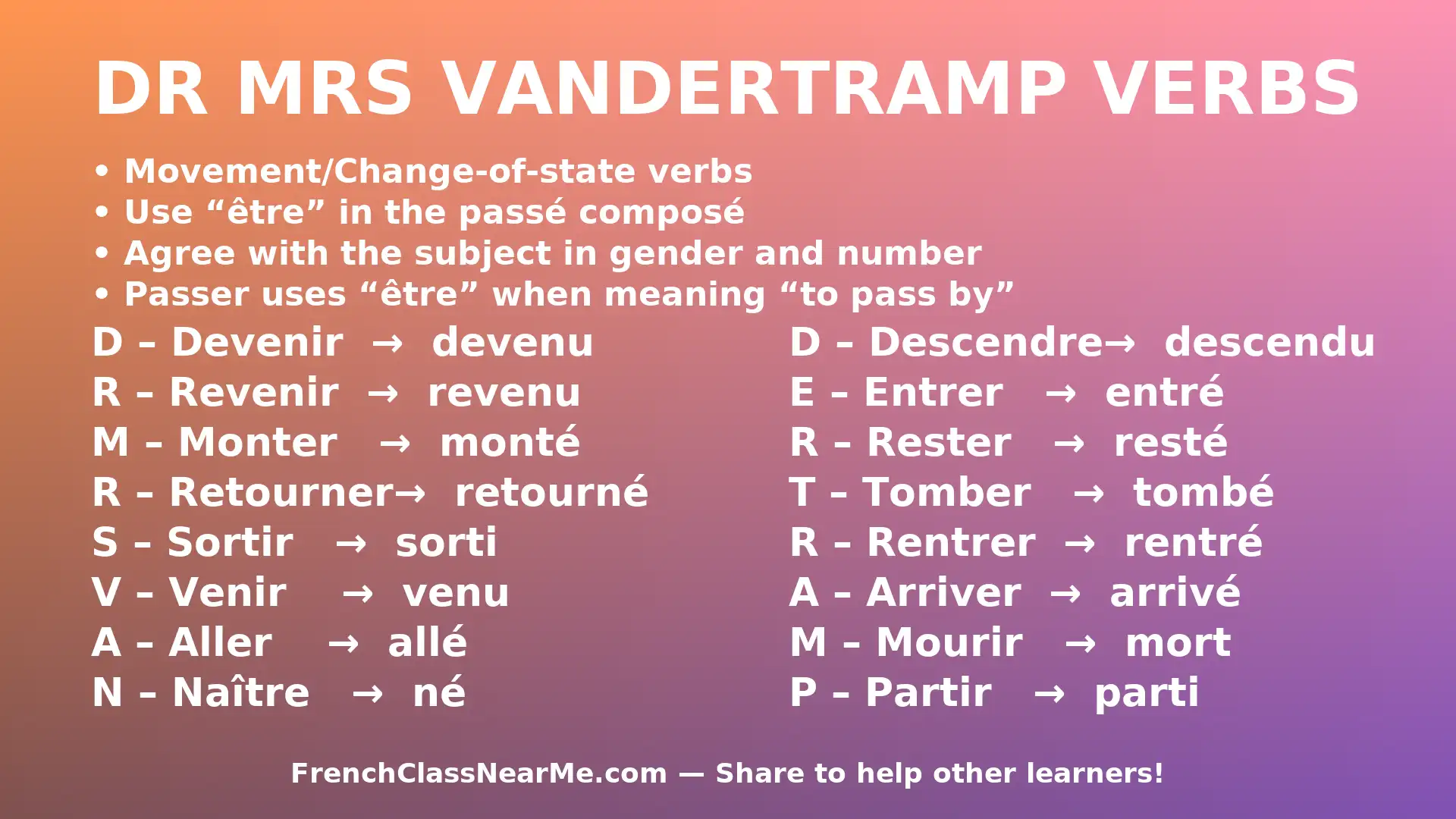
Before we break these verbs down, let’s look at the complete list.
The Full DR MRS VANDERTRAMP List
Here’s a clear table showing all the verbs, their meanings, and their past participles so you can reference them easily.
| Letter | Verb | Meaning | Past Participle |
|---|---|---|---|
| D | Devenir | to become | devenu |
| R | Revenir | to come back | revenu |
| M | Monter | to go up | monté |
| R | Retourner | to return | retourné |
| S | Sortir | to go out | sorti |
| V | Venir | to come | venu |
| A | Aller | to go | allé |
| N | Naître | to be born | né |
| D | Descendre | to go down | descendu |
| E | Entrer | to enter | entré |
| R | Rester | to stay | resté |
| T | Tomber | to fall | tombé |
| R | Rentrer | to go back in | rentré |
| A | Arriver | to arrive | arrivé |
| M | Mourir | to die | mort |
| P | Partir | to leave | parti |
Remember: Passer takes “être” only when it means “to pass by,” not when it means “to spend time.”
Now let’s take this deeper so you really understand how to use these verbs properly.
How To Form DR MRS VANDERTRAMP Passé Composé
To form the DR MRS VANDERTRAMP passé composé, use être as the auxiliary verb, then add the past participle, which must agree with the subject in gender and number.
Structure:
Subject + être (present tense) + past participle
Examples:
Elle est arrivée.
Ils sont partis.
Marie et Sophie sont venues.
DR MRS VANDERTRAMP verbs always use être in the passé composé, and agreement is required.
DR MRS VANDERTRAMP French Verbs Explained With Clear Examples
DR MRS VANDERTRAMP French verbs are verbs that usually use être in compound tenses.
They mostly describe movement or a change of state, which is why French links them directly to the subject.
Common examples:
Il est arrivé.
Elle est partie.
Ils sont revenus.
Some of these verbs can switch to avoir when they take a direct object.
Example:
Elle a sorti la poubelle.
Movement or change of state → être and agreement. Action on an object → avoir.
The 6 DR MRS VANDERTRAMP Verbs That Can Use Avoir (With Clear Examples)
Most learners are taught that DR MRS VANDERTRAMP verbs always use être in the passé composé. That’s true when the verb shows movement or a change of state. But here’s the part teachers often fail to explain properly: six of these verbs can also use avoir when they are used with a direct object. When that happens, the meaning changes slightly because the verb is no longer just about “going” or “coming,” but about doing something to something.
These six verbs are:
Monter, Descendre, Sortir, Rentrer, Retourner, Passer
Let’s break this down with clear examples.
Monter (to go up / to take up)
- With être (movement):
Je suis monté au deuxième étage.
I went up to the second floor. - With avoir (object):
J’ai monté les valises.
I carried the suitcases upstairs.
Descendre (to go down / to take down)
- With être:
Elle est descendue trop tôt.
She went down too early. - With avoir:
Elle a descendu les chaises.
She took down the chairs.
Sortir (to go out / to take out)
- With être:
Nous sommes sortis hier soir.
We went out last night. - With avoir:
J’ai sorti le chien.
I took the dog out.
Rentrer (to come back / to bring back)
- With être:
Il est rentré tard.
He came back late. - With avoir:
Il a rentré les chaises.
He brought the chairs back inside.
Retourner (to return / to flip or turn something)
- With être:
Elle est retournée à la maison.
She went back home. - With avoir:
Elle a retourné la veste.
She turned the jacket inside out.
Passer (to pass by / to spend time)
- With être:
Nous sommes passés par le parc.
We passed by the park. - With avoir:
J’ai passé une bonne journée.
I had a good day.
So,
What Is The Core Rule Behind DR MRS VANDERTRAMP Verbs?
DR MRS VANDERTRAMP verbs use être in the passé composé when the verb describes movement or a change of state of the subject. The sentence focuses on what happens to the subject, not on an action performed on something else.
Examples:
- Elle est arrivée.
- Ils sont partis.
- Nous sommes restés.
In each case, the subject moves or changes state, which is why être is required.
So let’s check
Past Participles Of Dr Mrs Vandertramp Verbs
Past Participles Of Dr Mrs Vandertramp Verbs are the verb forms used with être in the passé composé, and they agree with the subject in gender and number.
| Verb | Past Participle |
|---|---|
| Aller | Allé |
| Venir | Venu |
| Arriver | Arrivé |
| Partir | Parti |
| Entrer | Entré |
| Sortir | Sorti |
| Monter | Monté |
| Descendre | Descendu |
| Naître | Né |
| Mourir | Mort |
| Rester | Resté |
| Retourner | Retourné |
| Tomber | Tombé |
| Passer | Passé |
| Devenir | Devenu |
| Revenir | Revenu |
With Dr Mrs Vandertramp verbs, the past participle follows a different rule than most learners expect. These verbs form the passé composé with être, not avoir, and that single change affects agreement.
Here’s the rule you must remember:
When a verb uses être, the past participle agrees with the subject.
That means you match it to the gender and number of the person or thing doing the action.
Examples
- Il est allé
- Elle est allée
- Ils sont arrivés
- Elles sont arrivées
You add:
- -e for feminine
- -s for plural
- -es for feminine plural
Where learners mess up is forgetting this agreement or applying it inconsistently. Another common mistake is overthinking exceptions. For standard Dr Mrs Vandertramp verbs used normally, agreement is automatic.
One important clarification: when these verbs are used transitively (with a direct object), many switch back to avoir, and the agreement rule changes completely. That’s why understanding meaning matters more than memorizing the list.
Get the meaning right first. The agreement follows naturally.
In case you are wondering,
Are Dr Mrs Vandertramp Irregular Verbs?
No. Dr Mrs Vandertramp verbs are not a group of irregular verbs. They are a memory list of verbs that typically use être in the passé composé.
Some Dr Mrs Vandertramp verbs are regular, and some are irregular. What makes them “Vandertramp” is the auxiliary être, not whether the verb is regular or irregular.
Examples Of Irregular Ones
Venir → venu
Revenir → revenu
Devenir → devenu
Naître → né
Mourir → mort
Examples Of Regular Ones
Aller → allé
Arriver → arrivé
Entrer → entré
Sortir → sorti
Tomber → tombé
Rester → resté
Passer → passé
Key Rule
Dr Mrs Vandertramp groups verbs by auxiliary (être), not by regularity.
When Do DR MRS VANDERTRAMP Verbs Use Avoir Instead?
Many DR MRS VANDERTRAMP verbs can switch back to avoir when they take a direct object. In this situation, the verb no longer describes simple movement or change of state. It describes an action done to something.
Compare the difference:
- Elle est sortie.
(She went out.) - Elle a sorti les poubelles.
(She took out the trash.)
Another example:
- Il est monté.
(He went up.) - Il a monté les valises.
(He carried the suitcases upstairs.)
Same verb, different meaning, different auxiliary. When avoir is used, agreement with the subject disappears.
A Simple Trick To Choose Between Être And Avoir
When hesitation appears, one question usually solves the problem:
Is the subject moving or changing state without acting on a direct object?
- Yes → use être
- No → use avoir
Examples:
- Elle est descendue. → movement → être
- Elle a descendu l’escalier. → direct object → avoir
Using this decision shortcut consistently removes guesswork and makes DR MRS VANDERTRAMP verbs much easier to apply correctly in real sentences.
Now that you understand how to use these verbs, let’s see how to practice them.
Practice Using DR MRS VANDERTRAMP
The best way to learn DR MRS VANDERTRAMP is through repetition and real-life examples. Start by writing simple sentences in the passé composé using each verb. Don’t worry about perfection at first—your goal is to build rhythm and confidence.
For example:
Je suis arrivé(e) à 8h.
Nous sommes partis tôt.
Elle est née en France.
Then, practice the agreement rules by intentionally switching the subjects. That forces your brain to adapt quickly:
Ils sont tombés.
Elles sont venues.
Je suis entrée (if you are female).
Another excellent practice technique is storytelling. Describe your day or a past experience using as many of the verbs as possible. This helps you link each verb to real-life actions, making it easier to remember conversations later.
Before moving on, one small tip: whenever you’re unsure whether to use “être” or “avoir,” look at the verb’s meaning in context. If it reflects movement or change of state, it probably belongs to DR MRS VANDERTRAMP.
Now let’s expand your understanding even more with additional sections that deepen your mastery.
Common Mistakes to Avoid With DR MRS VANDERTRAMP
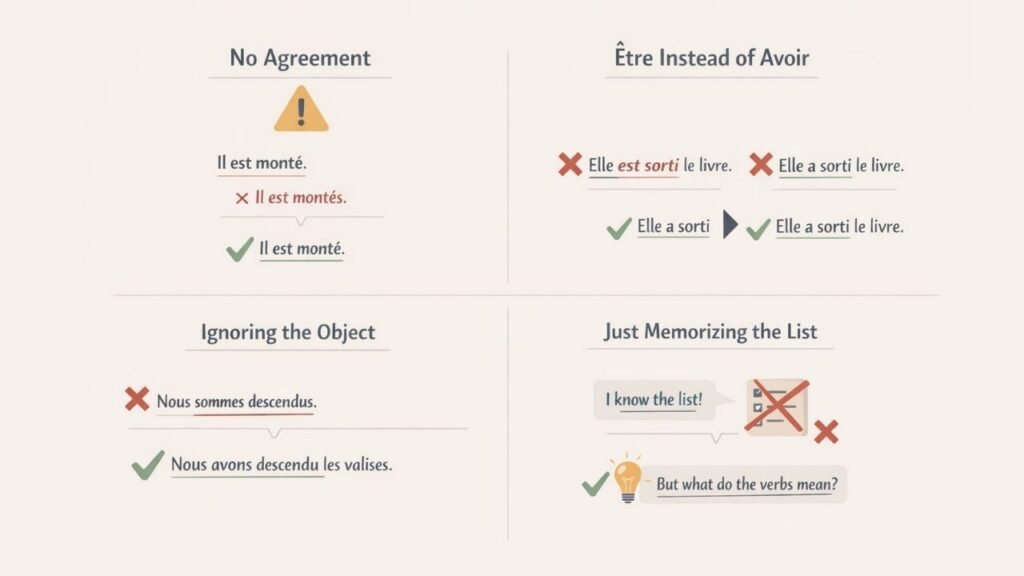
Even learners who know the DR MRS VANDERTRAMP list well still make errors in real sentences. These mistakes usually come from misunderstanding how the verbs behave in context rather than from forgetting the verbs themselves. Knowing what to avoid is just as important as knowing the rule.
Forgetting Past Participle Agreement
One of the most frequent mistakes is forgetting to make the past participle agree when être is used. When a DR MRS VANDERTRAMP verb uses être, the past participle must match the subject in gender and number.
Examples:
- Elle est arrivée.
- Elles sont arrivées.
Forgetting the final -e or -s does not usually block comprehension, but it makes the sentence grammatically incorrect and is especially noticeable in writing and exams.
Using Être When Avoir Is Required
Another common error is using être automatically just because a verb belongs to the DR MRS VANDERTRAMP group. Some of these verbs switch to avoir when they take a direct object.
Compare:
- Il est descendu. (He went down.)
- Il a descendu l’escalier. (He went down the stairs.)
The verb stays the same, but the auxiliary changes because the structure of the sentence changes.
Memorizing The List Without Understanding The Meaning
Many learners try to memorize DR MRS VANDERTRAMP as a fixed list without understanding why these verbs use être. This often leads to hesitation and overthinking when forming sentences.
These verbs typically describe:
- Movement
- Arrival or departure
- A change of state
Understanding this idea makes the rule easier to apply than memorization alone.
Ignoring Context And Direct Objects
Context matters more than the verb itself. Before choosing the auxiliary, always check what the verb is doing in the sentence.
A helpful question to ask is:
Is the subject moving or changing state, or is something being moved by the subject?
- Subject moving → être
- Something being acted on → avoir
This habit prevents many of the most common DR MRS VANDERTRAMP mistakes.
Now, let’s talk about
DR MRS VANDERTRAMP Conjugations: How To Go About It
DR MRS VANDERTRAMP conjugations are built the same way as other French verbs. What changes is the auxiliary in compound tenses: these verbs typically use être, and the past participle agrees with the subject.
Step 1: Conjugate the auxiliary être
Je suis, Tu es, Il/Elle est, Nous sommes, Vous êtes, Ils/Elles sont
Step 2: Add the past participle of the main verb
Aller → allé, Venir → venu, Arriver → arrivé, Partir → parti
Step 3: Add agreement when needed
Elle est arrivée
Ils sont partis
Elles sont venues
Step 4: Watch the “switch verbs” (can take avoir with a direct object)
Elle a monté les escaliers
Il a sorti la poubelle
Être + past participle + agreement. If there is a direct object with certain verbs, check if avoir is required.
In case you are wondering,
How Does DR MRS VANDERTRAMP Helps You Speak Naturally?
Mastering DR MRS VANDERTRAMP is not just about forming correct sentences. It directly affects how smoothly you speak when talking about past events. Once these verbs become automatic, your French sounds more fluid and more natural.
It Reduces Hesitation When Speaking About The Past
When you know instantly which verbs use être, you stop pausing mid-sentence to think about grammar. Describing where you went, who arrived, or how a situation changed becomes faster and more confident.
Examples like je suis arrivé, elle est partie, or nous sommes restés come out naturally instead of feeling forced.
It Makes Storytelling And Daily Conversations Flow Better
DR MRS VANDERTRAMP verbs appear constantly in real conversations. They are essential for telling stories, describing trips, explaining life events, and sharing personal experiences.
When these verbs are automatic, you can focus on what you want to say, not on how to build the sentence. This makes conversations smoother and more engaging.
It Helps You Sound More Native And Less Translated
Many learners mentally translate from English before speaking French. This often leads to hesitation and unnatural phrasing.
Understanding how DR MRS VANDERTRAMP works helps you think in French patterns instead of translating word by word. The result is speech that sounds more natural and closer to how native speakers describe past events.
How To Build Long Sentences With DR MRS VANDERTRAMP
Once simple sentences feel comfortable, the next step is learning how to connect them. Building longer sentences with DR MRS VANDERTRAMP verbs helps your French sound smoother, more natural, and closer to real spoken language.
Linking DR MRS VANDERTRAMP Verbs In One Sentence
You can combine several DR MRS VANDERTRAMP verbs in a single sentence as long as they describe a sequence of movements or changes of state. Each verb keeps être and follows agreement rules.
Example:
Je suis arrivé, je suis entré et je suis resté une heure.
This technique allows you to describe events clearly without breaking your speech into short, unnatural sentences.
Using Time Connectors To Add Flow
Time connectors help organize actions and make your sentence easier to follow. Common connectors include puis, ensuite, and finalement.
Example:
Je suis arrivé, puis je suis entré, et ensuite je suis resté une heure.
These connectors guide the listener through the sequence and improve overall fluency.
A Simple Pattern You Can Reuse In Conversations
A reliable pattern for longer sentences is:
Subject + être + verb → connector → être + verb
Example:
Nous sommes partis tôt, ensuite nous sommes arrivés au village, et finalement nous sommes restés chez des amis.
Practicing this structure trains you to speak in complete, flowing ideas instead of isolated sentences.
maybe you are still wonderting,
Is Venir A DR MRS VANDERTRAMP Verb?
Yes. venir is a Dr Mrs Vandertramp verb.
It uses être in the passé composé, and the past participle agrees with the subject.
Il est venu.
Elle est venue.
Key Rule: Venir always uses être in compound tenses.
What Does DR MRS VANDERTRAMP Mean In French?
DR MRS VANDERTRAMP is a memory acronym, not a French word.
It helps learners remember verbs that usually use être in the passé composé.
Each letter stands for a common verb of movement or change of state:
Devenir, Revenir, Monter, Rester, Sortir, Venir, Aller, Naître, Descendre, Entrer, Retourner, Tomber, Arriver, Mourir, Passer.
Key Point: DR MRS VANDERTRAMP is not a French term. It’s an English memory aid used to remember verbs that take être.
Why Do DR MRS VANDERTRAMP Verbs Use Être?
DR MRS VANDERTRAMP verbs use être because they describe movement or a change of state.
In French, verbs showing these actions usually take être instead of avoir in compound tenses.
These verbs focus on where someone goes or how their state changes, not on an object being acted on.
Examples:
Il est arrivé.
Elle est partie.
Key Rule: When a verb shows movement or change of state, French typically uses être, and the past participle agrees with the subject.
Is DR MRS VANDERTRAMP Still Taught In Modern French?
Yes. DR MRS VANDERTRAMP is still taught, but mainly as a learning aid.
It is used in schools and language classes to help beginners remember which verbs take être in the passé composé.
However, native French speakers do not think in DR MRS VANDERTRAMP. They simply know which verbs use être naturally.
Key Point: DR MRS VANDERTRAMP is a teaching shortcut for learners, not a rule used by native speakers.
Do All DR MRS VANDERTRAMP Verbs Always Use Être?
No. DR MRS VANDERTRAMP verbs do not always use être.
Some of them can use avoir when they take a direct object or when the meaning changes.
Examples with être (movement or change of state):
Elle est montée.
Ils sont sortis.
Examples with avoir (direct object):
Elle a monté les escaliers.
Il a sorti la poubelle.
Key Rule: Use être for movement or state change. Use avoir when the verb acts on an object.
How Do I Know When To Use Être Or Avoir?
Look at what the verb is doing in the sentence.
If it shows movement or a change of state, use être. If it acts on a direct object, use avoir.
Examples with être:
Elle est arrivée.
Ils sont partis.
Examples with avoir:
Elle a monté les escaliers.
Il a passé le pont.
Key Rule: No direct object → être.
Direct object present → avoir.
Do DR MRS VANDERTRAMP Verbs Require Agreement?
Yes. DR MRS VANDERTRAMP verbs require agreement when they use être.
The past participle agrees with the subject in gender and number.
Examples:
Elle est allée.
Ils sont partis.
Marie et Sophie sont venues.
When these verbs use avoir, there is no agreement with the subject.
Example:
Elle a sorti la poubelle.
Key Rule: Être → agreement with the subject. Avoir → no agreement with the subject.
What Is The Most Common Mistake With DR MRS VANDERTRAMP?
The most common mistake is thinking DR MRS VANDERTRAMP always means être.
Some of these verbs switch to avoir when they take a direct object.
Examples learners get wrong:
Elle a monté les escaliers.
Il a sorti la poubelle.
Another frequent mistake is forgetting agreement when être is used.
Example:
Elle est allée, not allé.
Key Rule: Check the meaning and structure first. Être is not automatic.
Are DR MRS VANDERTRAMP Verbs Used Often In Daily French?
Yes. DR MRS VANDERTRAMP verbs are used very often in daily French.
They describe common actions like going, coming, arriving, leaving, and returning.
Examples you hear every day:
Je suis arrivé.
Il est parti.
Elle est venue.
Because these verbs talk about movement and change, they appear constantly in real conversations.
Key Point: If you want to sound natural in French, you must be comfortable using these verbs correctly.
Can DR MRS VANDERTRAMP Verbs Be Used In Long Sentences?
Yes. DR MRS VANDERTRAMP verbs work normally in long and complex sentences.
Sentence length does not change the auxiliary or the agreement.
Example:
Elle est arrivée tard hier soir après un long voyage en train.
Even in long sentences, the same rules apply.
Key Rule: Ignore sentence length. Choose être or avoir based on the verb’s role, then apply agreement if être is used.
Is DR MRS VANDERTRAMP Used Only In The Passé Composé?
No. DR MRS VANDERTRAMP is not limited to the passé composé.
These verbs use être in all compound tenses, not just one.
Examples:
Elle est allée. (passé composé)
Elle était allée. (plus-que-parfait)
Elle sera allée. (futur antérieur)
What changes is the tense, not the auxiliary.
Key Rule: If a tense is compound and the verb is DR MRS VANDERTRAMP, it uses être, and the past participle agrees with the subject.
Do Native Speakers Think About DR MRS VANDERTRAMP?
No. Native French speakers do not think about DR MRS VANDERTRAMP.
They naturally know which verbs use être without using an acronym.
DR MRS VANDERTRAMP is a learning tool for students, not a mental process used by natives.
Examples natives use instinctively:
Je suis arrivé.
Elle est partie.
Key Point: Native speakers rely on intuition and habit. DR MRS VANDERTRAMP exists to help learners reach that level faster.
Is DR MRS VANDERTRAMP Enough To Master Être Verbs?
No. DR MRS VANDERTRAMP alone is not enough.
It helps you remember the main verbs that use être, but it does not explain when meaning changes or when avoir is required.
Learners still struggle with verbs like monter, descendre, sortir, and passer.
Example:
Elle est descendue.
Elle a descendu les valises.
Key Point: DR MRS VANDERTRAMP is a starting point. Mastery comes from understanding structure, meaning, and agreement.
Why Does Agreement Matter With Être?
Agreement matters because être links the verb directly to the subject.
When être is used, the past participle behaves like an adjective and must match the subject in gender and number.
Examples:
Elle est arrivée.
Ils sont partis.
Marie et Sophie sont venues.
With avoir, this agreement does not happen in normal cases.
Key Rule: Être connects the action to the subject, so the past participle agrees with the subject.
Can DR MRS VANDERTRAMP Verbs Be Used In Negative Sentences?
Yes. DR MRS VANDERTRAMP verbs work normally in negative sentences.
Negation does not change the auxiliary or the agreement.
Example:
Elle n’est pas venue.
Ils ne sont jamais partis.
The only change is the position of ne…pas around the auxiliary.
Key Rule: Negation affects word order, not verb choice or agreement.
Is Aller Part Of DR MRS VANDERTRAMP?
Yes. Aller is part of DR MRS VANDERTRAMP.
It uses être in compound tenses and requires agreement with the subject.
Examples:
Il est allé au travail.
Elle est allée à l’école.
Ils sont allés en France.
Key Rule: Aller always uses être
Is Recevoir DR MRS VANDERTRAMP?
No. Recevoir is not a DR MRS VANDERTRAMP verb.
It uses avoir, not être, in compound tenses.
Example:
J’ai reçu le message.
Elle a reçu un cadeau.
Recevoir describes receiving an object, not movement or a change of state.
If a verb normally uses avoir and takes a direct object, it is not DR MRS VANDERTRAMP.
Is Entendre Vandertramp
No. Entendre is not a DR MRS VANDERTRAMP verb.
It uses avoir, not être, in compound tenses.
Example:
J’ai entendu le bruit.
Entendre describes perception, not movement or a change of state.
If a verb uses avoir by default and does not show movement or state change, it is not DR MRS VANDERTRAMP.
Do DR MRS VANDERTRAMP Verbs Change Meaning With Avoir?
Yes. Some DR MRS VANDERTRAMP verbs change meaning when they use avoir.
The auxiliary switches when the verb acts on a direct object, and the focus shifts from movement to action.
Examples with être (movement or state):
Elle est montée.
Il est sorti.
Examples with avoir (action on something):
Elle a monté les escaliers.
Il a sorti la poubelle.
Key Rule: Être = movement or change of state.
Avoir = action performed on an object.
Is Sortir Always A DR MRS VANDERTRAMP Verb?
No. Sortir is not always a DR MRS VANDERTRAMP verb.
It uses être only when it shows movement. It switches to avoir when it takes a direct object.
Examples with être (movement):
Elle est sortie.
Ils sont sortis.
Examples with avoir (direct object):
Elle a sorti la poubelle.
Il a sorti sa voiture.
Key Rule:
Movement → être and agreement.
Direct object → avoir, no agreement with the subject.
Is Descendre Always Used With Être?
No. Descendre is not always used with être.
It uses être when it shows movement, and avoir when it takes a direct object.
Examples with être (movement):
Elle est descendue.
Ils sont descendus.
Examples with avoir (direct object):
Elle a descendu les valises.
Il a descendu l’escalier.
Key Rule:
Movement or change of state → être.
Action on an object → avoir.
Can Beginners Learn DR MRS VANDERTRAMP Easily?
Yes. Beginners can learn DR MRS VANDERTRAMP easily if it’s taught as a pattern, not a rule list.
The verbs describe movement or change of state, which makes them intuitive.
Examples beginners grasp quickly:
Je suis allé.
Elle est arrivée.
Confusion only starts when learners ignore meaning and focus on memorization alone.
Key Point: Learn the idea first (movement vs object), then the list. That’s what makes it stick.
Is Descendre DR MRS VANDERTRAMP?
Yes. Descendre is a DR MRS VANDERTRAMP verb—but not in every case.
It uses être when it shows movement, and avoir when it takes a direct object.
Examples with être (movement):
Elle est descendue.
Ils sont descendus.
Examples with avoir (direct object):
Elle a descendu les valises.
Il a descendu l’escalier.
Here is what you need to keep in mind: Movement or change of position → être and agreement.
Action on an object → avoir.
Is DR MRS VANDERTRAMP Used In Spoken French?
Yes, the verbs are used constantly—but the acronym is not.
Native speakers never think “DR MRS VANDERTRAMP.” They simply use être naturally with these verbs in speech.
Examples you hear every day:
Je suis arrivé.
Elle est partie.
Ils sont revenus.
Key Point: The acronym is for learners. In spoken French, only the verbs and correct auxiliary matter.
Does DR MRS VANDERTRAMP Apply To Reflexive Verbs?
No. DR MRS VANDERTRAMP does not apply to reflexive verbs.
Reflexive verbs use être by rule, not because of the DR MRS VANDERTRAMP list.
Example:
Elle s’est levée.
Ils se sont lavés.
DR MRS VANDERTRAMP helps with non-reflexive movement verbs. Reflexive verbs follow a different system.
Key Rule:
Reflexive verb → être automatically, with agreement.
DR MRS VANDERTRAMP → memory aid, not a reflexive rule.
Is Arriver Part Of DR MRS VANDERTRAMP?
Yes. Arriver is part of DR MRS VANDERTRAMP.
It uses être in compound tenses, and the past participle agrees with the subject.
Examples:
Il est arrivé tôt.
Elle est arrivée hier.
Ils sont arrivés ensemble.
Key Rule: Arriver always uses être, and agreement is required in gender and number.
Is Mourir A DR MRS VANDERTRAMP Verb?
Yes. Mourir is a DR MRS VANDERTRAMP verb.
It uses être in compound tenses, and the past participle agrees with the subject.
Examples:
Il est mort.
Elle est morte.
Ils sont morts.
Key Rule: Mourir always takes être and always requires agreement.
Is Naître A DR MRS VANDERTRAMP Verb?
Yes. Naître is a DR MRS VANDERTRAMP verb.
It uses être in compound tenses, and the past participle agrees with the subject.
Examples:
Il est né en France.
Elle est née à Paris.
Ils sont nés en 1995.
Key Rule: Naître always takes être, and agreement with the subject is required.
Is Passer Always Used With Être?
No. Passer is not always used with être.
It uses être when it shows movement or a change of state, and avoir when it takes a direct object.
Examples with être (movement):
Elle est passée par la porte.
Ils sont passés devant l’école.
Examples with avoir (direct object):
Elle a passé l’examen.
Il a passé la soirée chez lui.
Key Rule:
Movement or location → être and agreement.
Direct object → avoir, no agreement with the subject.
Can DR MRS VANDERTRAMP Verbs Be Combined In One Sentence?
Yes. DR MRS VANDERTRAMP verbs can be combined in one sentence without any problem.
Each verb keeps its own auxiliary and agreement rules.
Example:
Elle est arrivée, puis elle est partie quelques minutes plus tard.
Another example:
Ils sont venus, sont entrés, et sont restés longtemps.
Key Rule: Treat each verb separately. If it uses être, apply agreement to that verb only.
Is Monter Always Used With Être?
No. Monter is not always used with être.
It uses être when it shows movement, and avoir when it takes a direct object.
Examples with être (movement):
Elle est montée.
Ils sont montés rapidement.
Examples with avoir (direct object):
Elle a monté les escaliers.
Il a monté le meuble.
Key Rule:
Movement or change of position → être and agreement.
Action on an object → avoir, no agreement with the subject.
Is Rester A DR MRS VANDERTRAMP Verb?
Yes. Rester is a DR MRS VANDERTRAMP verb.
It uses être in compound tenses, and the past participle agrees with the subject.
Examples:
Il est resté à la maison.
Elle est restée tard.
Ils sont restés ensemble.
Key Rule: Rester always takes être, and agreement in gender and number is required.
Is Retourner Part Of DR MRS VANDERTRAMP?
Yes. Retourner is part of DR MRS VANDERTRAMP.
It uses être when it shows movement or a change of location, and the past participle agrees with the subject.
Examples with être (movement):
Il est retourné chez lui.
Elle est retournée au travail.
Retourner can also use avoir when it takes a direct object.
Examples with avoir:
Il a retourné la veste.
Elle a retourné la page.
Key Rule:
Movement → être and agreement.
Direct object → avoir, no agreement with the subject.
Does DR MRS VANDERTRAMP Apply To The Imperfect?
No. DR MRS VANDERTRAMP does not apply to the imperfect tense.
The imperfect is a simple tense, so it does not use être or avoir as auxiliaries.
Example:
Il allait au travail.
Elle arrivait tard.
DR MRS VANDERTRAMP only matters in compound tenses, where an auxiliary is required.
Key Rule: No auxiliary = no DR MRS VANDERTRAMP.
Is Tomber A DR MRS VANDERTRAMP Verb?
Yes. Tomber is a DR MRS VANDERTRAMP verb.
It uses être in compound tenses, and the past participle agrees with the subject.
Examples:
Il est tombé.
Elle est tombée.
Ils sont tombés.
Key Rule: Tomber always takes être, with agreement in gender and number.
Is Partir Always Used With Être?
Yes. Partir is always used with être.
It does not take a direct object, so it never switches to avoir.
Examples:
Il est parti tôt.
Elle est partie hier.
Ils sont partis ensemble.
Key Rule: Partir always uses être, and the past participle agrees with the subject.
Can DR MRS VANDERTRAMP Verbs Be Used In Questions?
Yes. DR MRS VANDERTRAMP verbs work normally in questions.
Forming a question does not change the auxiliary or the agreement.
Examples:
Est-elle arrivée à temps ?
Sont-ils partis tôt ?
Est-ce qu’il est venu hier ?
Only the word order changes, not the verb rules.
Key Rule: Question or statement, DR MRS VANDERTRAMP verbs still use être and follow the same agreement rules.
Is Devenir A DR MRS VANDERTRAMP Verb?
Yes. Devenir is a DR MRS VANDERTRAMP verb.
It uses être in compound tenses, and the past participle agrees with the subject.
Examples:
Il est devenu médecin.
Elle est devenue célèbre.
Ils sont devenus amis.
Key Rule: Devenir always takes être, with agreement in gender and number.
Is Entrer Always Used With Être?
No. Entrer is not always used with être.
It uses être when it shows movement into a place, and avoir when it takes a direct object.
Examples with être (movement):
Il est entré dans la salle.
Elle est entrée chez elle.
Examples with avoir (direct object):
Il a entré la voiture dans le garage.
Elle a entré les données.
Key Rule:
Movement → être and agreement.
Direct object → avoir, no agreement with the subject.
Is Sortir Difficult For Learners?
Yes. Sortir is difficult for learners because it switches between être and avoir.
The difficulty is not the verb itself, but knowing which meaning is used.
Examples with être (movement):
Elle est sortie.
Examples with avoir (direct object):
Elle a sorti la poubelle.
Many learners apply être automatically and make mistakes.
Key Rule:
Movement → être and agreement.
Direct object → avoir.
Is DR MRS VANDERTRAMP Required For Exams?
Yes. DR MRS VANDERTRAMP is effectively required for exams, even if it’s not named explicitly.
Grammar tests expect you to choose the correct auxiliary (être or avoir) and apply agreement correctly.
Exams test results, not acronyms. If you misuse the auxiliary or forget agreement, you lose points.
Examples examiners expect:
Elle est arrivée.
Ils sont partis.
Elle a sorti la poubelle.
Key Point: You won’t be graded on the acronym, but you will be graded on mastering the rules it represents.
Can I Skip Learning DR MRS VANDERTRAMP?
Yes, you can skip the acronym—but you cannot skip the rules behind it.
If you don’t learn DR MRS VANDERTRAMP (or an equivalent system), you must still know which verbs use être and when agreement is required.
Native speakers don’t use the acronym, but they’ve internalized the pattern through exposure. Learners don’t have that luxury at the start.
Key Point: You can skip the name, not the knowledge. DR MRS VANDERTRAMP simply makes the learning faster and more reliable.
Does DR MRS VANDERTRAMP Improve Fluency?
Yes. DR MRS VANDERTRAMP improves fluency by reducing hesitation.
It helps learners choose the correct auxiliary automatically, instead of stopping to think mid-sentence.
When you know these verbs well, sentences come out faster and cleaner.
Examples:
Je suis arrivé.
Elle est partie.
Key Point: Fluency improves when grammar choices become instinctive. DR MRS VANDERTRAMP speeds up that process.
Is DR MRS VANDERTRAMP The Same In All French Varieties?
Yes. The verbs covered by DR MRS VANDERTRAMP are the same across all major varieties of French.
Standard French rules for être in compound tenses apply in France, Canada, Belgium, Switzerland, and beyond.
What can vary slightly is usage frequency or phrasing, not the grammar rule itself.
Examples used everywhere:
Il est arrivé.
Elle est partie.
Key Point: DR MRS VANDERTRAMP reflects standard French grammar, which is consistent across French-speaking regions.
Are There Exceptions To DR MRS VANDERTRAMP?
Yes. There are important exceptions and limits to DR MRS VANDERTRAMP.
Some verbs on the list can switch to avoir, and others fall outside the acronym entirely.
Common exceptions:
- Monter, Descendre, Sortir, Passer, Retourner, Entrer use avoir when they take a direct object.
Elle a monté les escaliers.
Il a passé l’examen. - Reflexive verbs use être by rule, not because of DR MRS VANDERTRAMP.
Elle s’est levée.
Key Rule: DR MRS VANDERTRAMP is a memory aid, not a law. Always check meaning and sentence structure first.
Is DR MRS VANDERTRAMP Only For Beginners?
No. DR MRS VANDERTRAMP is not only for beginners.
Beginners use it to learn which verbs take être, while advanced learners use it to avoid agreement and auxiliary mistakes in fast speech and writing.
Even at higher levels, verbs like monter, sortir, passer, retourner still cause errors if the structure isn’t clear.
Key Point: DR MRS VANDERTRAMP starts as a learning shortcut, but it remains useful until the pattern becomes automatic.
Can DR MRS VANDERTRAMP Be Learned Through Practice?
Yes. DR MRS VANDERTRAMP is best learned through repeated practice.
Using these verbs in real sentences helps you choose être or avoir automatically and apply agreement without thinking.
Practice examples:
Je suis arrivé tard.
Elle a sorti la poubelle.
Ils sont partis tôt.
Key Point: Repetition turns the rule into instinct. Practice is what makes DR MRS VANDERTRAMP stick.
Is Agreement Audible In Spoken French?
Sometimes, but not always.
Agreement with être is often silent in speech, but it becomes audible in certain cases.
Audible examples:
Elle est allée → [é] vs Ils sont allés → [é] + s sound in liaison
Elle est venue vs Ils sont venus
Silent examples:
Il est parti / Elle est partie (same pronunciation)
Key Rule: Agreement matters even when you can’t hear it. It’s always visible in writing and sometimes audible in speech.
Is DR MRS VANDERTRAMP Logical?
Yes. DR MRS VANDERTRAMP is mostly logical because it groups verbs of movement and change of state.
These verbs naturally connect to the subject, which is why French often uses être with them in compound tenses.
Examples:
Elle est arrivée.
Ils sont partis.
The “not logical” part is that a few verbs can switch to avoir when they take a direct object.
Example:
Elle a monté les escaliers.
Key Point: The pattern is logical, but you still have to watch meaning and sentence structure.
Can Children Learn DR MRS VANDERTRAMP?
Yes. Children can learn DR MRS VANDERTRAMP easily when it’s taught through examples, not rules.
The verbs describe simple actions children already understand, like going, arriving, and leaving.
Examples:
Il est allé à l’école.
Elle est arrivée à la maison.
Children struggle only when grammar is overexplained.
Key Point: Simple sentences and repetition make DR MRS VANDERTRAMP easy for children to learn and use.
Does DR MRS VANDERTRAMP Apply To Compound Future Tenses?
Yes. DR MRS VANDERTRAMP applies to compound future tenses.
These verbs use être in the futur antérieur, and the past participle agrees with the subject.
Examples:
Elle sera arrivée avant midi.
Ils seront partis demain matin.
The tense changes, but the auxiliary does not.
Key Rule: Any compound tense + DR MRS VANDERTRAMP verb → être + agreement.
Is DR MRS VANDERTRAMP Hard To Master?
No. DR MRS VANDERTRAMP is not hard to master if you focus on meaning, not memorization.
The verbs follow a clear pattern: movement or change of state → être.
Most difficulty comes from a few verbs that can switch to avoir when they take a direct object.
Examples:
Elle est montée.
Elle a monté les escaliers.
Key Point: Master the pattern first, then practice the switching verbs. That’s what makes it easy.
Does DR MRS VANDERTRAMP Affect Sentence Flow?
No. DR MRS VANDERTRAMP does not affect sentence flow.
It only determines which auxiliary (être or avoir) is used and whether agreement is required. The structure and rhythm of the sentence stay natural.
Examples:
Je suis arrivé tard.
Elle est partie rapidement.
When used correctly, these verbs sound smooth and natural in speech and writing.
Key Point: Correct auxiliary choice improves clarity, not complexity. DR MRS VANDERTRAMP does not slow down or complicate sentences.
Is DR MRS VANDERTRAMP Still Worth Learning?
Yes. DR MRS VANDERTRAMP is still worth learning.
It helps learners choose être correctly, avoid agreement mistakes, and speak with more confidence.
Even though native speakers don’t use the acronym, the pattern behind it appears constantly in real French.
Examples:
Je suis arrivé.
Elle est partie.
Key Point: DR MRS VANDERTRAMP saves time and prevents errors. It’s a shortcut to accuracy, not an outdated rule.
Conclusion
The goal of this article was to show you exactly how to use DR MRS VANDERTRAMP in French grammar, and now you understand how these verbs work, how to apply agreement, and how to practice them confidently. By internalizing these patterns and using them in real-life sentences, you will steadily improve your fluency and accuracy in the passé composé. Keep practicing and speaking, and soon these verbs will become second nature.