Common French Idiomatic Phrases are the reason French conversations can feel confusing even when the vocabulary seems familiar. You hear all the words, yet the meaning slips away. That’s because native speakers rely on idioms every day. Without them, your French lacks flow and natural rhythm. This guide walks you through 110 real idiomatic phrases, explained simply for learners.
Now that you know why idioms matter, let’s break them down properly.
What French Idiomatic Phrases Really Are
French idiomatic phrases are fixed expressions whose meanings cannot be understood word-for-word. If you translate them literally, you often get something strange or funny. Native speakers don’t think about these expressions; they use them automatically in conversation, at work, with friends, and even in formal settings.
For learners, idioms are one of the final steps toward sounding natural. Vocabulary and grammar help you form sentences. Idioms help you sound human.
Why Native Speakers Use Idioms So Much
Idioms save time. They add emotion. They signal belonging. When a French speaker uses an idiom, they are not trying to be clever — they are being normal. If you avoid idioms, your French stays correct but distant. If you use them correctly, your French becomes alive.
That brings us to the phrases themselves.
French Idiomatic Phrases About Life And Situations
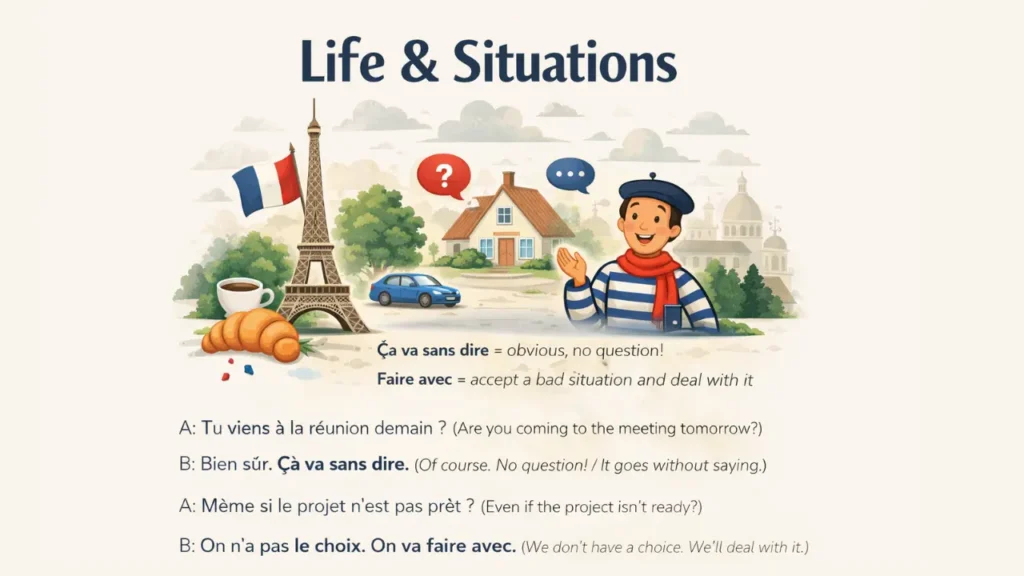
- Ça marche – It works / okay
Used constantly to agree or confirm something. - Comme ci, comme ça – So-so
Neutral way to say things are neither good nor bad. - Ça roule – All good
Very casual and friendly. - Ça va sans dire – That goes without saying
Used to emphasize something obvious. - C’est la vie – That’s life
Acceptance of a situation you can’t change. - Il y a un hic – There’s a catch
Often used when a plan has a hidden problem. - Être dans le pétrin – To be in trouble
Common in spoken French. - Faire avec – To make do
Used when options are limited. - Tomber à l’eau – To fall through
When plans are canceled or fail. - Ça ne fait rien – It doesn’t matter
French Idiomatic Phrases About Emotions And Feelings
- Avoir le cafard – To feel down
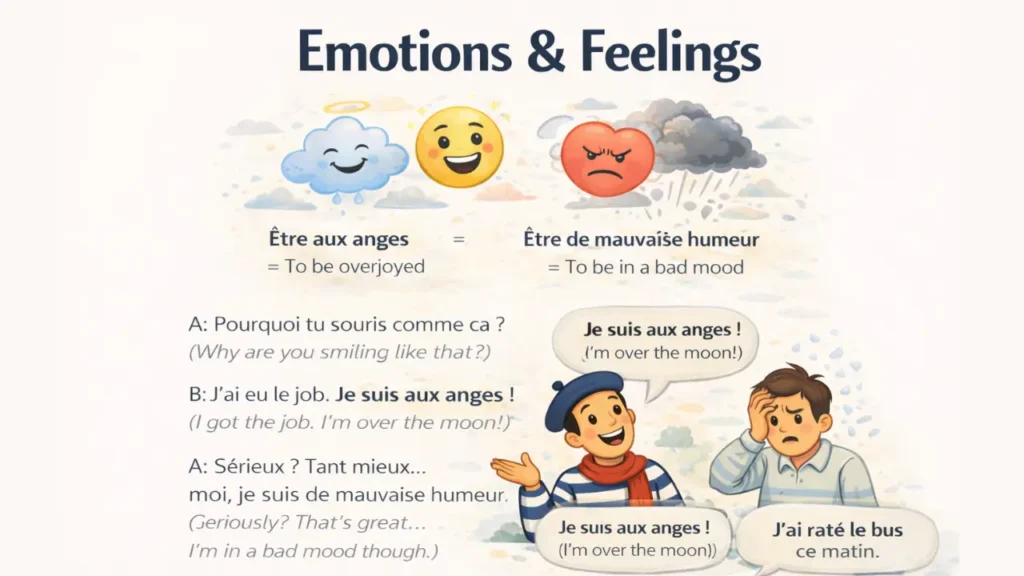
Very common for sadness or low mood. - Être aux anges – To be overjoyed
- Avoir la pêche – To feel great
Informal and positive. - Être à bout – To be exhausted
- Avoir le cœur gros – To feel heavy-hearted
- Être sur un petit nuage – To be on cloud nine
- Avoir la boule au ventre – To feel anxious
- Être de bonne humeur – To be in a good mood
- Être de mauvaise humeur – To be in a bad mood
- Avoir le moral à zéro – To feel very low
French Idiomatic Phrases Used In Conversations
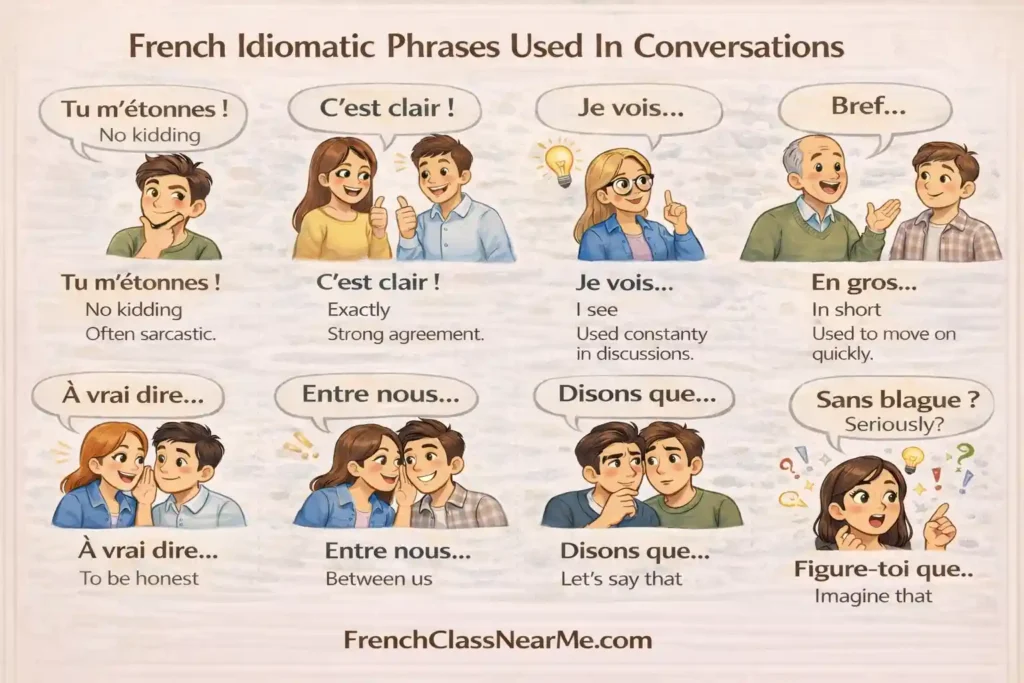
- Tu m’étonnes – No kidding
Often sarcastic. - C’est clair – Exactly
Strong agreement. - Je vois – I see
Used constantly in discussions. - Bref – In short
Used to move on quickly. - En gros – Basically
- À vrai dire – To be honest
- Entre nous – Between us
- Disons que – Let’s say that
- Sans blague – Seriously?
- Figure-toi que – Imagine that
French Idiomatic Phrases About Work
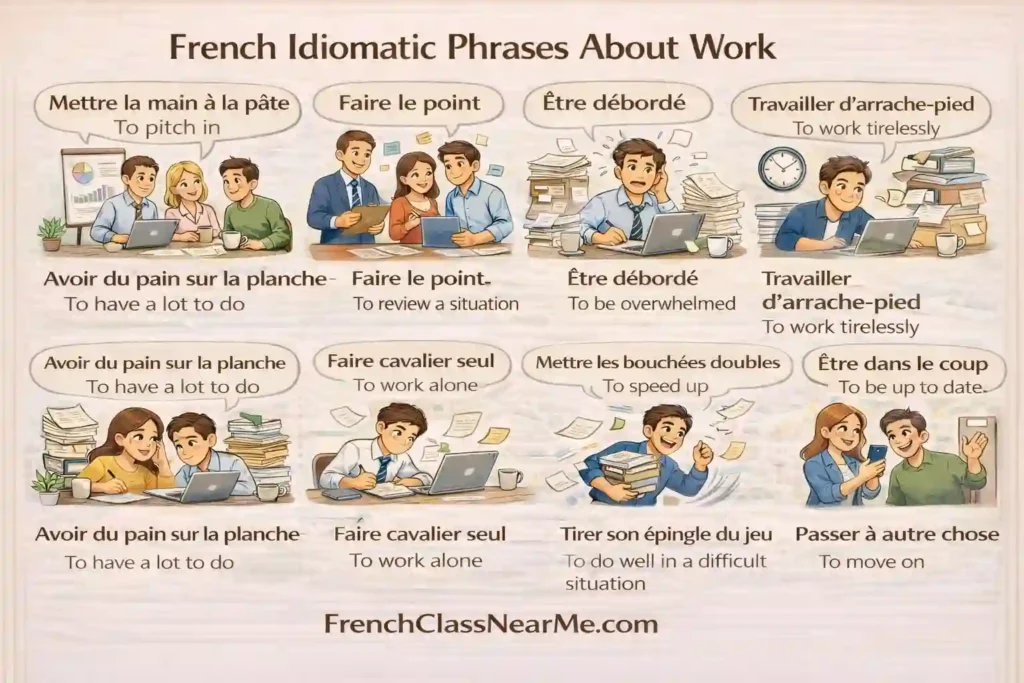
- Mettre la main à la pâte – To pitch in
- Faire le point – To review a situation
- Être débordé – To be overwhelmed
- Travailler d’arrache-pied – To work tirelessly
- Avoir du pain sur la planche – To have a lot to do
- Faire cavalier seul – To work alone
- Mettre les bouchées doubles – To speed up
- Être dans le coup – To be up to date
- Tirer son épingle du jeu – To do well in a difficult situation
- Passer à autre chose – To move on
French Idiomatic Phrases About Time And Frequency
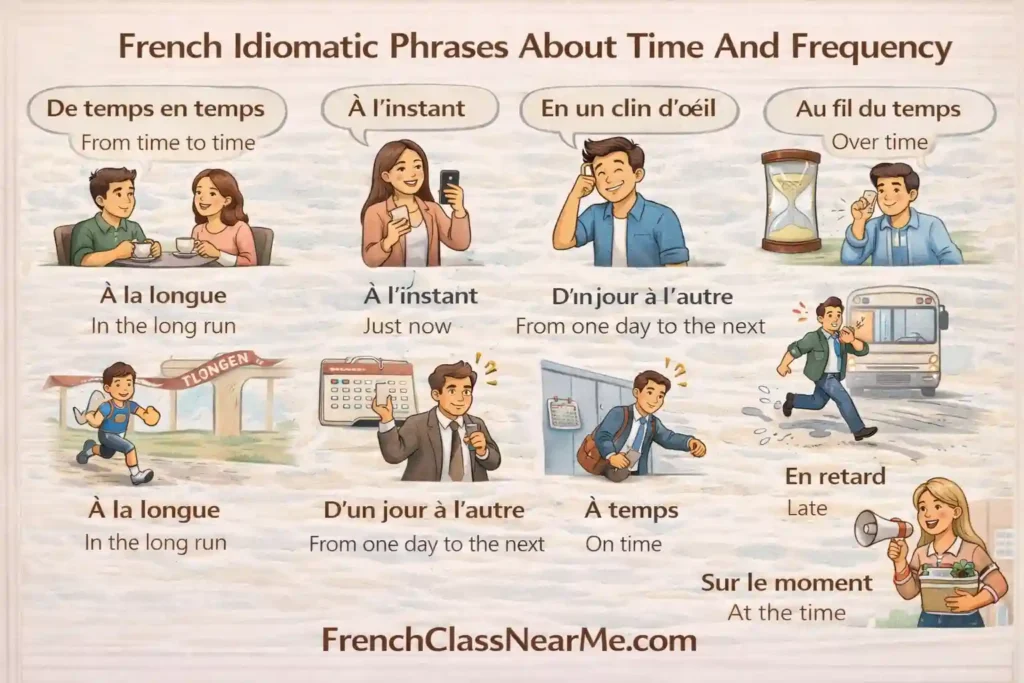
- De temps en temps – From time to time
- À l’instant – Just now
- En un clin d’œil – In the blink of an eye
- Au fil du temps – Over time
- À la longue – In the long run
- D’un jour à l’autre – From one day to the next
- À temps – On time
- En retard – Late
- À l’avance – In advance
- Sur le moment – At the time
French Idioms Related To Money And Value
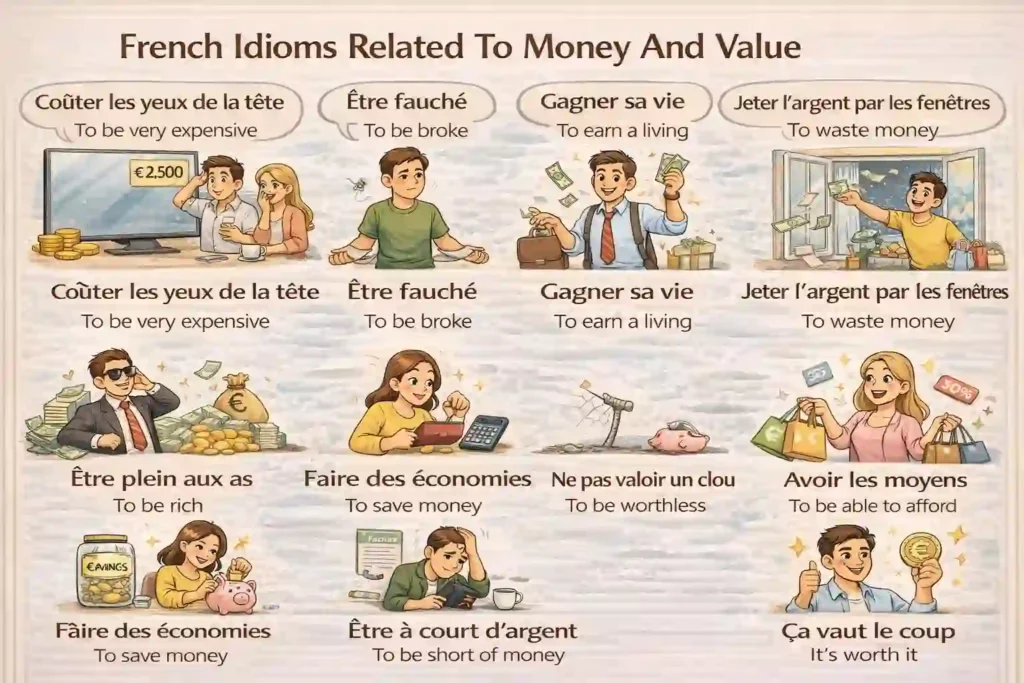
- Coûter les yeux de la tête – To be very expensive
- Être fauché – To be broke
- Gagner sa vie – To earn a living
- Jeter l’argent par les fenêtres – To waste money
- Être plein aux as – To be rich
- Ne pas valoir un clou – To be worthless
- Faire des économies – To save money
- Être à court d’argent – To be short of money
- Avoir les moyens – To be able to afford
- Ça vaut le coup – It’s worth it
Idiomatic Phrases About Communication
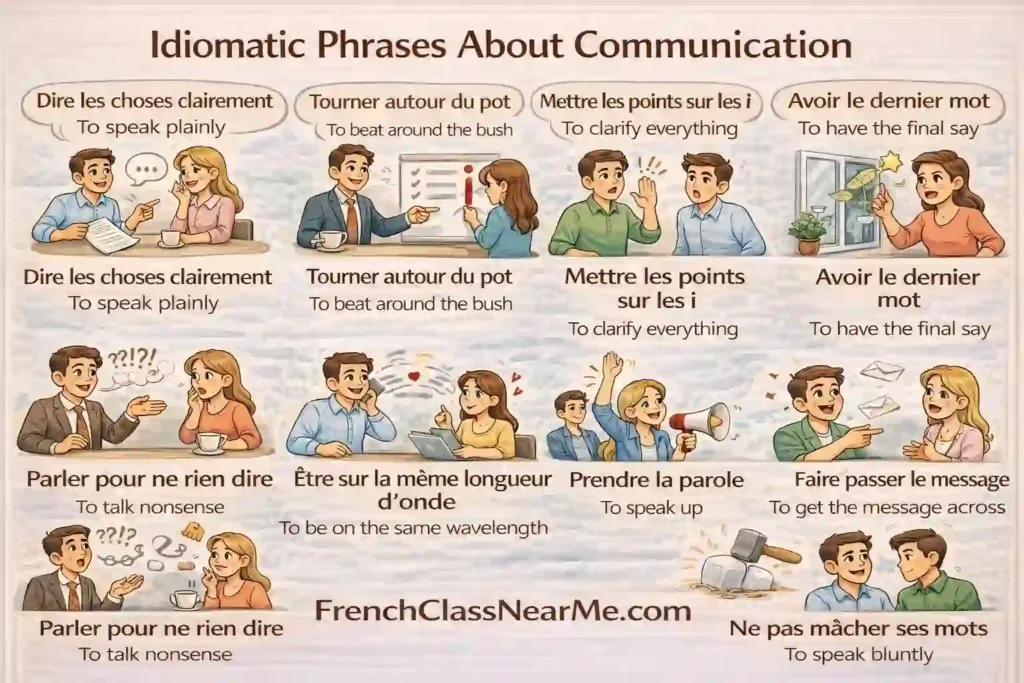
- Dire les choses clairement – To speak plainly
- Tourner autour du pot – To beat around the bush
- Mettre les points sur les i – To clarify everything
- Couper la parole – To interrupt
- Avoir le dernier mot – To have the final say
- Parler pour ne rien dire – To talk nonsense
- Être sur la même longueur d’onde – To be on the same wavelength
- Prendre la parole – To speak up
- Faire passer le message – To get the message across
- Ne pas mâcher ses mots – To speak bluntly
French Idioms About Decisions And Choices
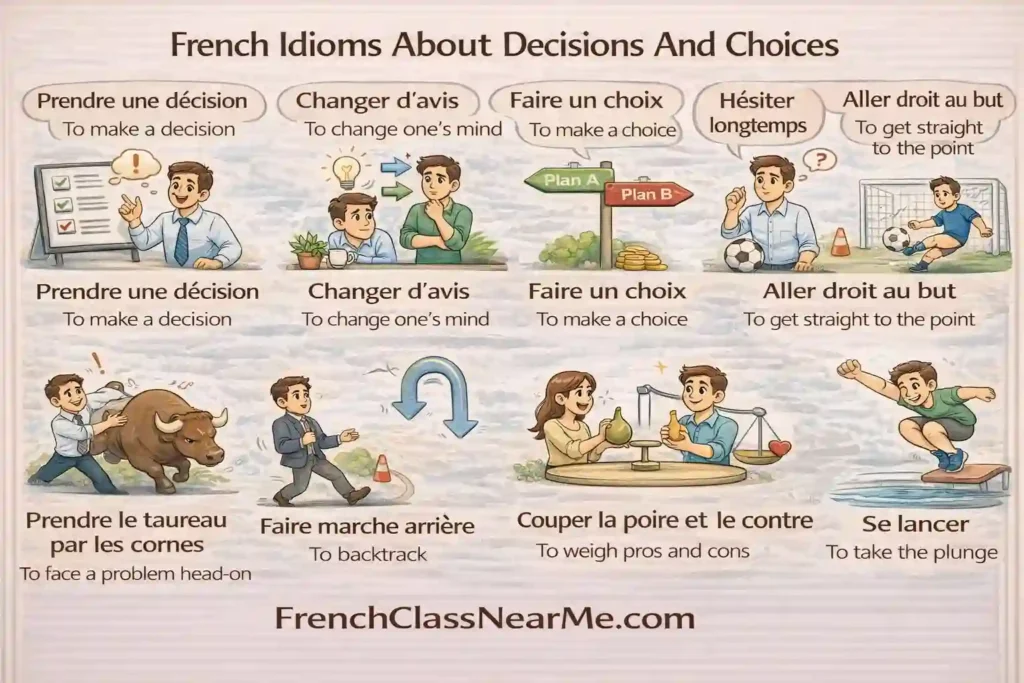
- Prendre une décision – To make a decision
- Changer d’avis – To change one’s mind
- Faire un choix – To make a choice
- Hésiter longtemps – To hesitate
- Aller droit au but – To get straight to the point
- Prendre le taureau par les cornes – To face a problem head-on
- Faire marche arrière – To backtrack
- Couper la poire en deux – To compromise
- Peser le pour et le contre – To weigh pros and cons
- Se lancer – To take the plunge
Idiomatic Phrases About Relationships
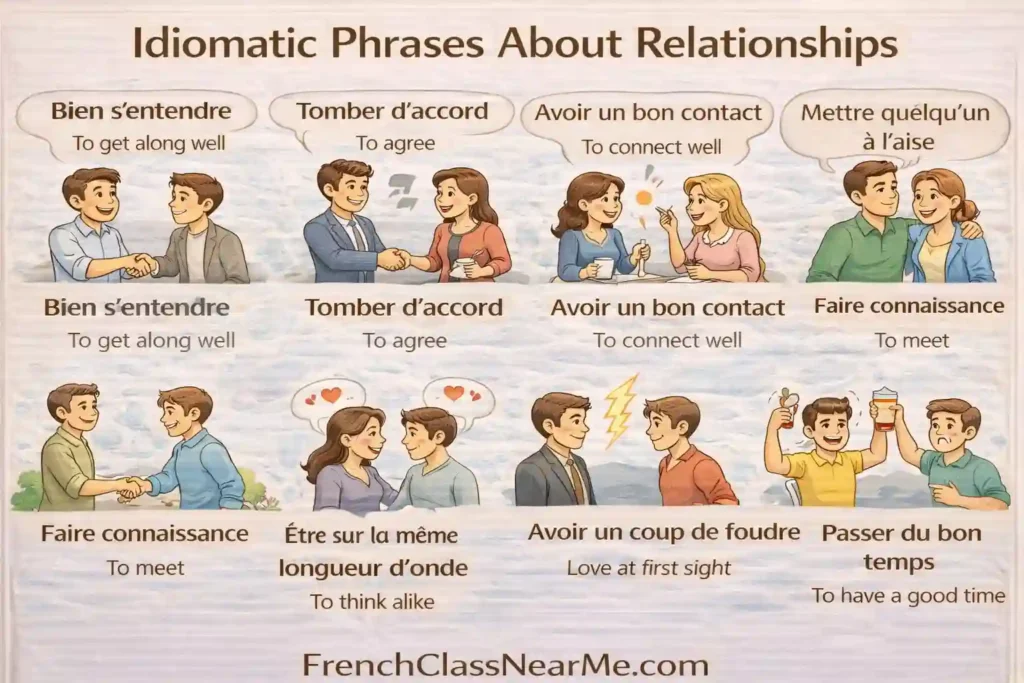
- Bien s’entendre – To get along well
- Tomber d’accord – To agree
- Avoir un bon contact – To connect well
- Mettre quelqu’un à l’aise – To make someone comfortable
- Faire connaissance – To meet
- Être sur la même longueur d’onde – To think alike
- Avoir un coup de foudre – Love at first sight
- Se prendre la tête – To argue or overthink
- Passer du bon temps – To have a good time
- Perdre contact – To lose touch
French Idioms Used To React Or Emphasize
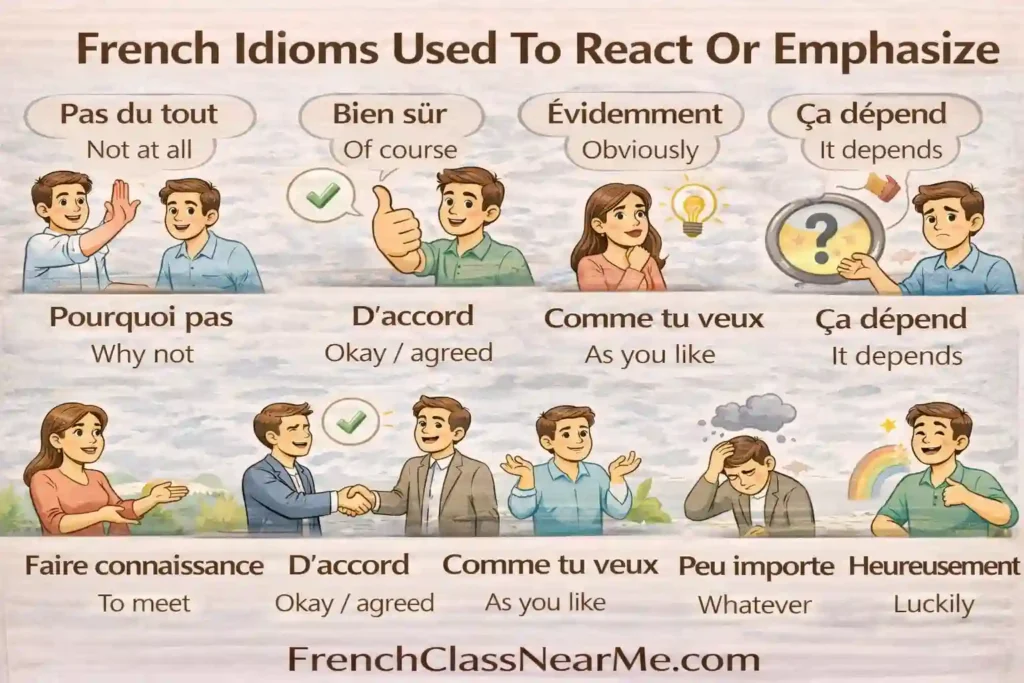
- Pas du tout – Not at all
- Bien sûr – Of course
- Évidemment – Obviously
- Ça dépend – It depends
- Pourquoi pas – Why not
- D’accord – Okay / agreed
- Comme tu veux – As you like
- Peu importe – Whatever
- Tant pis – Too bad
- Heureusement – Luckily
Very Common Spoken French Idioms
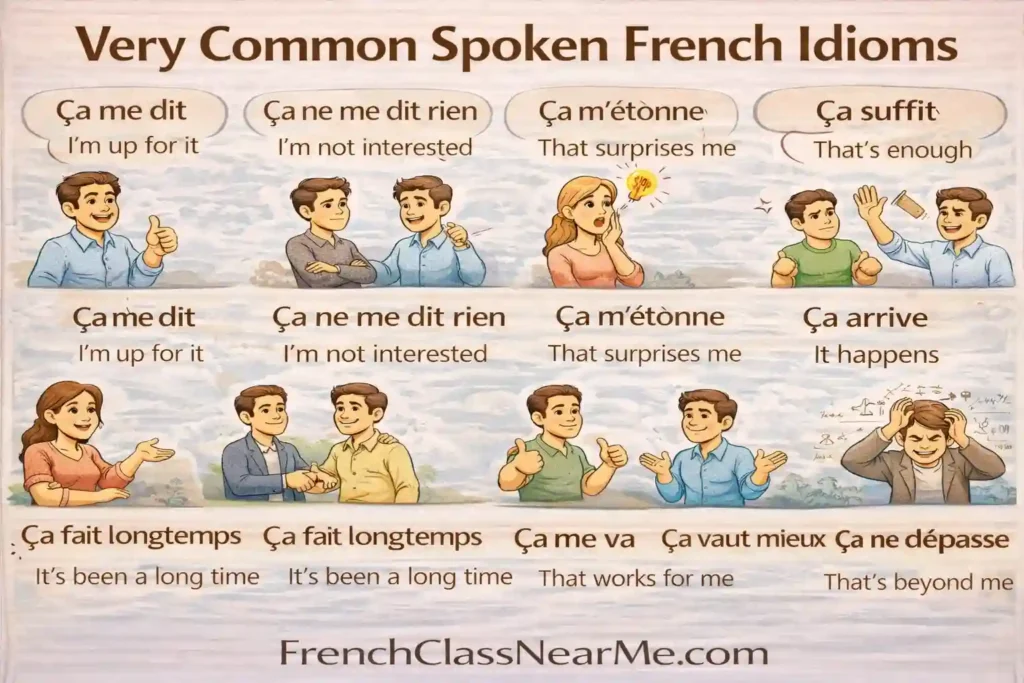
- Ça me dit – I’m up for it
- Ça ne me dit rien – I’m not interested
- Ça m’étonne – That surprises me
- Ça suffit – That’s enough
- Ça arrive – It happens
- Ça fait longtemps – It’s been a long time
- Ça me va – That works for me
- Ça vaut mieux – That’s better
- Ça n’a rien à voir – That has nothing to do with it
- Ça me dépasse – That’s beyond me
How To Learn And Use French Idioms Correctly
Now that you know the phrases, the mistake most learners make is trying to memorize them like a vocabulary list. That doesn’t work. Idioms stick when you hear them, see them, and reuse them in context.
Start by picking five idioms that match your daily life. Use them in simple sentences. Repeat them aloud. Listen for them in videos, podcasts, and conversations. Over time, they stop feeling like expressions and start feeling natural.
Common Mistakes Learners Make With Idioms
Idioms are powerful, but they’re also easy to misuse. Most mistakes don’t come from lack of vocabulary—they come from timing, tone, and context. Here are the most common traps learners fall into, and how to avoid them.
- Using idioms too early
Many learners try to sound “native” before they’re ready. Idioms work best when your basic sentence structure is already solid. If the sentence itself sounds unnatural, the idiom will only make it worse. - Forcing idioms into every sentence
Native speakers don’t speak in idioms nonstop. Using too many makes your speech feel unnatural and exaggerated. One well-placed idiom is far more effective than three forced ones. - Ignoring context
Some idioms fit casual conversations but sound awkward or inappropriate in professional or academic settings. What works with friends may not work in an email, presentation, or interview. - Using the wrong tone
Idioms can sound playful, sarcastic, emotional, or blunt. If the tone doesn’t match the situation, your message can come across as rude, childish, or confusing—even if the grammar is correct. - Translating idioms word for word
Idioms don’t follow logic. Translating them directly from your native language almost never works. Always learn them as fixed expressions with a specific meaning. - Misusing tense or structure
Many idioms are flexible, but not unlimited. Changing verb tense, articles, or word order incorrectly can make the idiom sound “off” to native ears. - Using rare idioms instead of common ones
Some learners focus on fancy or literary idioms that native speakers rarely use. Everyday, spoken idioms are more useful and more natural.
Why Idioms Are A Turning Point In Learning French
Grammar builds structure. Vocabulary builds meaning. Idioms build identity. When you start understanding and using idiomatic French, conversations become smoother, faster, and more enjoyable. You stop translating in your head and start reacting naturally.
That brings everything together.
Final Thoughts
Learning French idiomatic phrases is not about sounding impressive. It’s about sounding real. These 110 common French idiomatic phrases you’ll hear native speakers use daily are the backbone of everyday communication. Master them slowly, use them correctly, and your French will move from “correct” to “confident.”