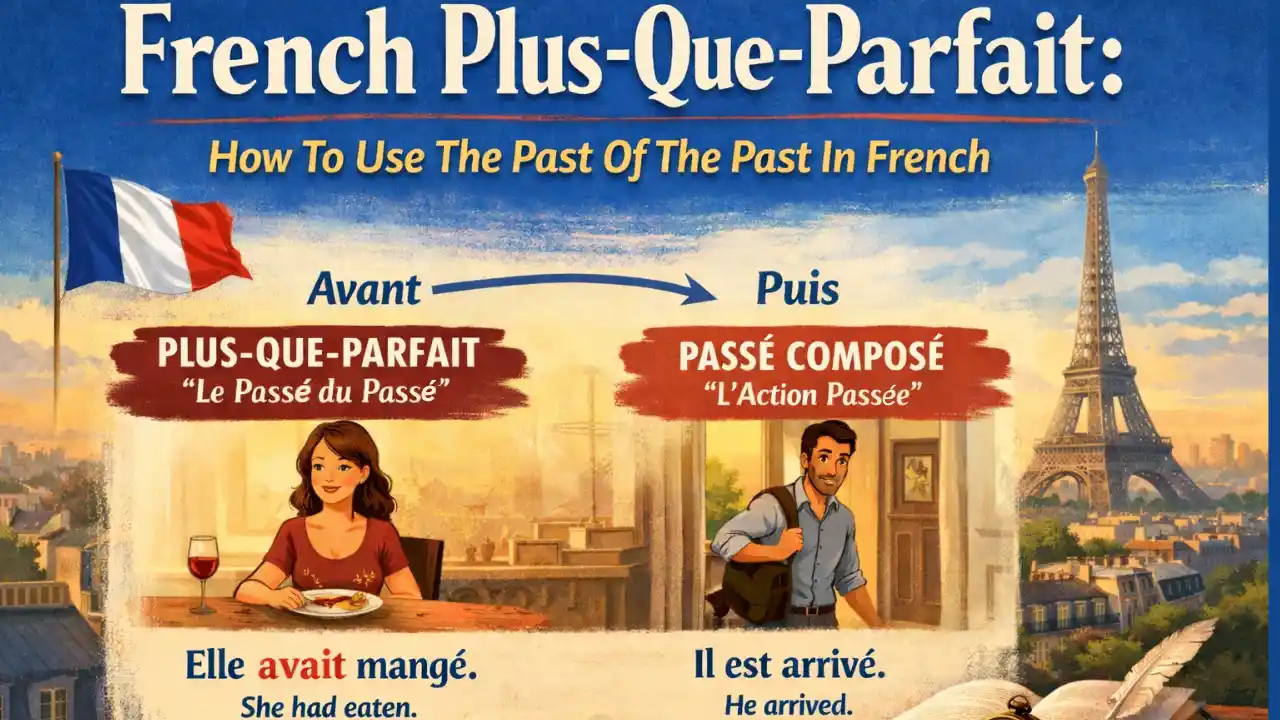
Talking about the past in French becomes much easier once the passe composé starts to feel familiar. This tense pops up everywhere—when someone says what they did today, shares a quick story, or explains something surprising that just happened. Because it’s the most common past tense in everyday French, getting comfortable with it instantly boosts confidence.
This guide explains the passe composé which is one of the French tenses that is part of the indicative mood in a simple, practical way. It shows how the tense works, how to build it step-by-step, when to use it, and how it differs from other past forms. It includes clear examples, easy tables, and friendly explanations so the structure becomes predictable. After a few patterns sink in, the passe composé feels much less like grammar and much more like natural communication.
What Is The Passe Composé In French
The passe composé is the tense used to talk about finished actions in the past. It’s used for things that happened once, happened suddenly, or had a clear beginning and end. Whether the action happened two minutes ago or several years ago, the idea is the same: the action is done.
The tense is built with two parts:
- an auxiliary verb (avoir or être) in the present
- the past participle of the main verb
Together, these two parts express a completed event.
Why The Passe Composé Matters
The passe composé is the backbone of past narration. It’s the tense people use the most when talking about anything that happened. Without it, conversations feel incomplete. Once the structure becomes familiar, speaking about everyday life becomes easier and much more natural.
How Passe Composé Compares To English
English has several ways to talk about completed actions (“I went,” “I have gone,” “I did”), but French uses the same structure for all of them. This makes the passe composé more consistent than English, even if it looks different at first. Once the pattern becomes familiar, the connection between the two languages becomes clear.
The Two Auxiliaries That Create Passe Composé
Every verb in the passe composé uses either avoir or être as a helper verb. Avoir is used most of the time; être is used for specific categories like movement verbs and reflexive verbs. Choosing the right auxiliary matters because it affects agreement rules and the structure of the sentence.
The Role Of Avoir In Passe Composé
Avoir is the default auxiliary and covers the majority of verbs. Its structure is predictable, and for most sentences, the past participle will not change. This makes avoir the easiest starting point for forming the passe composé.
The Role Of Être In Passe Composé
Être works with two main groups: movement verbs and reflexive verbs. When a verb uses être, the past participle must agree with the subject in gender and number. This adds an extra step, but the patterns are consistent, and once understood, they’re easy to apply.
When To Use Passe Composé
The passe composé is used in many everyday contexts, especially when something is clear and complete. Common situations include:
Completed Actions
Any action that finished at a specific point belongs to the passe composé.
One-Time Events
If an action happened only once, or only briefly, this is the natural tense.
Sudden Changes
Quick emotional or physical changes fit perfectly into the passe composé.
Sequences Of Actions
When telling a story, each event in the sequence usually appears in this tense.
Actions With Time Indicators
Words like hier, ce matin, soudain, tout à coup, or tout à l’heure often signal the passe composé because they mark specific moments.
Formation Of The Passe Composé
Step 1: Choose The Correct Auxiliary
Every verb requires either avoir or être, depending on its type.
Step 2: Conjugate The Auxiliary In The Present
This forms the foundation of the tense.
Step 3: Add The Past Participle
The past participle stays the same for every subject, except when agreement rules apply.
The Three Verb Groups And The Past Participle
ER Verbs
Most ER verbs form the past participle with -é. This group is the most regular and predictable.
IR Verbs
Regular IR verbs usually end with -i in the past participle. Many follow this simple pattern.
RE Verbs
Many RE verbs use -u for the past participle, though irregularities exist.
Agreement Rules In Passe Composé
Avoir: Agreement Only With Direct Objects Before The Verb
With avoir, the past participle agrees only if the direct object appears before the verb. Otherwise, there’s no agreement at all.
Être: Agreement With The Subject
With être, the past participle always matches the subject’s gender and number.
Reflexive Verbs
Because reflexive verbs use être, they follow the same agreement rules, except when the reflexive pronoun is acting as an indirect object.
Avoir In The Passe Composé: The Core Building Block
Avoir is the auxiliary used for most French verbs, which is why mastering it makes the passe composé feel much simpler. Once the pattern becomes familiar, forming past sentences becomes almost automatic. The structure stays the same no matter the subject: the auxiliary changes, but the past participle does not.
How Avoir Works In The Passe Composé
The structure is straightforward:
Subject + avoir (present) + past participle
Because avoir does not require agreement in most cases, the pattern remains stable. This is one of the main reasons learners find the passe composé easier when using avoir.
Why Avoir Is The Default Auxiliary
Most French verbs describe actions that do not involve movement toward or away from a point, nor do they reflect an action done to oneself. These regular actions naturally pair with avoir. The tense stays lighter, more direct, and easy to build because the past participle rarely changes form.
When Agreement Happens With Avoir
Agreement occurs only when a direct object comes before the verb. If the object appears after the verb, there is no agreement. This rule surprises many learners at first, but once the logic is clear, the pattern becomes intuitive.
Common Verbs That Use Avoir
Most everyday verbs fall into this category. This includes actions like speaking, eating, finishing tasks, choosing things, traveling, seeing, taking, learning, and many others. Because these verbs appear in daily life, the avoir form of the passe composé becomes a highly practical tool.
Être In The Passe Composé: Movement, Change, And Reflexive Forms
Être forms the passe composé for two important groups of verbs: movement verbs and reflexive verbs. These categories include common actions like leaving, arriving, going out, returning, waking up, sitting down, and getting up. Understanding when and why être is used makes the system much more predictable.
When To Use Être
Être is used with verbs that express movement or a change of state. This includes going up, coming down, entering, staying, falling, arriving, leaving, being born, and dying. These verbs typically involve a shift in position or a major life transition.
Subject Agreement With Être
When using être as the auxiliary, the past participle must match the subject in gender and number. This rule is consistent across all être verbs, including reflexive verbs. Agreement brings clarity to the sentence and reflects the subject’s characteristics.
Reflexive Verbs Automatically Use Être
Any verb that includes “se” in its structure uses être in the passe composé. Reflexive verbs describe actions that the subject performs on themselves, such as washing, getting dressed, sitting down, or remembering something.
When Agreement Does Not Apply To Reflexive Verbs
If the reflexive pronoun represents an indirect object rather than a direct object, there is no agreement. This distinction ensures that agreement only reflects the part of the sentence directly affected by the verb.
The DR MRS VANDERTRAMP System Explained
The DR MRS VANDERTRAMP list helps learners identify verbs that use être. Although not every movement verb belongs to this list, it covers the most common ones. Understanding the logic behind these verbs makes the system clearer than memorizing letters.
Why These Verbs Use Être
Each verb expresses a transition from one state or place to another. French categorizes these actions as movements or life changes, creating a natural connection to être rather than avoir.
Agreement Patterns Within This Group
Agreement remains consistent across the entire group. The past participle will match the subject in gender and number, making the endings change depending on who is performing the action.
Common Confusions And How To Avoid Them
Some verbs in this category can take avoir instead of être when they have a direct object. This dual behavior depends on whether the verb expresses pure movement or affects something else. Understanding context prevents mistakes and strengthens overall accuracy.
Irregular Past Participles In Passe Composé
Many French verbs have irregular past participles. Learning them is essential because they appear frequently in everyday speech. These irregular forms do not follow predictable patterns, so exposure and repetition help internalize them.
Why Irregular Forms Exist
Irregular verbs come from older patterns in the French language and maintained historical structures that do not match regular modern conjugation. These forms remain stable over time, making them reliable once learned.
How To Learn Irregular Past Participles
Grouping them by endings or patterns helps with memorization. Because they appear constantly, seeing them in real sentences accelerates recognition. Practice makes these irregular shapes feel familiar.
How Passe Composé Works In Real-Life Speech
The passe composé drives conversations about what happened. It gives clarity, pace, and structure to ideas. In daily life, French speakers use it to narrate, explain, summarize, and share stories quickly and efficiently.
Summarizing The Day
People use the passe composé to talk about things they have done, appointments they had, and tasks they completed. It shapes the rhythm of simple conversations.
Explaining What Changed
Any shift—emotionally, physically, or situationally—takes the passe composé. This includes sudden news, surprises, or updates.
Sharing Short Stories
When telling anecdotes, speakers stack passe composé verbs to deliver key events one after another.
Giving News
Announcements, results, and achievements naturally use this tense because they describe finished actions.
Advanced Distinctions, Agreement Rules, And Native-Level Patterns
Understanding the basic structure of the passe composé is one thing—but using it naturally, confidently, and with the same rhythm as native speakers requires a deeper look at how the tense behaves in real contexts. This part focuses on the fine details: agreement rules, subtle contrasts, storytelling patterns, and common traps learners often face.
Avoir vs Être: The Real Difference In Meaning
Why Most Verbs Use Avoir
Avoir pairs naturally with verbs that describe simple actions—things someone did, not things someone became or underwent. These verbs do not involve movement in space or a shift in state, which is why avoir remains the default.
Why Only Certain Verbs Use Être
Être marks verbs that involve a physical transition, personal transformation, or an action performed by the subject on themselves. This creates a semantic category: verbs that express movement, entry, exit, birth, death, and self-directed actions.
When A Verb Can Use Both Avoir And Être
Some verbs switch auxiliaries depending on the meaning. If the verb expresses simple action on an object, avoir appears. If the verb expresses movement or change of position, être appears. The auxiliary reveals the intended meaning.
Agreement Rules Explained Clearly
Agreement With Être
All verbs that use être require the past participle to match the subject’s gender and number. This creates a predictable pattern:
- feminine adds -e
- plural adds -s
- feminine plural adds -es
This rule applies to movement verbs and reflexive verbs unless the reflexive pronoun acts as an indirect object.
Agreement With Avoir
Avoir requires agreement only if a direct object comes before the verb. If the object comes after, there is no change. This rule ensures the past participle reflects the object it describes, not the subject.
Agreement With Reflexive Verbs
Reflexive verbs generally behave like être verbs, but the reflexive pronoun can complicate agreement. If the pronoun is a direct object, agreement applies. If the pronoun is indirect, no agreement occurs.
Breaking Down The DR MRS VANDERTRAMP Verbs
Movement verbs often confuse learners because the pattern feels irregular at first. But the logic is simple: all these verbs express going somewhere, coming from somewhere, or changing location. Their participles shift based on the subject.
A Clear Way To Understand The Pattern
These verbs behave like markers of physical transition. Each one signals movement toward or away from a point, or a passage from one state to another. The auxiliary être marks this physical or metaphorical shift.
When These Verbs Use Avoir Instead
If the verb takes a direct object and focuses more on the action applied to something else than the movement itself, it switches to avoir. This shift reflects the change in meaning rather than an exception to the rule.
Using Passe Composé In Storytelling
The passe composé gives structure and clarity to stories. It serves as the action backbone in narration, while the imparfait paints background details. Understanding how native speakers transition between the two creates smoother stories and stronger comprehension.
How Passe Composé Moves A Story Forward
Each completed action appears in the passe composé. These events form the “plot points” in a personal story or anecdote.
How To Alternate Between Tenses
A typical narrative flow uses the imparfait to describe what was happening and the passe composé to explain what interrupted or changed the situation. This contrast gives stories rhythm and clarity.
When To Use Only Passe Composé
Short updates, quick summaries, breaking news, and simple recaps rely solely on the passe composé. If the focus is on what happened, not on the background, this tense carries the entire message.
Time Expressions That Signal Passe Composé
Certain words naturally pair with this tense. They emphasize the idea of completion or punctual actions.
Expressions That Indicate A Completed Moment
Words associated with specific times naturally point toward the passe composé. These markers anchor the verb in time.
Expressions That Signal Duration With A Clear End
Even when describing periods, if the duration has a clear endpoint, the passe composé fits naturally.
How These Expressions Shape Meaning
Each time expression creates a frame of reference. They define the boundaries of the action and help determine whether the verb describes something completed or ongoing.
Common Mistakes And How To Avoid Them
Confusing Avoir And Être
Learners often mix auxiliaries because they memorize lists rather than understand meaning. Thinking in terms of movement, change, and reflexivity helps clarify the choice.
Forgetting Agreement
Agreement mistakes usually happen when the structure becomes long or the object appears before the verb. Knowing where to look for the direct object prevents errors.
Overusing The Passe Composé
Some learners use the passe composé too often and forget to switch to the imparfait for background actions. Recognizing the function of each tense clarifies when each should appear.
Mixing English Logic With French
English often relies on simple past, which has broader uses. French separates ongoing states and completed actions more clearly. Understanding this distinction prevents tense confusion.
Complete Agreement Tables, Irregular Participles, And Native Usage Patterns
This part brings everything together by showing the agreement rules, auxiliary choices, and irregular past participles in clean, easy-to-read tables. Each table is designed for quick reference, especially for learners who want to check patterns fast while practicing or writing.
Agreement Tables In The Passe Composé
Agreement Table With Être
The past participle always agrees with the subject.
| Subject Type | Ending Added | Example Pattern |
|---|---|---|
| Masculine singular | no ending | allé |
| Feminine singular | + e | allée |
| Masculine plural | + s | allés |
| Feminine plural | + es | allées |
This pattern applies to all verbs using être, including reflexive verbs when the pronoun is a direct object.
Agreement Table With Avoir
Agreement happens only when the direct object appears before the verb.
| Position of Direct Object | Agreement? | Example Idea |
|---|---|---|
| No direct object | No agreement | past participle unchanged |
| Direct object after verb | No agreement | unchanged participle |
| Direct object before verb | Yes, agree with object | participle matches object |
This rule works for pronouns such as le, la, les, and for relative clauses where the object precedes the verb.
Agreement Table For Reflexive Verbs
Reflexive verbs use être, but agreement depends on the function of the reflexive pronoun.
| Pronoun Type | Agreement? | Explanation |
|---|---|---|
| Direct object | Yes | pronoun receives action directly |
| Indirect object | No | pronoun benefits from action, not target of it |
Understanding whether the pronoun acts as a direct object ensures accurate agreement.
Clear List Of Common Irregular Past Participles
Many of the most frequent verbs in French have irregular past participles. Learning these forms early helps with speaking and comprehension because they appear constantly.
Irregular Forms Organized By Ending Type
| Ending | Verb Examples | Past Participle Pattern |
|---|---|---|
| -u | savoir, vouloir, avoir, pouvoir, boire | su, voulu, eu, pu, bu |
| -i | suivre, rire, vivre | suivi, ri, vécu |
| -is | mettre, prendre | mis, pris |
| -it | écrire, conduire | écrit, conduit |
| -ert | ouvrir, offrir | ouvert, offert |
| Miscellaneous | être, faire, naître | été, fait, né |
Patterns appear when grouped, even if the verbs themselves look irregular in isolation.
Passe Composé With Object Pronouns
Using object pronouns before the verb affects agreement. Understanding the order of pronouns helps maintain accuracy.
Pronoun Order In Passe Composé
Pronouns come before the auxiliary.
| Sentence Element | Position |
|---|---|
| Reflexive or object pronoun | before auxiliary |
| Auxiliary verb | conjugated in present |
| Past participle | final position |
When the pronoun is a direct object, the participle must agree with it.
Negative Forms In Passe Composé
Negation wraps around the auxiliary verb, not the past participle.
Structure Of Negative Passe Composé
ne + auxiliary + pas + past participle
The structure remains identical whether using avoir or être.
Negative Structure With Pronouns
When pronouns appear, they come before the auxiliary but stay inside the negative structure. This placement remains consistent across all reflexive and non-reflexive forms.
Questions In The Passe Composé
Questions follow typical French structures but keep the passe composé intact.
Using Est-Ce Que
The question remains simple because the structure of the tense does not change.
Using Inversion
Inversion occurs with the auxiliary verb, not with the past participle.
Using Rising Intonation
Informal speech often relies on intonation alone. The structure stays the same, making it easy to form quick questions.
Adverbs In Passe Composé
Adverb placement affects clarity and rhythm.
Adverbs Commonly Used With Passe Composé
Words that describe frequency, precision, or intensity often appear in the middle of the structure.
Where Adverbs Go
Short and common adverbs usually appear between the auxiliary and the past participle. Longer or more detailed adverbs often appear before or after the entire verb structure.
How Placement Changes Emphasis
Shifting adverb position can highlight the completeness of the action, the moment it happened, or the speaker’s attitude toward the action.
Passive Voice In Passe Composé
The passive voice uses être as the auxiliary and follows normal agreement rules.
Structure Of Passive Voice With Passe Composé
Subject + être (present) + past participle + par/de + agent
Agreement follows the same rules as other être-based constructions.
When Passive Voice Makes Sense
It suits formal situations or contexts where the agent is irrelevant. The structure remains clean and predictable.
Spoken French And The Passe Composé
Native speakers often simplify or shorten structures in conversation, but the tense itself remains the same.
How Speech Affects Rhythm
People tend to use shorter adverbial expressions and rely on context more than explicit time markers. This makes the passe composé sound more fluid.
Contractions And Informal Patterns
Informal French contracts words like “j’ai” or “t’as,” but the grammatical structure remains unchanged.
Importance Of Context
Listeners interpret the meaning of the passe composé through context, making clear auxiliary usage essential for understanding.
How Native Speakers Choose Between Tenses
Native speakers use the passe composé without thinking because the contrast with the imparfait is instinctive.
Knowing The Function Of Each Tense
The passe composé expresses what happened.
The imparfait expresses what was happening.
The Natural Flow Of Storytelling
The combination of the two tenses builds rhythm, structure, and clarity in stories.
Subtle Shifts In Meaning
A single tense change can shift a sentence from descriptive to decisive, which highlights the importance of choosing correctly.
Practical Communication Patterns, Time Markers, And Real-Life Usage
Understanding the mechanics of the passe composé is helpful, but using it naturally in conversation requires recognizing how it behaves in real situations. This part focuses on practical patterns, everyday communication, and the time expressions that guide tense choice. These patterns mirror how native speakers talk, making the tense feel more intuitive and less mechanical.
Passe Composé In Everyday Communication
Sharing News Or Updates
The passe composé appears whenever someone gives a simple update about their day or something that recently happened. These sentences are short, direct, and focus on completed actions. This makes the tense ideal for quick messages, summaries, and everyday interactions.
Reporting What Someone Did
Most action-based explanations rely on the passe composé. Whether someone went somewhere, ate something, met someone, or finished something, French automatically chooses this tense because the action is complete.
Talking About Achievements
Any kind of accomplishment—small or big—uses the passe composé. The tense highlights the result, which is why it fits naturally with personal milestones or completed tasks.
Describing Surprising Moments
When something suddenly happens or shocks someone, the passe composé captures the moment. Its direct structure helps express rapid changes and unexpected events clearly.
Reacting To New Information
French often uses short passe composé sentences to show reaction or realization. The tense conveys immediacy and completion, making it perfect for spontaneous responses.
Passe Composé Time Markers (Essential For Fluency)
Time markers help signal whether the action is completed, ongoing, or habitual. These expressions guide tense choice and make sentences clearer.
Time Markers That Favor Passe Composé
These expressions point to specific, completed moments:
| Time Expression | Meaning |
|---|---|
| hier | yesterday |
| ce matin | this morning |
| tout à coup | suddenly |
| l’an dernier | last year |
| il y a deux jours | two days ago |
| soudain | suddenly |
| une fois | once |
| à midi | at noon |
| à ce moment-là | at that moment |
These markers anchor the action in a moment, which aligns perfectly with the passe composé.
Duration Markers With Clear Endpoints
When the duration has a known limit, the passe composé fits naturally.
| Expression | Meaning |
|---|---|
| pendant deux heures | for two hours |
| toute la journée | the whole day |
| pendant un an | for a year |
| pendant un moment | for a while |
Even though these describe longer actions, the clear endpoint points toward the passe composé.
Time Expressions That Contrast With Imparfait
Some expressions naturally pair with the imparfait, but can also appear with the passe composé depending on meaning. The key difference lies in whether the expression marks a specific moment or a habitual pattern.
How Passe Composé Shapes Storytelling
The Action Backbone
In narratives, the passe composé serves as the sequence of key actions. Each completed event pushes the story forward. Without it, stories lose structure and pace.
When To Switch To Imparfait
Stories alternate between the imparfait and the passe composé. The imparfait sets the atmosphere. The passe composé signals what happened. This back-and-forth creates a natural storytelling rhythm.
Highlighting Important Moments
Because the passe composé focuses on action, it highlights transitions, reactions, and plot points. It draws attention to the moments that matter most in the narrative.
Keeping Stories Short And Clear
When someone wants to recount a simple event with no background information, the passe composé alone is used. This keeps descriptions efficient and direct.
Using Passe Composé With “Y” And “En”
Pronoun placement sometimes confuses learners, but the passe composé stays stable.
Placement With Pronouns
Object and adverbial pronouns always come before the auxiliary, whether using avoir or être.
This order does not change the meaning of the tense, only the structure.
Agreement Rules With Pronouns
Agreement depends on whether the pronoun is a direct object (agreement required) or an indirect object (no agreement). Pronouns like “y” and “en” never trigger agreement.
Adverbs: How They Change The Rhythm Of Passe Composé
Short Adverbs In The Middle
Common adverbs like déjà, beaucoup, bien, mal, peu, trop, often appear between the auxiliary and the past participle. This position makes speech more natural and fluid.
Longer Expressions Around The Structure
Detailed adverbs or multi-word expressions often appear before or after the full verb structure. This gives the sentence more breathing room and better pacing.
Adverbs That Change Meaning Depending On Placement
Certain adverbs subtly adjust the meaning based on where they appear. When the adverb sits between the auxiliary and the participle, the focus shifts toward the action. When placed later, the focus broadens to the sentence overall.
Passive Voice Patterns With Passe Composé
How Passive Voice Works
In passive voice constructions, être becomes the auxiliary, and agreement follows the same rules as other être verbs. This keeps the structure consistent and predictable.
When Passive Voice Adds Clarity
Passive voice helps when the person doing the action is unknown, unimportant, or intentionally left out. This structure appears frequently in formal French, instructions, and official announcements.
Advanced Distinctions Native Speakers Make Instinctively
Completed vs. Result-Focused
The passe composé sometimes emphasizes the result rather than the action itself. This subtle distinction appears in emotions, achievements, and changes of state.
Momentary vs. Lasting Meaning
The passe composé shows completion even for long actions. What matters is perspective: whether the speaker sees the action as finished.
Emotion Or Reaction In The Passe Composé
When expressing sudden emotional reactions, French uses the passe composé because the shift is viewed as instantaneous rather than ongoing.
Memory Techniques To Internalize The Patterns
Connect Meaning To Auxiliary Choice
Rather than memorizing lists, associating meaning with either avoir or être helps internalize patterns more quickly. Movement links to être. Simple actions link to avoir.
Practice With Real Stories
Listening to short anecdotes or phrases that mix the passe composé and imparfait builds instinct. Exposure helps the brain recognize when each tense naturally appears.
Rewrite Daily Events
Describing one’s day using the passe composé solidifies the structure through repetition. The more real the practice feels, the faster the tense becomes automatic.
How Passe Composé Builds Toward Fluency
The passe composé plays a central role in every conversation about the past. Mastering it makes it easier to describe experiences, understand native speakers, and follow stories. Because it interacts closely with other past tenses, especially the imparfait, it becomes a stepping stone toward more advanced expression.
The more predictable the structure feels, the more natural the tense becomes. When the auxiliary choice, agreement rules, and time markers become second nature, speaking becomes clearer and more confident.
Conclusion
The passe composé is one of the most important tools for expressing past actions in French. It forms the backbone of everyday communication, storytelling, updates, and personal experiences. Once the logic behind auxiliary choice, past participle formation, and agreement becomes familiar, the tense shifts from something that feels technical to something that feels natural. It takes practice to build instinct, but the patterns are predictable, and the tense rewards consistency with clarity and confidence.
Knowing when to use the passe composé also strengthens understanding of other past tenses, especially the imparfait. The contrast between what happened and what was happening creates the natural rhythm found in real French stories and conversations. With time markers, object pronouns, irregular participles, and agreement rules all fitting into place, sentences become cleaner, smoother, and easier to build.
Mastering this tense unlocks much more than grammar. It allows clearer expression of personal experiences, better comprehension of spoken French, and stronger engagement with native materials. The passe composé appears everywhere, which is why understanding it deeply is essential for moving toward real fluency.