If you’ve ever tried to conjugate faire in french and wondered why this single verb appears in so many everyday expressions, you’re not alone. This guide gives you a simple, beginner-friendly path to mastering its forms across all major tenses. You’ll explore clear examples, past-tense structures, real-life usage, and practical exercises that make each conjugation feel natural and easy to apply.
First thing first,
Why Faire Is One Of The Most Important Verbs In French
The verb faire carries more meaning than most French verbs because it covers actions, weather, activities, chores, sports, and idiomatic expressions. It works in casual conversations, formal writing, everyday habits, and descriptions. Once you master its conjugations, you unlock a huge part of real spoken French.
Faire means “to do” or “to make,” but in French it also forms expressions like faire du sport, faire la cuisine, faire attention, faire beau, and hundreds more. This makes faire one of the most versatile verbs in the language.
in short, let’s map out the structure
How To Conjugate Faire In French Across Tenses
Because faire is an irregular verb, you must memorize its forms. But the patterns repeat, and once you understand them, the tense system becomes easier.
Here’s a quick overview:
Present Tense (Simple Present / Present Continuous)
| Person | Conjugation |
|---|---|
| Je | fais |
| Tu | fais |
| Il/Elle/On | fait |
| Nous | faisons |
| Vous | faites |
| Ils/Elles | font |
Examples:
- Je fais mes devoirs.
- Ils font du sport.
- Nous faisons un gâteau.
Imparfait (Past Continuous / Used to form)
| Person | Conjugation |
|---|---|
| Je | faisais |
| Tu | faisais |
| Il/Elle/On | faisait |
| Nous | faisions |
| Vous | faisiez |
| Ils/Elles | faisaient |
Examples:
- Je faisais souvent du vélo.
- Ils faisaient la cuisine ensemble.
- Elle faisait ses devoirs chaque soir.
Futur Simple
| Person | Conjugation |
|---|---|
| Je | ferai |
| Tu | feras |
| Il/Elle/On | fera |
| Nous | ferons |
| Vous | ferez |
| Ils/Elles | feront |
Examples:
- Je ferai une pause demain.
- Nous ferons la réservation.
- Ils feront le voyage cet été.
Conditional
| Person | Conjugation |
|---|---|
| Je | ferais |
| Tu | ferais |
| Il/Elle/On | ferait |
| Nous | ferions |
| Vous | feriez |
| Ils/Elles | feraient |
Examples:
- Je ferais la vaisselle si j’avais le temps.
- Nous ferions un effort.
- Ils feraient mieux s’ils essayaient.
Subjunctive
| Person | Conjugation |
|---|---|
| Que je | fasse |
| Que tu | fasses |
| Qu’il/elle/on | fasse |
| Que nous | fassions |
| Que vous | fassiez |
| Qu’ils/elles | fassent |
Examples:
- Il faut que tu fasses attention.
- Je veux qu’ils fassent un effort.
now let’s dive deeper
How To Conjugate Faire In The Passé Composé
The passé composé of faire uses:
avoir + fait
There is no agreement, because avoir is the auxiliary and fait never changes.
Examples:
- J’ai fait mes devoirs.
- Nous avons fait la fête.
- Elle a fait un gâteau.
- Ils ont fait un effort.
Notice how fait stays the same.
here’s a table for clarity
Table: Faire In The Passé Composé
| Person | Conjugation | Example |
|---|---|---|
| Je | ai fait | J’ai fait un plan. |
| Tu | as fait | Tu as fait le bon choix. |
| Il/Elle/On | a fait | Elle a fait du progrès. |
| Nous | avons fait | Nous avons fait une erreur. |
| Vous | avez fait | Vous avez fait un effort. |
| Ils/Elles | ont fait | Ils ont fait leurs valises. |
now that you have the past covered
How To Conjugate Faire In The Imparfait
The imparfait expresses repeated, habitual, or background actions.
Conjugation pattern: fais- + imparfait endings
Examples:
- Je faisais la cuisine chaque dimanche.
- Ils faisaient du bruit.
- Nous faisions attention.
The imparfait is especially useful for storytelling.
in short, let’s expand into more past uses
How To Conjugate Faire In Other Past Tenses
Here is how to conjugate the:
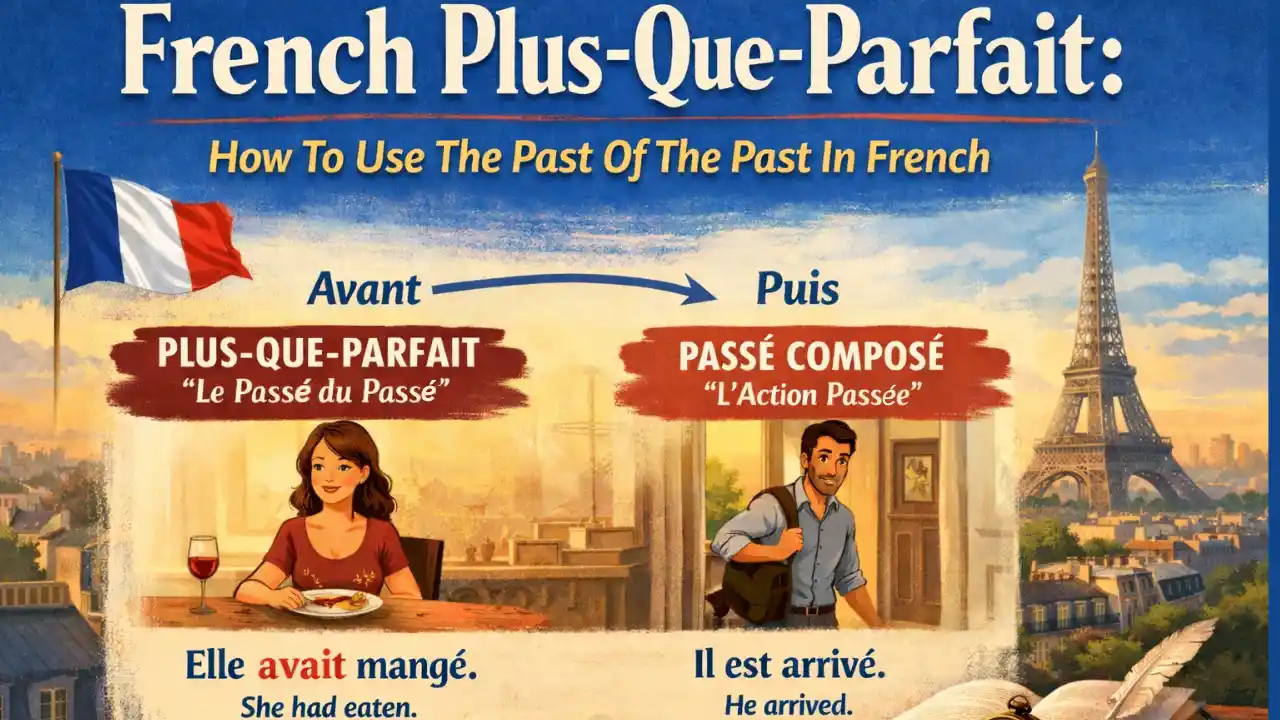
Plus-Que-Parfait
Structure: avoir (imparfait) + fait
Examples:
- J’avais fait mes révisions avant l’examen.
- Ils avaient fait la réservation.
- Nous avions fait une erreur.
Passé Simple (mostly literary)
- Je fis
- Tu fis
- Il fit
- Nous fîmes
- Vous fîtes
- Ils firent
Example:
Il fit un geste.
You’ll see this in stories, not daily conversation.
Passé Antérieur
Rare, but used in literature:
eut fait, eurent fait, etc.
now let’s focus on real usage
How To Conjugate Faire In French Through Real Everyday Sentences
Daily Routines
- Je fais le lit.
- Elle fait la cuisine.
- Ils font la vaisselle.
Weather Expressions
- Il fait froid.
- Il fait beau.
- Il fait chaud.
Sports
- Nous faisons du tennis.
- Tu fais du yoga.
Idiomatic Expressions
- Faire attention
- Faire semblant
- Faire la queue
- Faire partie de
- Faire de son mieux
Work And Study
- Je fais un rapport.
- Ils font une présentation.
- Elle fait une recherche.
now that the usage is clear
How To Conjugate Faire In French (With Examples)
Here are sentence models you can reuse:
Present
- Je fais un gâteau.
- Ils font une activité.
Imparfait
- Je faisais mes devoirs tous les jours.
Passé Composé
- Elle a fait une erreur.
Futur Simple
- Nous ferons un effort demain.
Conditional
- Je ferais une pause si possible.
Subjunctive
- Il faut que tu fasses ton travail.
now let’s compare faire across tenses
Table: Faire Across The Most Useful Tenses
| Tense | Example | Meaning |
|---|---|---|
| Present | Je fais un test. | I am doing a test |
| Imparfait | Je faisais un test. | I was doing / used to do |
| Passé composé | J’ai fait un test. | I did / have done |
| Plus-que-parfait | J’avais fait un test. | I had done |
| Future | Je ferai un test. | I will do |
| Conditional | Je ferais un test. | I would do |
| Subjunctive | Il faut que je fasse un test. | It is necessary that I do |
now it’s time to practice
Practical Exercises To Help You Conjugate Faire In French With Ease
Exercise 1: Conjugate Faire In The Correct Tense
- Je ______ (faire) un gâteau. (present)
- Ils ______ (faire) leurs devoirs hier. (passé composé)
- Nous ______ (faire) du sport chaque semaine. (imparfait)
- Je ______ (faire) un effort demain. (futur)
- Elle ______ (faire) la cuisine si elle avait le temps. (conditionnel)
Exercise 2: Rewrite Using Faire
Replace the expression with faire when possible.
- J’effectue mes devoirs.
- Ils préparent une fête.
- Je cuisine le dîner.
- Elle prend un effort.
- Nous organisons une activité.
Exercise 3: Conjugate Faire In Passé Composé
- Je ______ un voyage.
- Ils ______ une erreur.
- Nous ______ attention.
- Elle ______ une pause.
- Tu ______ un gâteau.
Exercise 4: Translate Into French
- I made a mistake.
- We were doing homework.
- They will do the presentation.
- She does the cooking.
- You would do your best.
now let’s correct your answers
Corrections
Correction Exercise 1
- fais
- ont fait
- faisions
- ferai
- ferait
Fully written:
- Je fais un gâteau.
- Ils ont fait leurs devoirs hier.
- Nous faisions du sport chaque semaine.
- Je ferai un effort demain.
- Elle ferait la cuisine si elle avait le temps.
Correction Exercise 2
- Je fais mes devoirs.
- Ils font une fête.
- Je fais le dîner.
- Elle fait un effort.
- Nous faisons une activité.
Correction Exercise 3
- J’ai fait un voyage.
- Ils ont fait une erreur.
- Nous avons fait attention.
- Elle a fait une pause.
- Tu as fait un gâteau.
Correction Exercise 4
- J’ai fait une erreur.
- Nous faisions les devoirs.
- Ils feront la présentation.
- Elle fait la cuisine.
- Tu ferais de ton mieux.
now let’s create the most complete FAQ on this topic
FAQs About Conjugating Faire In French
What Does The Verb Faire Mean In French?
Faire generally means “to do” or “to make,” but in French it expands into hundreds of expressions. You’ll use it to describe activities, weather, sports, chores, emotions, and everyday tasks. Because it appears in so many real situations, mastering it gives you immediate confidence and fluency in everyday conversations.
Why Is Faire Considered An Important Verb In French?
Because it appears everywhere: in expressions, weather phrases, school activities, work tasks, sports, and idioms. You simply can’t speak daily French without faire. It’s one of the first irregular verbs learners must master, and doing so unlocks a huge part of natural communication.
Is Faire A Regular Or Irregular Verb?
Faire is irregular, which means it doesn’t follow the typical -re or -ir patterns. You must memorize its forms, but once you internalize the endings across a few tenses, it becomes predictable. Irregular verbs are common in French, and faire is one of the most frequently used among them.
How Do You Conjugate Faire In The Present Tense?
The forms are: je fais, tu fais, il fait, nous faisons, vous faites, ils font. These appear constantly in daily conversations, so learning and practicing them is essential. You’ll see them used with chores, activities, obligations, and expressions like faire attention.
How Do You Conjugate Faire In The Imparfait?
The imparfait forms are: je faisais, tu faisais, il faisait, nous faisions, vous faisiez, ils faisaient. You use the imparfait for repeated past actions, incomplete actions, or background descriptions. It helps you tell stories clearly and naturally.
How Do You Conjugate Faire In The Passé Composé?
Faire uses avoir as its auxiliary. The passé composé is built with: avoir + fait. The participle fait never changes. Example: J’ai fait une erreur. This tense is used for completed, specific past actions, and it’s extremely common in daily communication.
What Is The Difference Between Imparfait And Passé Composé For Faire?
Imparfait describes ongoing or repeated past actions (je faisais mes devoirs chaque soir). Passé composé describes completed actions (j’ai fait mes devoirs hier). The context determines which one is correct. French relies heavily on this distinction for clear storytelling.
Does Faire Follow A Pattern In The Future And Conditional?
Yes. The future uses the stem fer- with future endings: je ferai, tu feras, etc. The conditional uses the same stem with conditional endings: je ferais, nous ferions, etc. Once you memorize fer-, these two tenses become extremely easy to apply.
How Do You Conjugate Faire In The Subjunctive?
The subjunctive forms include: que je fasse, que tu fasses, qu’il fasse, que nous fassions, que vous fassiez, qu’ils fassent. This mood is used in expressions of emotion, obligation, doubt, or desire. It appears often in formal writing or polite speech.
Is Faire Used For Weather Expressions?
Yes. Weather often uses faire. Examples include: Il fait froid, Il fait chaud, Il fait beau, and Il fait sombre. These expressions appear constantly in daily conversations because they help describe conditions quickly and naturally.
Does Faire Work With Sports And Activities?
Absolutely. You use faire + du/de la/de l’ + activity for many sports and hobbies. Examples include faire du vélo, faire du yoga, faire de la natation. This structure is a cornerstone of everyday French vocabulary.
Can Faire Be Used In Idiomatic Expressions?
Yes, and this is where the verb becomes truly powerful. Phrases like faire attention, faire semblant, faire la queue, faire une pause, and faire de son mieux all rely on faire. These expressions appear constantly in natural speech.
Is Faire Used Formally Or Informally?
Both. Faire appears in casual conversations, academic settings, workplace communication, and formal writing. Its usefulness spans every register of the French language, making it one of the most flexible verbs a learner can master.
Does Faire Have A Reflexive Form?
Yes, but the reflexive form changes meaning. For example, se faire can mean “to get something done to oneself,” like se faire couper les cheveux. It’s extremely useful for everyday situations where the subject receives an action indirectly.
How Do You Use Faire In Negative Sentences?
Place ne and pas around the conjugated form. Example: Je ne fais pas mes devoirs aujourd’hui. In passé composé: Je n’ai pas fait mes devoirs. The negative structure behaves normally with faire across all tenses.
How Do You Use Faire In Questions?
Simply invert the subject and verb or use est-ce que. Examples: Fais-tu tes devoirs ? or Est-ce que tu fais attention ? Both forms are common and accepted in spoken and written French.
Do You Need Agreement With The Past Participle Fait?
No. Because avoir is used as the auxiliary, fait stays invariable: Elle a fait, Ils ont fait, Nous avons fait. This rule makes the passé composé of faire one of the easiest forms in the language.
Can Faire Be Used In Commands?
Yes. The imperative forms are fais, faisons, and faites. Examples include: Fais attention ! and Faites vos devoirs ! These commands appear frequently, especially in everyday instructions or reminders.
How Common Is Faire In Spoken French?
Extremely common. You’ll hear faire in conversations, instructions, plans, and expressions. It’s one of the top verbs you’ll encounter daily, whether talking about weather, habits, activities, or personal tasks.
Is Faire Used In Academic Writing?
Yes. It appears in reports, presentations, formal descriptions, and research contexts. You might see it used to express actions, results, or processes. The verb transitions seamlessly between everyday speech and professional writing.
Does Faire Have Compound Tenses Beyond Passé Composé?
Yes. Faire also appears in plus-que-parfait (j’avais fait), futur antérieur (j’aurai fait), and conditionnel passé (j’aurais fait). These forms help express chronological relationships, past hypotheticals, and completed future actions.
Can Faire Be Used With People And Objects?
Yes. Faire can describe actions involving people (faire venir quelqu’un, faire rire une personne) or objects (faire tomber un verre, faire fonctionner un appareil). This flexibility makes it extremely valuable.
Is Faire Used In Causative Structures?
Yes. The causative faire + infinitive expresses having someone else do something. Example: Je fais réparer ma voiture. This is a powerful structure that learners use constantly once they learn it.
Can Faire Be Used Without A Direct Object?
Sometimes, such as in weather expressions (il fait froid). But in many situations, faire requires either a direct object or an expression to complete the idea. Understanding context helps you choose the correct structure.
What Are Common Mistakes Learners Make With Faire?
Common errors include using a regular conjugation pattern, forgetting expressions that require faire, mixing up imparfait and passé composé, and misunderstanding the causative form. Practice with examples helps eliminate these mistakes quickly.
How Can I Practice Faire Daily?
Use daily habits: describe weather, talk about what you’re doing, rewrite sentences in different tenses, and translate small phrases. Practicing 5–10 short sentences a day with faire builds confidence fast.
Is Faire Used In Polite Expressions?
Yes. Polite forms often use the conditional: Je ferais mieux d’écouter, Vous feriez un bon choix. These expressions help soften tone while still communicating clearly.
Does Faire Change In Passé Simple?
Yes. The literary forms include je fis, il fit, nous fîmes, etc. You’ll mainly see these in novels, historical writing, or storytelling. They’re useful for reading but not essential for everyday speaking.
Is Faire Easy To Learn Once You Understand The Patterns?
Yes. Even though it’s irregular, the forms repeat across tenses. Once you understand the stems—fais-, fer-, fass-, fait—you can easily predict the correct endings.
Why Does Faire Take Avoir In Compound Tenses?
Because faire expresses an action rather than a movement or reflexive change. French uses avoir as the auxiliary for most verbs, and faire follows this pattern consistently.
Can Faire Be Combined With Adverbs?
Yes. You can say je fais souvent, ils font toujours, elle a fait rapidement. Adverbs slide naturally before or after the verb depending on what feels most natural in context.
Why Should Beginners Focus On The Verb Faire?
Because it gives immediate power in real conversations. You can describe activities, plans, tasks, skills, and weather. It appears everywhere, so mastering it early accelerates your fluency faster than most other verbs.
Conclusion
Now that you’ve seen how the verb faire works across every major tense, expression, and real-life situation, you can approach it with far more confidence. In short, once you understand the patterns and practice with short daily sentences, faire becomes one of the easiest irregular verbs to use naturally. If you want to strengthen your skills even more, explore related verbs, expand your idiomatic expressions, and continue mixing tenses in your practice—the progress you gain from faire carries over into every part of your French learning journey.