If you plan to visit a French-speaking country, learning French Vocabulary For Travel can make the difference between feeling confident and feeling lost. This guide focuses on the exact words and phrases you’ll need in real situations—at airports, hotels, restaurants, shops, and while getting around. With beginner-friendly explanations and audio support for correct pronunciation, you’ll learn how to communicate clearly without memorizing useless vocabulary or relying on guesswork.
French Possessive Adjectives: Master Mon, Ton, Son In Minutes With This Easy Method
French Possessive Pronouns: The Complete Breakdown Your Teacher Never Gave You
Now that the importance of these travel-ready phrases is clear, this guide provides all the vocabulary needed to move confidently through real travel situations. The focus is practical French: words and expressions actually used in France, Belgium, Switzerland, Quebec, and many parts of Africa and the Caribbean. Every section includes clear examples and mobile-friendly tables so that travelers can quickly review when needed.
Essential French Travel Basics Every Traveler Must Know
Traveling becomes much easier when familiar with everyday travel expressions, polite phrases, and common questions. These foundational phrases appear in multiple situations.
| English | French |
|---|---|
| Hello | Bonjour |
| Good evening | Bonsoir |
| Please | S’il vous plaît |
| Thank you | Merci |
| Excuse me | Excusez-moi |
| I don’t understand | Je ne comprends pas |
| Do you speak English? | Parlez-vous anglais ? |
| I speak a little French | Je parle un peu français |
| Where is…? | Où est… ? |
| How much is it? | C’est combien ? |
Listen To The Audio On Essential French Travel Basics
With that said, it’s time to explore each travel situation in detail, beginning with airports — the very first contact point in most journeys.
French Vocabulary for Airports

Airports can feel chaotic, especially when English is not the dominant language. Knowing a few strategic words helps travelers navigate check-in desks, security checks, boarding gates, and immigration counters with ease.
Useful Airport Words and Expressions
| English | French |
|---|---|
| Airport | L’aéroport |
| Flight | Le vol |
| Boarding pass | La carte d’embarquement |
| Gate | La porte d’embarquement |
| Check-in | L’enregistrement |
| Security check | Le contrôle de sécurité |
| Passport | Le passeport |
| Luggage / bags | Les bagages |
| Carry-on bag | Le sac à main |
| Suitcase | La valise |
| Delayed | Retardé |
| Cancelled | Annulé |
Listen To The Audio On Useful Airport Words and Expressions
Helpful Airport Questions
| English | French |
|---|---|
| Where is the check-in counter? | Où est le comptoir d’enregistrement ? |
| Where is gate B12? | Où se trouve la porte B12 ? |
| Is this the line for Air France? | C’est la file pour Air France ? |
| Where do I pick up my luggage? | Où puis-je récupérer mes bagages ? |
| My flight is delayed | Mon vol est retardé |
| My luggage is missing | Mes bagages sont perdus |
Listen To The Audio On Helpful Airport Questions
Travelers who can use these expressions often feel more confident approaching staff. Now that airport navigation feels clearer, the next step is arriving at the accommodation.
French Vocabulary for Hotels
Hotels are one of the most important places where French vocabulary truly matters. Receptionists often speak English, but using French makes communication smoother and builds a positive connection right away. Hotel vocabulary helps with check-in, payment, room service, and handling unexpected issues.
Common Hotel Words
| English | French |
|---|---|
| Hotel | L’hôtel |
| Reservation | La réservation |
| Room | La chambre |
| Key / key card | La clé / la carte |
| Bathroom | La salle de bain |
| Breakfast | Le petit-déjeuner |
| Elevator | L’ascenseur |
| Reception | La réception |
| Invoice | La facture |
Listen To The Audio On Common Hotel Words
Useful Hotel Phrases
| English | French |
|---|---|
| I have a reservation | J’ai une réservation |
| I would like to check in | Je voudrais m’enregistrer |
| Is breakfast included? | Le petit-déjeuner est inclus ? |
| Can I see the room? | Puis-je voir la chambre ? |
| I need clean towels | J’ai besoin de serviettes propres |
| The Wi-Fi doesn’t work | Le Wi-Fi ne marche pas |
| What time is check-out? | À quelle heure est le départ ? |
Listen To The Audio On Useful Hotel Phrases
Hotel vocabulary is particularly important because many hotel interactions happen quickly, and guests often feel rushed. With these phrases handled, the next major travel situation involves ordering food — one of the highlights of any French trip.
French Vocabulary for Restaurants
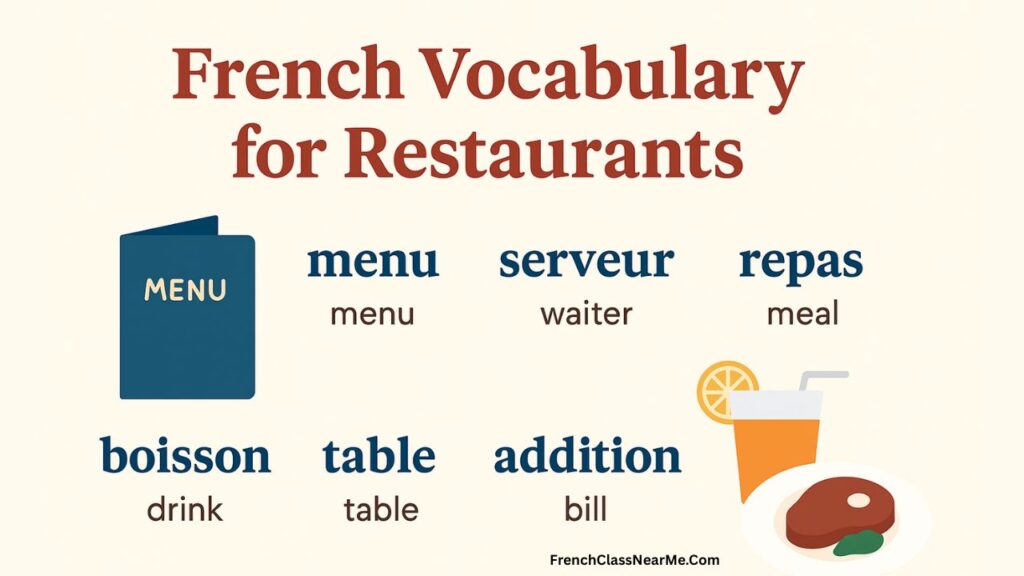
Restaurants are where travelers use the most French. Knowing how to order food, ask for recommendations, and handle the bill makes dining far more enjoyable. Most servers appreciate even small attempts at French, and the experience becomes smoother.
Common Restaurant Vocabulary
| English | French |
|---|---|
| Menu | Le menu / La carte |
| Table | La table |
| Waiter / waitress | Le serveur / la serveuse |
| Water | L’eau |
| Bread | Le pain |
| Starter | L’entrée |
| Main course | Le plat |
| Dessert | Le dessert |
| Bill | L’addition |
Listen To The Audio On Common Restaurant Vocabulary
Useful Restaurant Phrases
| English | French |
|---|---|
| A table for two, please | Une table pour deux, s’il vous plaît |
| I would like… | Je voudrais… |
| What do you recommend? | Que recommandez-vous ? |
| I am allergic to… | Je suis allergique à… |
| Can we have the bill? | L’addition, s’il vous plaît |
| Is service included? | Le service est inclus ? |
| Still or sparkling water? | Plate ou gazeuse ? |
Listen To The Audio On Useful Restaurant Phrases
Restaurant situations often bring small challenges — pronunciation, quick questions from servers, crowded spaces — so memorizing the essentials helps travelers communicate confidently.
Now that dining situations are clear, the next essential travel topic involves getting around by train.
French Vocabulary for Train Stations
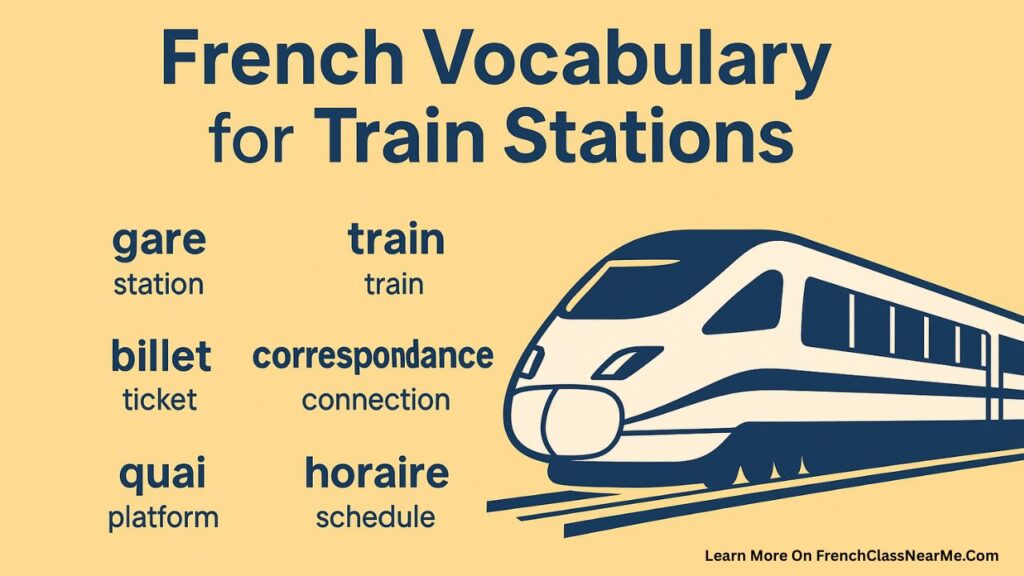
Train travel is an essential part of exploring France, Belgium, Switzerland, and many other French-speaking places. From local metros to long-distance TGV trains, knowing the right vocabulary helps travelers avoid confusion at platforms and ticket machines.
Key Train Station Words
| English | French |
|---|---|
| Train station | La gare |
| Train | Le train |
| Platform | Le quai |
| Ticket | Le billet |
| Seat | La place |
| Schedule | L’horaire |
| One-way ticket | Un aller simple |
| Round trip ticket | Un aller-retour |
| Track number | Le numéro de voie |
Audio On Key Train Station Words Key Train Station Words
Useful Questions at Train Stations
| English | French |
|---|---|
| Where is the platform of this train? | Où est le quai de ce train ? |
| Does this train stop at Lyon? | Ce train s’arrête à Lyon ? |
| When does the next train leave? | Quand part le prochain train ? |
| Is this seat available? | Cette place est libre ? |
| The train is late | Le train est en retard |
Audio On The Useful Questions at Train Stations
French train stations are fast-paced, so knowing these phrases saves time and prevents misunderstandings.
Moving forward, the next major travel category involves asking for and understanding directions — one of the most common situations travelers face.
French Vocabulary for Directions
Asking for and understanding directions is essential for travelers exploring cities like Paris, Nice, Lyon, Geneva, Brussels, or Montreal. Locals appreciate simple, clear language when helping visitors.
Common Words for Directions
| English | French |
|---|---|
| Left | Gauche |
| Right | Droite |
| Straight ahead | Tout droit |
| Near / close | Près |
| Far | Loin |
| Street | La rue |
| Avenue | L’avenue |
| Bridge | Le pont |
| Corner | Le coin |
Audio On Common Words for Directions
Useful Direction Phrases
| English | French |
|---|---|
| How do I get to…? | Comment aller à… ? |
| Where is the metro station? | Où est la station de métro ? |
| Is it far? | C’est loin ? |
| Turn left / right | Tournez à gauche / à droite |
| It’s straight ahead | C’est tout droit |
| I’m lost | Je suis perdu(e) |
Audio On Useful Direction Phrases
Directions are important not just for walking but for using public transportation. With that covered, shopping becomes the next essential travel scenario.
French Vocabulary for Shopping
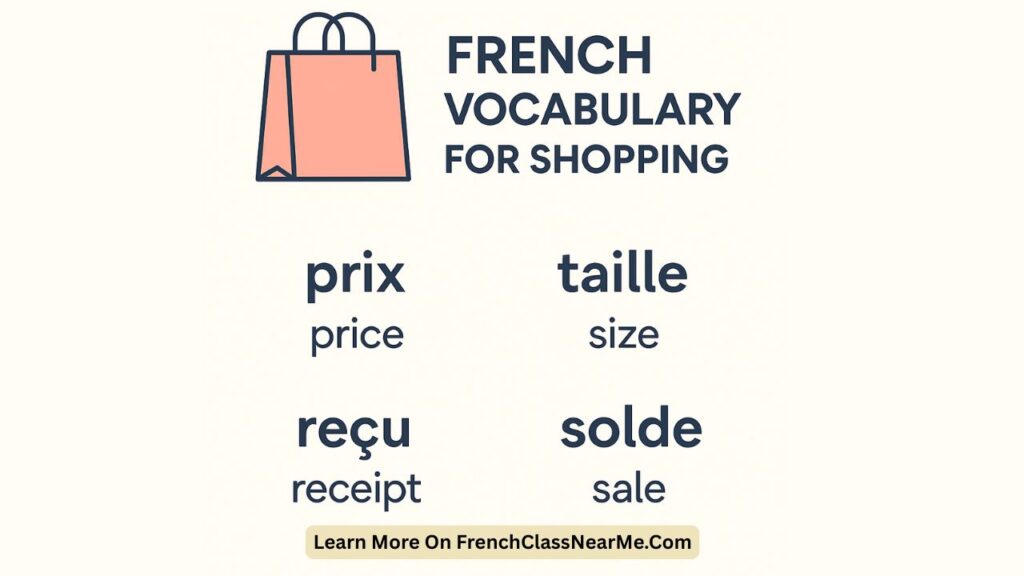
Whether visiting a pastry shop, clothing boutique, market, or souvenir store, shopping vocabulary helps travelers navigate prices, sizes, and polite interactions.
Essential Shopping Words
| English | French |
|---|---|
| Store | Le magasin |
| Market | Le marché |
| Price | Le prix |
| Size | La taille |
| Sale | La promotion / Le solde |
| Receipt | Le reçu |
| Cashier | La caisse |
| Bag | Le sac |
Audio On Essential Shopping Words
Useful Shopping Phrases
| English | French |
|---|---|
| How much is this? | C’est combien ? |
| Do you have this in another size? | Vous avez ceci en une autre taille ? |
| I’m just looking | Je regarde seulement |
| Can I try it on? | Je peux l’essayer ? |
| I’ll take it | Je le prends |
| Do you accept credit cards? | Vous acceptez les cartes de crédit? |
Audio On Useful Shopping Phrases
This vocabulary helps travelers feel confident shopping without needing to switch to English.
After shopping situations, one final essential category remains: emergencies.
French Vocabulary for Emergencies

Travelers never want to think about emergencies, but having a few essential phrases can be extremely helpful in urgent situations.
Emergency Words and Phrases
| English | French |
|---|---|
| Help! | Au secours ! |
| Call the police | Appelez la police |
| I need a doctor | J’ai besoin d’un médecin |
| Pharmacy | La pharmacie |
| I’m hurt | Je suis blessé(e) |
| I lost my passport | J’ai perdu mon passeport |
| It’s an emergency | C’est une urgence |
| Can you help me? | Pouvez-vous m’aider ? |
Audio On Emergency Words and Phrases In French
Emergency Services in Some French-Speaking Countries
| Country | Emergency Number |
|---|---|
| France | 112 or 15 |
| Belgium | 112 |
| Switzerland | 112 |
| Canada (Quebec) | 911 |
Emergency Services in Some French-Speaking Countries
Now that the essential travel situations have been covered in depth, let’s learn some specialized travel vocabulary and natural-sounding example sentences.
Additional Vocabulary for Real Travel Situations
French travel experiences extend far beyond airports, hotels, restaurants, trains, directions, shopping, and emergencies. Travelers often find themselves navigating new neighborhoods, ordering coffee in local cafés, exploring museums, renting bikes, using public transportation, and asking for everyday services. Being prepared with specialized vocabulary makes each moment feel easier and more enjoyable.
Now that the core vocabulary has been explored, it’s helpful to look at more real-world situations travelers encounter.
French Vocabulary for Cafés and Bakeries
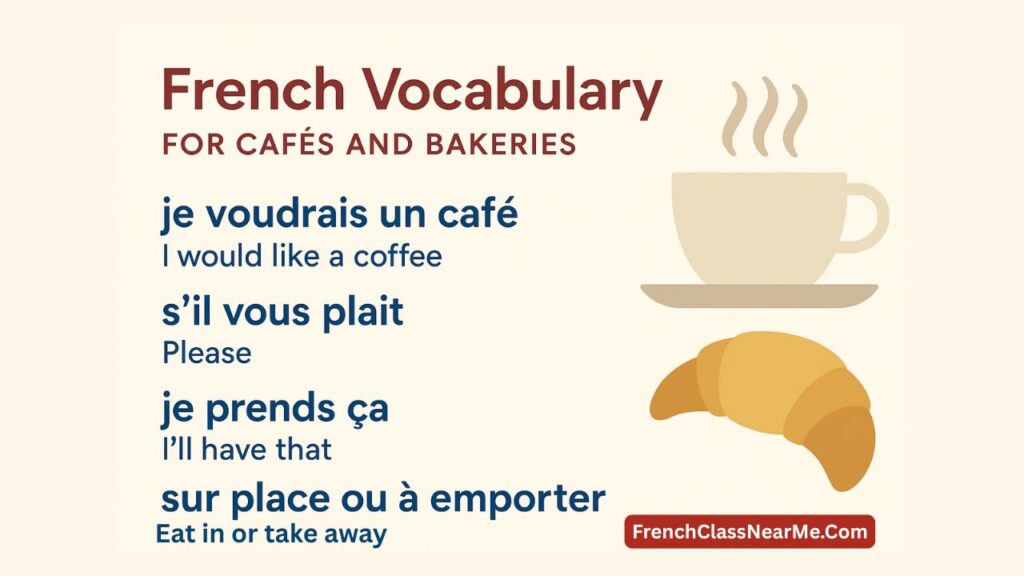
Cafés and bakeries are central to French-speaking cultures. These are often the first places travelers visit each morning, making café vocabulary essential for ordering food confidently.
Useful Words for Cafés
| English | French |
|---|---|
| Coffee | Le café |
| Cappuccino | Le cappuccino |
| Latte | Le latte |
| Tea | Le thé |
| Milk | Le lait |
| Sugar | Le sucre |
| Croissant | Le croissant |
| Chocolate bread | Le pain au chocolat |
| Sandwich | Le sandwich |
| To take away | À emporter |
Audio Useful Words for Cafés In French
Example Phrases for Ordering
| English | French |
|---|---|
| I would like a coffee, please | Je voudrais un café, s’il vous plaît |
| A croissant and an orange juice | Un croissant et un jus d’orange |
| Is there a menu? | Il y a un menu ? |
| eat in or to take away? | Sur place ou à emporter ? |
| I’ll take this | Je prends ça |
Cafés are ideal places to practice French because interactions are short, simple, and friendly.
Audio For Example Phrases for Ordering In A Café
In short, mastering this vocabulary helps travelers start their mornings with confidence. Moving forward, the next category explores museums and sightseeing.
French Vocabulary for Museums and Sightseeing
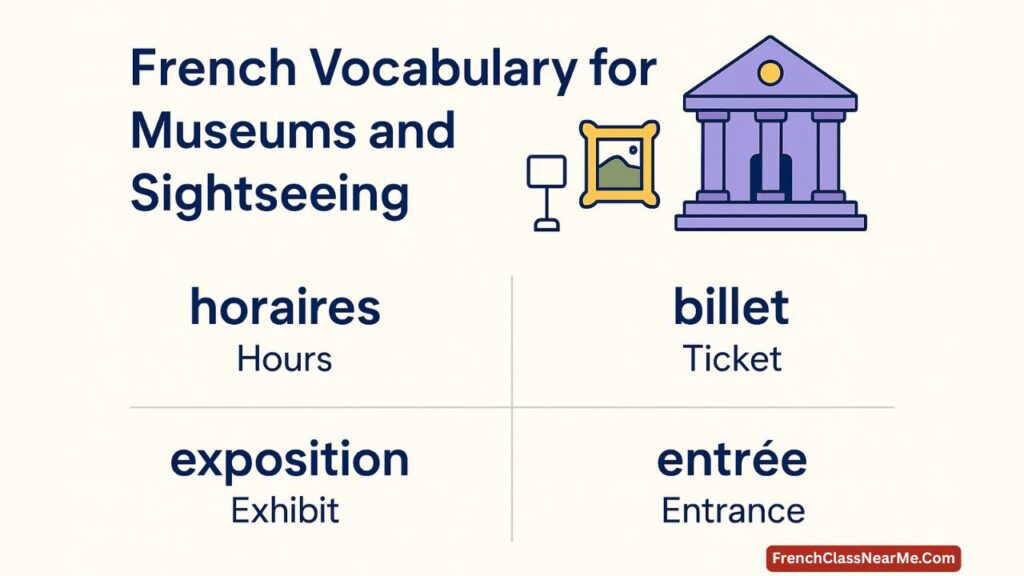
Museums are rich cultural spaces where travelers interact with staff, buy tickets, ask for directions, and explore exhibits. Knowing basic French helps avoid confusion and enhances the experience.
Common Museum Words
| English | French |
|---|---|
| Museum | Le musée |
| Ticket | Le billet |
| Exhibition | L’exposition |
| Audio guide | L’audioguide |
| Opening hours | Les horaires |
| Entrance | L’entrée |
| Exit | La sortie |
| Map | Le plan |
Audio For Common Museum Words In French
Useful Phrases for Museums
| English | French |
|---|---|
| Where is the entrance? | Où est l’entrée ? |
| How much is a ticket? | C’est combien pour un billet ? |
| Is there an audio guide? | Il y a un audioguide ? |
| Where is the restroom? | Où sont les toilettes ? |
| What time does it close? | Ça ferme à quelle heure ? |
Museums often use simple language on signs, which helps travelers navigate even if their French is basic.
That brings us to another daily necessity — transportation.
French Vocabulary for Public Transportation
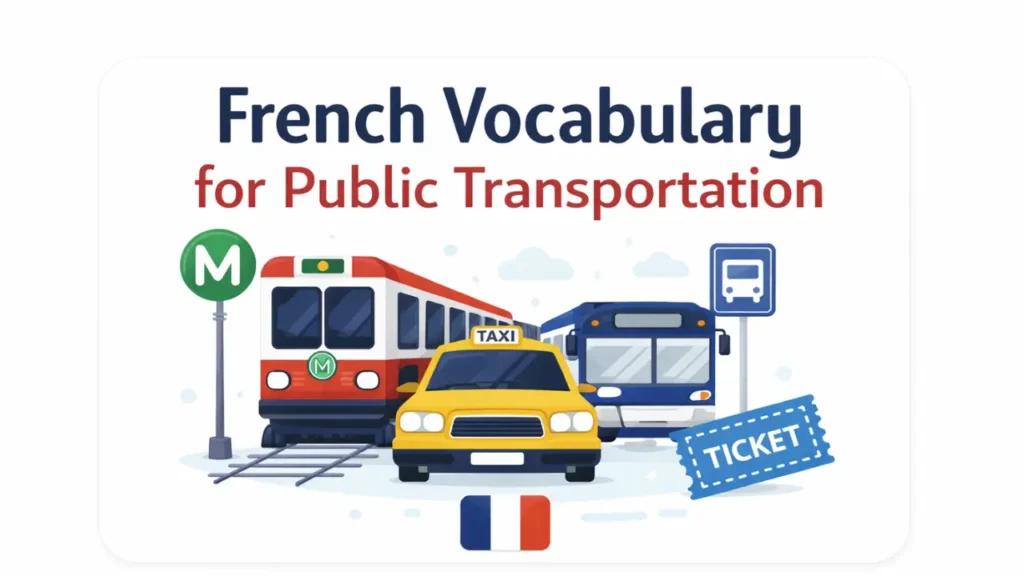
Buses, metros, trams, and taxis form an essential part of travel in France and other French-speaking places. Vocabulary related to transportation ensures smooth movement across cities.
Transportation Words
| English | French |
|---|---|
| Metro | Le métro |
| Bus | Le bus |
| Tram | Le tram |
| Taxi | Le taxi |
| Ticket | Le ticket |
| Subway line | La ligne de métro |
| Transfer | La correspondance |
| Stop | L’arrêt |
Audio For French Vocabulary for Transportation Words
Useful Phrases for Transportation
| English | French |
|---|---|
| Which line goes to…? | Quelle ligne va à… ? |
| Where can I buy tickets? | Où puis-je acheter des tickets ? |
| Does this bus go to the center? | Ce bus va au centre ? |
| I need a ticket | J’ai besoin d’un ticket |
| I want a day pass | Je veux un pass journée |
Public transportation signs in French cities usually include icons, making navigation easier once the basic vocabulary is familiar.
With transit covered, it becomes easier to explore local services.
French Vocabulary for Everyday Services
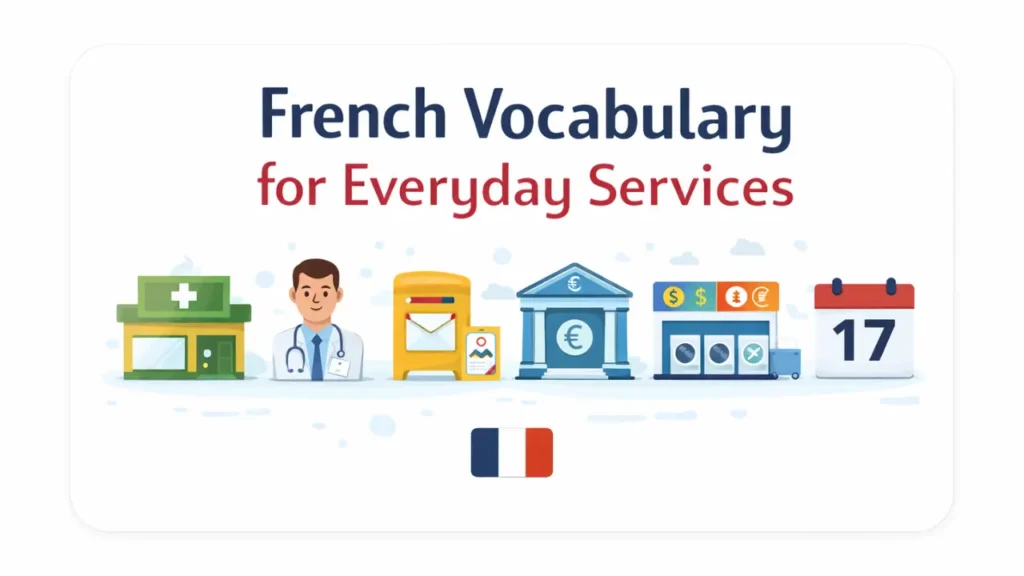
Travelers frequently need services such as postal offices, pharmacies, laundromats, and banks. Simple vocabulary ensures smooth communication.
Useful Service Words
| English | French |
|---|---|
| Pharmacy | La pharmacie |
| Doctor | Le médecin |
| Post office | La poste |
| Stamp | Le timbre |
| Bank | La banque |
| Currency exchange | Le bureau de change |
| Laundromat | La laverie |
| Appointment | Le rendez-vous |
Helpful Phrases
| English | French |
|---|---|
| I need stamps | J’ai besoin de timbres |
| Where is the pharmacy? | Où est la pharmacie ? |
| Can I exchange money here? | Je peux changer de l’argent ici ? |
| I need an appointment | J’ai besoin d’un rendez-vous |
| Is there a laundromat nearby? | Il y a une laverie près d’ici ? |
These phrases can be especially important when traveling for several days or weeks.
With everyday services understood, the next step is exploring places and activities.
French Vocabulary for Visiting Cities and Attractions
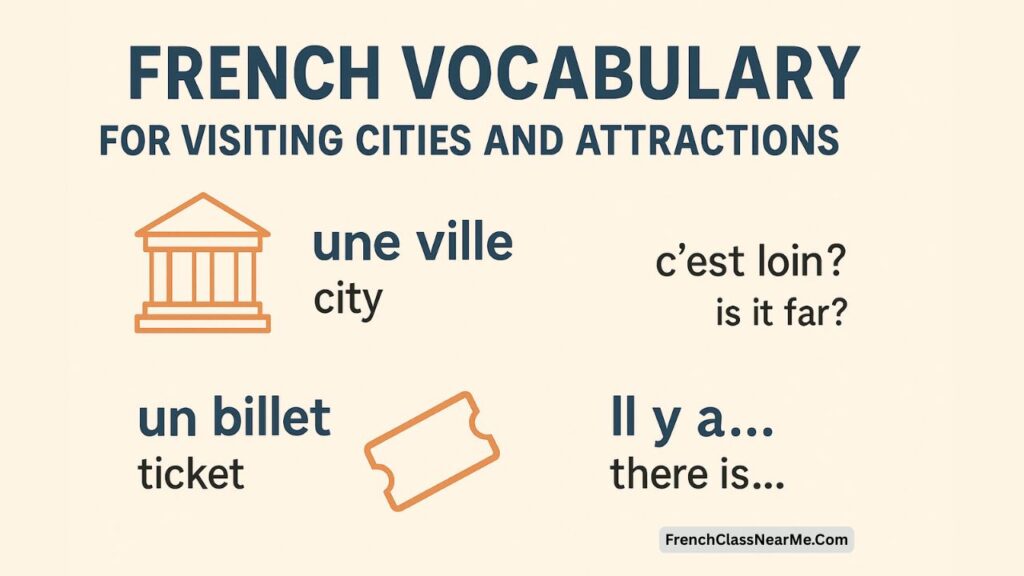
When visiting new cities, travelers often look for landmarks, parks, monuments, and other attractions. Knowing basic French helps ask questions with confidence.
Common Destination Words
| English | French |
|---|---|
| Park | Le parc |
| Beach | La plage |
| Bridge | Le pont |
| Castle | Le château |
| Monument | Le monument |
| City center | Le centre-ville |
| Neighborhood | Le quartier |
| Cathedral | La cathédrale |
Useful Phrases for Sightseeing
| English | French |
|---|---|
| Where is the city center? | Où est le centre-ville ? |
| Is it open today? | C’est ouvert aujourd’hui ? |
| How do I get there? | Comment y aller ? |
| Is it far from here? | C’est loin d’ici ? |
| Is there an entrance fee? | Il y a un prix d’entrée ? |
These phrases help travelers feel comfortable exploring cities without relying completely on English.
Now that sightseeing vocabulary is established, it is helpful to integrate real-life sample dialogues.
Real-Life Mini Dialogues for Travel Situations
Real conversations bring vocabulary to life. These short dialogues demonstrate how phrases sound in everyday travel moments.
Dialogue: Ordering at a Café
Customer: Bonjour, un café et un croissant, s’il vous plaît.
Server: Bien sûr. Sur place ou à emporter ?
Customer: Sur place, merci.
Server: Ça arrive tout de suite.
Dialogue: At a Hotel Reception
Traveler: Bonjour, j’ai une réservation au nom de Martin.
Receptionist: Oui, je la vois. Vous restez combien de nuits ?
Traveler: Trois nuits.
Receptionist: Parfait, voici votre clé. Le petit-déjeuner est au rez-de-chaussée.
Dialogue: Asking for Directions
Traveler: Excusez-moi, comment aller au musée ?
Local: Tournez à droite, puis allez tout droit.
Traveler: Merci beaucoup.
Local: Avec plaisir.
Dialogue: Buying Train Tickets
Traveler: Bonjour, un aller-retour pour Lyon, s’il vous plaît.
Agent: À quelle heure ?
Traveler: Le prochain train, s’il vous plaît.
Agent: Voilà vos billets. Le train part du quai 6.
These examples give travelers a realistic sense of what French interactions sound like.
In short, combining vocabulary with sample dialogues creates a complete foundation for practical communication. With that said, a deeper look at polite expressions helps travelers sound friendly and respectful.
French Etiquette Phrases Travelers Should Know
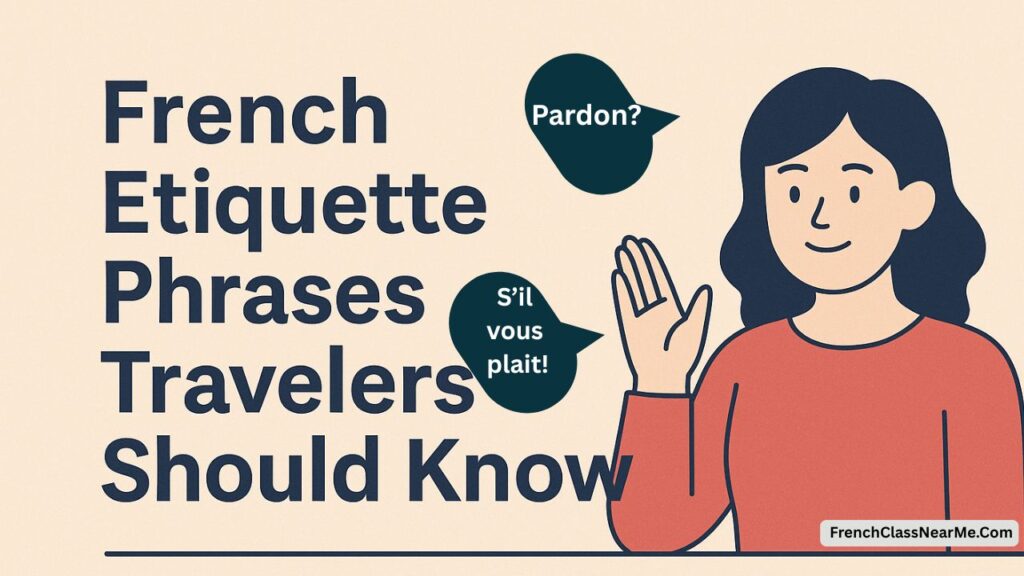
French-speaking cultures value politeness and small gestures of respect. Even short phrases can create a positive impression.
Useful Etiquette Expressions
| English | French |
|---|---|
| Please | S’il vous plaît |
| Thank you very much | Merci beaucoup |
| Sorry | Désolé(e) |
| After you | Après vous |
| Have a good day | Bonne journée |
| Enjoy your meal | Bon appétit |
| Excuse me for asking | Excusez-moi de demander |
| I’m not from here | Je ne suis pas d’ici |
These expressions help travelers build rapport effortlessly.
Moving forward, one more specialized category helps ensure complete preparation: handling unexpected travel challenges.
Extra Vocabulary for Travel Problems

Travel rarely goes perfectly. Travelers may face issues with reservations, transportation, or communication. Having clear French phrases reduces stress in these moments.
Common Travel Problems
| English | French |
|---|---|
| I missed my train | J’ai raté mon train |
| My hotel room is not ready | Ma chambre n’est pas prête |
| My phone doesn’t work | Mon téléphone ne fonctionne pas |
| I lost my wallet | J’ai perdu mon portefeuille |
| I cannot find this address | Je ne trouve pas cette adresse |
| There is a mistake | Il y a une erreur |
| I need help | J’ai besoin d’aide |
Useful Problem-Solving Phrases
| English | French |
|---|---|
| Can you repeat, please? | Pouvez-vous répéter, s’il vous plaît ? |
| Can you speak more slowly? | Pouvez-vous parler plus lentement ? |
| I don’t know what to do | Je ne sais pas quoi faire |
| I need information | J’ai besoin d’informations |
| Where is the nearest police station? | Où est le commissariat le plus proche ? |
Knowing these phrases provides reassurance during unpredictable moments.
Now that the expanded travel vocabulary has been covered in depth, the article continues with the FAQs and conclusion.
FAQs About French Vocabulary for Travel
What are the most important French words to learn before traveling?
The most important French words for travel are basic greetings, polite expressions, numbers, and directional terms. Words like bonjour, merci, s’il vous plaît, gauche, droite, and combien make navigating daily interactions easier. Travelers also benefit from learning menu terms, hotel phrases, and transportation vocabulary because these situations appear frequently throughout a trip.
How can beginners memorize French travel vocabulary quickly?
Beginners memorize faster by grouping words into categories such as airports, hotels, restaurants, and directions. Reviewing short word lists daily, practicing with flashcards, and repeating vocabulary aloud helps retention. Using the words during real or simulated situations, like ordering food or asking for directions, strengthens memory by creating practical associations.
Is French necessary when visiting Paris or other big cities?
French is not mandatory in large cities, but it makes the experience far more enjoyable. Locals appreciate even simple attempts, and communication becomes smoother in restaurants, shops, train stations, and less touristy areas. Knowing essential phrases can also reduce misunderstandings and gives travelers more confidence while navigating transportation systems or handling unexpected situations.
What French phrases are most useful in restaurants?
Useful restaurant phrases include je voudrais…, l’addition s’il vous plaît, and que recommandez-vous ? These help with ordering, requesting the bill, and asking for recommendations. Understanding terms such as entrée, plat, dessert, and boisson helps travelers read menus more easily. Simple politeness like bon appétit and merci creates friendly interactions with servers.
How do I ask for help in French during emergencies?
In emergencies, clear phrases work best. Travelers can say au secours for urgent help, j’ai besoin d’un médecin for medical needs, and appelez la police when contacting law enforcement is necessary. Knowing how to explain lost items, injuries, or urgent issues provides reassurance. Emergency numbers also vary by country, so learning the local number is useful.
What French words help with shopping while traveling?
Shopping vocabulary includes prix, taille, reçu, sac, and promotion. These cover price, size, receipt, bag, and sale. Travelers can use c’est combien to ask the cost, je regarde seulement when browsing, and je peux l’essayer to try on clothing. These phrases make shopping easier in markets, boutiques, and larger retail stores.
How can travelers politely ask locals for directions in French?
Politeness matters, so starting with excusez-moi helps. Asking comment aller à… followed by the destination works for most situations. Travelers should also understand responses like tournez à gauche, tout droit, and c’est loin. Locals often appreciate patience and willingness to listen, even if the traveler speaks slowly or imperfectly.
What French phrases help at hotels?
Hotel phrases include j’ai une réservation for check-in, le Wi-Fi ne fonctionne pas for technical problems, and à quelle heure est le départ for checkout times. Travelers often ask about breakfast, room amenities, or payment. Using simple, clear language in hotels keeps communication smooth and avoids confusion during busy moments at reception.
How do I explain that I don’t speak French well?
Travelers can say je parle un peu français or je ne parle pas bien français. These phrases set expectations and encourage locals to speak slowly or switch to simpler language. Adding pouvez-vous parler lentement helps guide the conversation. Most people respond kindly when travelers make an effort while acknowledging their limits.
What transportation vocabulary should travelers know?
Transportation vocabulary includes métro, bus, train, billet, correspondance, and arrêt. These help with understanding signs, navigating stations, buying tickets, and finding platforms. Travelers also benefit from learning ligne for subway lines and aller-retour for round trips. Using simple questions helps clarify routes when unfamiliar with the transit network.
How can travelers ask for the price of something in French?
The most common phrase is c’est combien ? This works for products, tickets, and services. Travelers can also say quel est le prix ? in more formal settings. Understanding numbers in French makes it easier to interpret prices. If confused, pointing to the item while repeating the phrase helps avoid misunderstandings.
What French phrases help at train stations?
At train stations, useful phrases include où est le quai ? for locating platforms and quand part le prochain train ? for asking departure times. Travelers can also ask ce train s’arrête à… to confirm stops. Knowing basic terms like billet, place, and aller simple helps navigate ticket purchases and boarding procedures.
Is French vocabulary different in Canada, Switzerland, or Belgium?
French vocabulary varies slightly across French-speaking regions, especially in Canada. For example, dépanneur means convenience store in Quebec, and billet may appear as ticket in France. While pronunciation and expressions may differ, core travel vocabulary remains widely understood. Learning standard French ensures smooth communication in all regions.
How can travelers practice French before a trip?
Travelers can practice by watching French videos, using flashcards, listening to travel dialogues, and rehearsing common phrases aloud. Engaging with authentic content, such as café menus or train signs, builds familiarity. Practicing with a native speaker or through audio-based lessons improves pronunciation and listening comprehension for real travel situations.
What French phrases help in cafés and bakeries?
Café phrases include je voudrais un café, s’il vous plaît and je prends ça when ordering quickly. Vocabulary such as croissant, pain au chocolat, jus d’orange, and sur place ou à emporter helps navigate typical interactions. Cafés are excellent places for travelers to practice short, friendly exchanges without pressure.
How can travelers order confidently in French restaurants?
Ordering confidently involves using je voudrais followed by the dish or drink. Asking que recommandez-vous invites suggestions. Travelers can clarify allergies by saying je suis allergique à… and request the bill using l’addition s’il vous plaît. Understanding menu sections like entrée, plat, and dessert also improves the experience.
What French words help in pharmacies and medical situations?
Common medical vocabulary includes la pharmacie, le médecin, la douleur, blessé(e), and ordonnance. Travelers can say j’ai besoin d’un médecin for urgent needs or j’ai mal ici while pointing to the injury. Pharmacies in French-speaking countries usually provide reliable assistance, especially when travelers explain symptoms clearly.
How can travelers avoid misunderstandings when speaking French?
Avoiding misunderstandings starts with speaking slowly, using simple vocabulary, and confirming details when unsure. Travelers can ask pouvez-vous répéter or pouvez-vous parler lentement for clarity. Gestures, pointing, and written information also help bridge communication gaps. Staying calm and friendly encourages locals to assist more patiently.
What French vocabulary helps with booking activities or excursions?
Useful terms include réservation, horaire, tarif, guide, and groupe. Travelers can ask est-ce disponible aujourd’hui ? when checking availability or combien de temps ça dure ? to inquire about duration. These phrases apply to tours, boat rides, museum experiences, or outdoor excursions, making activity planning much smoother.
How do I talk about transportation delays or issues in French?
Travelers often encounter issues like delays or cancellations. Phrases such as le train est en retard, le vol est annulé, or j’ai raté mon bus help describe problems. Asking que dois-je faire maintenant ? assists in understanding next steps. Staff members typically guide travelers once the situation is clearly communicated.
What French phrases help in post offices or banks during travel?
At post offices, travelers use j’ai besoin de timbres for stamps or où est la boîte aux lettres ? for mailboxes. At banks, vocabulary like retirer de l’argent, distributeur, and bureau de change helps with withdrawals and currency exchange. Speaking clearly and showing documents makes these interactions easier.
How can travelers sound more polite when speaking French?
Politeness comes from tone and word choice. Starting requests with excusez-moi and adding s’il vous plaît shows respect. Expressing gratitude with merci beaucoup or je vous remercie helps create positive interactions. Even limited French becomes more effective when paired with polite phrases and a friendly attitude.
What French vocabulary helps in taxis or ride services?
Taxi vocabulary includes l’adresse, le tarif, le compteur, and l’aéroport. Travelers can say vous pouvez m’emmener à… to request a destination or c’est loin d’ici ? to ask about distance. Understanding comment payer helps finalize the ride. These simple terms make navigating cities by taxi much more manageable.
How can travelers ask for recommendations in French?
Asking for suggestions is easy with phrases like que recommandez-vous ? or qu’est-ce que vous conseillez ? Locals often enjoy recommending restaurants, museums, or hidden spots. Travelers can also ask y a-t-il quelque chose à voir près d’ici ? when exploring new areas. These questions help create friendly conversations.
What French phrases help when checking into hotels?
Check-in becomes easier with j’ai une réservation, je voudrais m’enregistrer, or à quelle heure est le départ ? Travelers can request amenities using j’ai besoin de… and ask about breakfast with le petit-déjeuner est inclus ? Communicating room concerns politely ensures quicker assistance from hotel staff.
How do I handle mistakes in French conversations while traveling?
Mistakes are normal. Travelers can say désolé(e), je me suis trompé(e) to correct themselves or je voulais dire… to clarify. Locals usually appreciate the effort. Resetting the sentence slowly and using gestures helps redirect the conversation. Confidence grows with practice, and mistakes become less frequent over time.
What French vocabulary helps with renting bikes or scooters?
Bike rentals use terms like vélo, trottinette, casque, and location. Asking combien ça coûte ? helps determine price, while je veux le louer pour une heure clarifies duration. Travelers can also ask où est la station la plus proche ? for drop-off points. This vocabulary fits both city rentals and tourist areas.
What French words help for checking museum hours or buying tickets?
Key words include horaires, billet, tarif, exposition, entrée, and sortie. Travelers can ask c’est ouvert aujourd’hui ? or à quelle heure ça ferme ? These phrases work across museums, monuments, and attractions. Knowing this vocabulary helps avoid long lines or missed visits due to closing times.
Which French phrases help travelers feel more confident overall?
Confidence grows with small, dependable phrases like je voudrais…, excusez-moi, c’est où ?, and merci beaucoup. Using them consistently builds comfort. Travelers also benefit from repeating je parle un peu français to set expectations. Engaging with locals politely and practicing short phrases daily strengthens confidence in real travel settings.
Conclusion
Knowing French Vocabulary for Travel transforms a trip into a more meaningful experience. Even a basic understanding of airport terms, hotel phrases, restaurant vocabulary, transportation expressions, and emergency language helps travelers move with ease. These phrases not only simplify daily tasks but also create genuine moments of connection with local people. Speaking a little French shows respect for the culture, opens new possibilities, and makes every experience richer. With a solid vocabulary foundation and a bit of practice, traveling through French-speaking destinations becomes smoother, more enjoyable, and far more memorable.


)