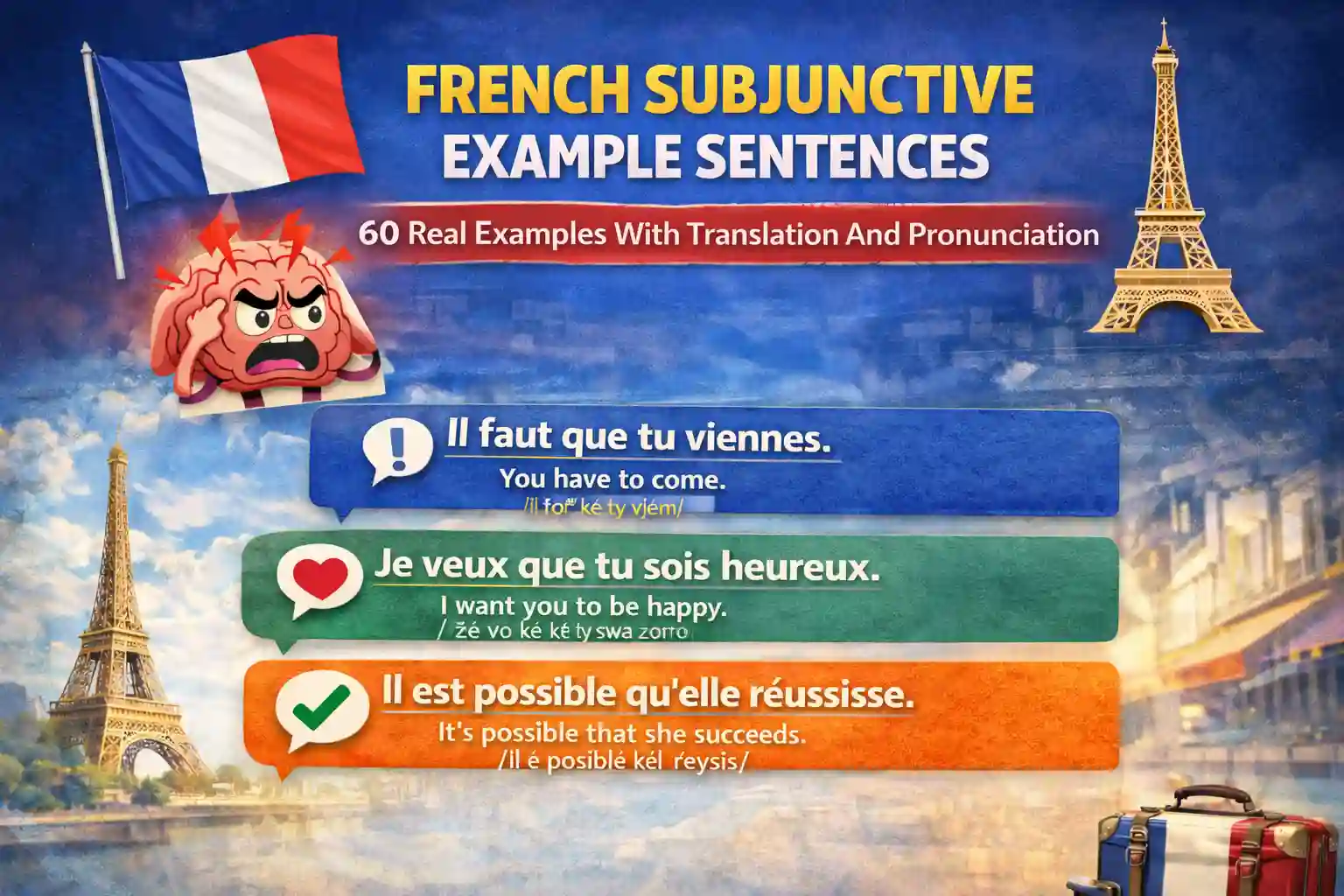
If you want to truly understand how the subjunctive works, studying French subjunctive example sentences will be extremely helpful. Grammar explanations alone rarely make the structure clear. However, when you see the subjunctive used in real sentences, the pattern becomes much easier to recognize.
If you are new to French subjunctive, you may want to start with our complete guide to French Subjunctive: Complete Guide For Beginners.
In this guide, you will explore a wide range of French subjunctive example sentences organized by common situations such as necessity, emotion, doubt, purpose, conjunctions, and everyday communication. Each sentence includes a transliteration and an English translation to make the structure easier for beginners to understand.
French Subjunctive Example Sentences Showing Necessity
Many subjunctive sentences appear when the speaker expresses necessity or obligation.
Example Sentences With “Il Faut Que”
Example
Il faut que tu viennes.
(eel foh kuh tu vyenn)
You must come.
Example
Il faut que nous partions maintenant.
(eel foh kuh noo par-tee-yon man-teh-nahn)
We must leave now.
Example
Il faut que vous finissiez ce travail.
(eel foh kuh voo fee-nee-see-ay suh tra-vye)
You must finish this work.
Example
Il faut que je fasse attention.
(eel foh kuh zhuh fass ah-tan-syon)
I must be careful.
Example
Il faut qu’ils arrivent tôt.
(eel foh keel zah-reev toh)
They must arrive early.
Example Sentences With “Il Est Important Que”
Example
Il est important que tu comprennes la règle.
(eel eh tan-por-tahn kuh tu kom-pren lah regl)
It is important that you understand the rule.
Example
Il est important que nous soyons prêts.
(eel eh tan-por-tahn kuh noo swa-yon pray)
It is important that we be ready.
Example
Il est important que les élèves étudient régulièrement.
(eel eh tan-por-tahn kuh lay zay-lev ay-tu-dee ray-gyoo-lyair-mon)
It is important that the students study regularly.
Example
Il est important que vous écoutiez attentivement.
(eel eh tan-por-tahn kuh voo ay-koo-tyay ah-tan-tee-vmon)
It is important that you listen carefully.
Example
Il est important qu’elle prenne une décision.
(eel eh tan-por-tahn kel prenn oon day-see-zyon)
It is important that she make a decision.
French Subjunctive Example Sentences Expressing Emotion
The subjunctive frequently appears when the speaker expresses feelings.
Example Sentences With “Je Suis Heureux Que”
Example
Je suis heureux que tu sois ici.
(zhuh swee uh-ruh kuh tu swah ee-see)
I am happy that you are here.
Example
Je suis heureux que vous veniez à la réunion.
(zhuh swee uh-ruh kuh voo veh-nye ah lah ray-u-nyon)
I am happy that you come to the meeting.
Example
Je suis heureux que nous soyons ensemble.
(zhuh swee uh-ruh kuh noo swa-yon ahn-sombl)
I am happy that we are together.
Example
Je suis heureux qu’elle réussisse.
(zhuh swee uh-ruh kel ray-oo-seess)
I am happy that she succeeds.
Example Sentences With “Je Suis Triste Que”
Example
Je suis triste qu’il parte.
(zhuh swee treest keel part)
I am sad that he leaves.
Example
Je suis triste que tu ne comprennes pas.
(zhuh swee treest kuh tu nuh kom-pren pah)
I am sad that you do not understand.
Example
Je suis triste que nous ne puissions pas venir.
(zhuh swee treest kuh noo nuh pwee-syon pah vuh-neer)
I am sad that we cannot come.
Example
Je suis triste qu’elle parte si tôt.
(zhuh swee treest kel part see toh)
I am sad that she leaves so early.
Example Sentences With “Je Regrette Que”
Example
Je regrette que tu ne viennes pas.
(zhuh ruh-gret kuh tu nuh vyenn pah)
I regret that you are not coming.
Example
Je regrette qu’ils partent si tôt.
(zhuh ruh-gret keel part see toh)
I regret that they leave so early.
Example
Je regrette que nous ayons si peu de temps.
(zhuh ruh-gret kuh noo zay-yon see puh duh tan)
I regret that we have so little time.
Example
Je regrette qu’elle ne puisse pas rester.
(zhuh ruh-gret kel nuh pweess pah res-tay)
I regret that she cannot stay.
French Subjunctive Example Sentences Showing Doubt
Expressions of doubt often trigger the subjunctive.
Example Sentences With “Je Doute Que”
Example
Je doute qu’il comprenne la situation.
(zhuh doot keel kom-pren lah see-tu-ah-syon)
I doubt that he understands the situation.
Example
Je doute qu’elle réussisse.
(zhuh doot kel ray-oo-seess)
I doubt that she succeeds.
Example
Je doute que nous ayons assez de temps.
(zhuh doot kuh noo zay-yon ah-say duh tan)
I doubt that we have enough time.
Example
Je doute qu’ils sachent la vérité.
(zhuh doot keel sash lah vay-ree-tay)
I doubt that they know the truth.
Example Sentences With “Je Ne Crois Pas Que”
Example
Je ne crois pas qu’il vienne aujourd’hui.
(zhuh nuh krwar pah keel vyenn oh-zhoor-dwee)
I do not believe that he is coming today.
Example
Je ne crois pas qu’ils soient prêts.
(zhuh nuh krwar pah keel swah pray)
I do not believe that they are ready.
Example
Je ne crois pas qu’elle comprenne le problème.
(zhuh nuh krwar pah kel kom-pren luh pro-blem)
I do not believe that she understands the problem.
Example
Je ne crois pas que nous puissions terminer à temps.
(zhuh nuh krwar pah kuh noo pwee-syon ter-mee-nay ah tan)
I do not believe that we can finish on time.
Example Sentences With “Il Est Possible Que”
Example
Il est possible qu’il pleuve demain.
(eel eh poh-seebl keel pluv duh-man)
It is possible that it rains tomorrow.
Example
Il est possible que nous arrivions tard.
(eel eh poh-seebl kuh noo zah-ree-vee-yon tar)
It is possible that we arrive late.
Example
Il est possible qu’elle oublie la réunion.
(eel eh poh-seebl kel oo-blee lah ray-u-nyon)
It is possible that she forgets the meeting.
Example
Il est possible qu’ils viennent ce soir.
(eel eh poh-seebl keel vyenn suh swar)
It is possible that they come tonight.
French Subjunctive Example Sentences With Purpose
The subjunctive also appears when the speaker describes purpose or intention.
Example Sentences With “Pour Que”
Example
Je travaille pour que tu réussisses.
(zhuh tra-vye poor kuh tu ray-oo-seess)
I work so that you succeed.
Example
Elle explique la leçon pour que nous comprenions.
(el eks-pleek lah luh-son poor kuh noo kom-pre-nyon)
She explains the lesson so that we understand.
Example
Je répète la phrase pour que tu entendes bien.
(zhuh ray-payt lah fraz poor kuh tu ahn-tand byen)
I repeat the sentence so that you hear clearly.
Example
Nous parlons lentement pour que tout le monde comprenne.
(noo par-lon lon-teh-mon poor kuh too luh mond kom-pren)
We speak slowly so that everyone understands.
Example Sentences With “Afin Que”
Example
Il parle lentement afin que tout le monde comprenne.
(eel parl lon-teh-mon ah-fan kuh too luh mond kom-pren)
He speaks slowly so that everyone understands.
Example
Nous répétons la phrase afin que vous la reteniez.
(noo ray-pay-ton lah fraz ah-fan kuh voo lah ruh-tuh-nye)
We repeat the sentence so that you remember it.
Example
Elle écrit le message afin que tout soit clair.
(el ay-kree luh mes-saj ah-fan kuh too swah clair)
She writes the message so that everything is clear.
Example
Ils expliquent la règle afin que les élèves comprennent.
(eel eks-pleek lah regl ah-fan kuh lay zay-lev kom-pren)
They explain the rule so that the students understand.
French Subjunctive Example Sentences With Conjunctions
Certain conjunctions almost always require the subjunctive.
Example Sentences With “Bien Que”
Example
Bien qu’il soit fatigué, il continue de travailler.
(byen keel swah fa-tee-gay eel kon-tee-new duh tra-vye)
Although he is tired, he continues to work.
Example
Bien que nous ayons peu de temps, nous finirons.
(byen kuh noo zay-yon puh duh tan noo fee-nee-ron)
Although we have little time, we will finish.
Example
Bien qu’elle soit malade, elle travaille.
(byen kel swah mah-lad el tra-vye)
Although she is sick, she works.
Example
Bien qu’ils soient jeunes, ils sont très talentueux.
(byen keel swah zhuhn eel son tray ta-lan-too-uh)
Although they are young, they are very talented.
Example Sentences With “Avant Que”
Example
Partons avant qu’il arrive.
(par-ton ah-van keel ah-reev)
Let’s leave before he arrives.
Example
Ferme la porte avant que le chien sorte.
(ferm lah port ah-van kuh luh shyen sort)
Close the door before the dog goes out.
Example
Je veux partir avant que la pluie commence.
(zhuh vuh par-teer ah-van kuh lah plwee ko-monss)
I want to leave before the rain begins.
Example
Finissons le travail avant qu’il soit trop tard.
(fee-nee-son luh tra-vye ah-van keel swah troh tar)
Let’s finish the work before it is too late.
Example Sentences With “À Condition Que”
Example
Tu peux sortir à condition que tu finisses tes devoirs.
(tu puh sor-teer ah kon-dee-syon kuh tu fee-nee-ss tay duh-vwar)
You can go out provided that you finish your homework.
Example
Nous partirons à condition que tout soit prêt.
(noo par-tee-ron ah kon-dee-syon kuh too swah pray)
We will leave provided that everything is ready.
Example
Je t’aide à condition que tu travailles sérieusement.
(zhuh ted ah kon-dee-syon kuh tu tra-vye say-ree-uhz-mon)
I help you provided that you work seriously.
Example
Ils acceptent à condition que nous respections les règles.
(eel zak-sept ah kon-dee-syon kuh noo res-pek-tyon lay regl)
They accept provided that we respect the rules.
French Subjunctive Example Sentences In Everyday Situations
The subjunctive appears regularly in daily conversations.
Example
Je veux que tu sois honnête.
(zhuh vuh kuh tu swah on-net)
I want you to be honest.
Example
Je préfère que nous partions tôt.
(zhuh pray-fair kuh noo par-tee-yon toh)
I prefer that we leave early.
Example
Il faut que tu fasses attention.
(eel foh kuh tu fass ah-tan-syon)
You must be careful.
Example
Je suis content que vous soyez ici.
(zhuh swee kon-tahn kuh voo swah ee-see)
I am happy that you are here.
Example
Je veux qu’il comprenne la vérité.
(zhuh vuh keel kom-pren lah vay-ree-tay)
I want him to understand the truth.
Example
Je veux que tu fasses de ton mieux.
(zhuh vuh kuh tu fass duh ton myuh)
I want you to do your best.
Tips For Practicing French Subjunctive Sentences
Seeing French subjunctive example sentences is helpful, but practicing them actively makes an even bigger difference.
You can strengthen your understanding by:
- reading French texts and noticing subjunctive triggers
- repeating sentences aloud to become familiar with pronunciation
- writing your own sentences using common expressions such as il faut que, je veux que, or je doute que
With regular exposure, recognizing the subjunctive becomes automatic.
Conclusion
Studying French subjunctive example sentences helps you see how this grammatical mood functions in real communication. Instead of focusing only on rules, you begin to notice patterns that appear naturally in everyday French.
As you continue practicing sentences that express emotion, doubt, necessity, and purpose, the subjunctive will gradually become easier to recognize and use. Over time, these structures will feel natural, helping you speak and understand French with greater confidence.