If you already know when the subjunctive appears, the next step is learning how to form it correctly. Many learners initially find French subjunctive conjugation intimidating, but the truth is that most verbs follow a predictable pattern. Once you understand the endings and the formation method, conjugating the French subjunctive becomes much easier.
If you are new to French subjunctive, you may want to start with our complete guide to French Subjunctive: Complete Guide For Beginners.
In this guide, you will learn how French subjunctive conjugation works, the endings used for regular verbs, the step-by-step method for forming the tense, and several examples with translations and transliterations to make the process clear.
By the end of this article, you will understand how to build the French subjunctive for most verbs and recognize its forms in real sentences.
What Is French Subjunctive Conjugation
French subjunctive conjugation refers to the process of modifying a verb so that it reflects the subjunctive mood rather than the indicative mood.
Unlike the indicative, which describes facts, the subjunctive expresses uncertainty, emotions, wishes, or necessity. Because of this, verbs in the subjunctive take different endings.
The subjunctive is most often used in subordinate clauses introduced by que.
Example
Je veux que tu viennes.
(zhuh vuh kuh tu vyenn)
I want you to come.
The verb viennes is the subjunctive form of venir.
The important idea here is that the subjunctive does not change the time of the action but rather the speaker’s attitude toward the action.
French Subjunctive Endings
Most verbs in the French subjunctive share the same endings. These endings apply to regular verbs and many irregular verbs as well.
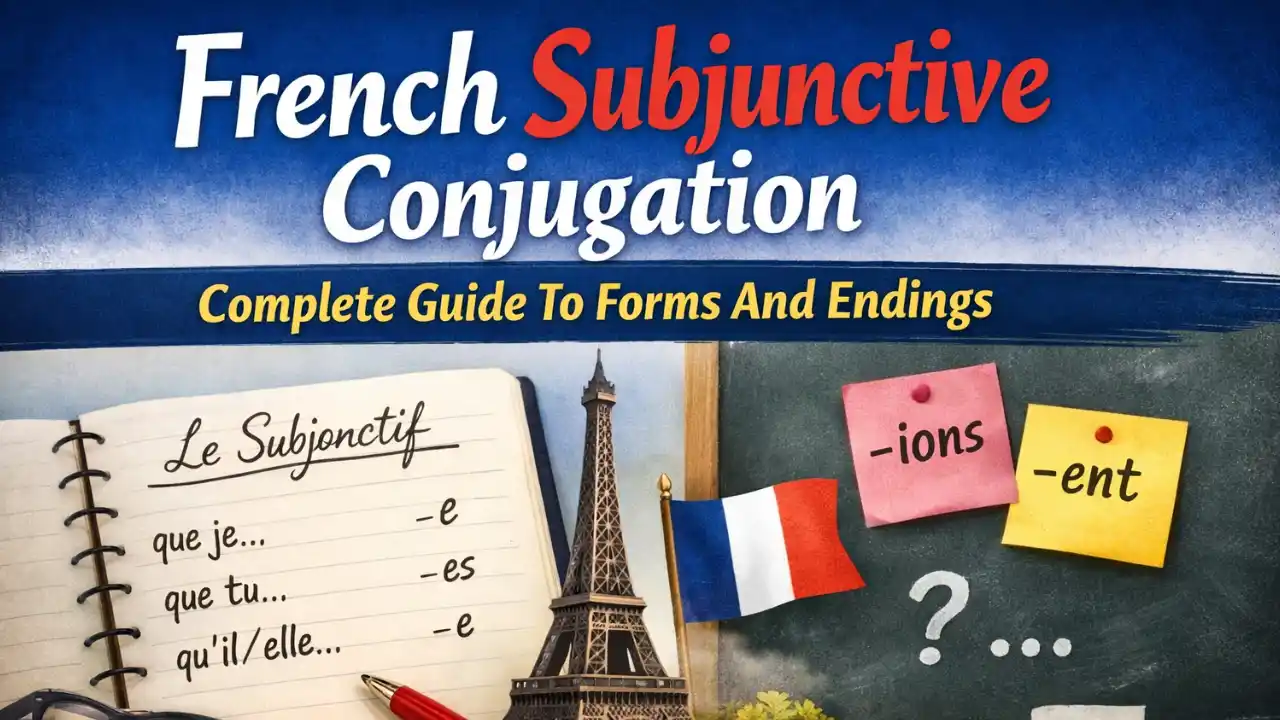
The standard subjunctive endings are:
- e
- es
- e
- ions
- iez
- ent
These endings correspond to the following subject pronouns.
je → e
tu → es
il / elle / on → e
nous → ions
vous → iez
ils / elles → ent
Because the endings remain consistent, learning them is one of the easiest ways to start recognizing the subjunctive.
Step-By-Step Method To Form The French Subjunctive
A helpful way to form the French subjunctive is by following a simple three-step process.
Step 1: Find The Third-Person Plural Present Form
Start with the third-person plural form of the present indicative.
For example:
parler → ils parlent
finir → ils finissent
prendre → ils prennent
Step 2: Remove The Ending “-ent”
Remove the final -ent to find the verb stem.
parlent → parl
finissent → finiss
prennent → prenn
Step 3: Add The Subjunctive Endings
Now add the subjunctive endings.
This produces the full conjugation.
Understanding this method makes it possible to conjugate hundreds of verbs with minimal memorization.
French Subjunctive Conjugation For -ER Verbs
Let’s start with -ER verbs, which are the most common verbs in French.
Verb: parler (to speak)
Subjunctive conjugation:
que je parle
que tu parles
qu’il parle
que nous parlions
que vous parliez
qu’ils parlent
Example
Je veux que tu parles français.
(zhuh vuh kuh tu parl fran-say)
I want you to speak French.
Notice that the endings follow the standard subjunctive pattern.
French Subjunctive Conjugation For -IR Verbs
Next, let’s look at a regular -IR verb.
Verb: finir (to finish)
Subjunctive conjugation:
que je finisse
que tu finisses
qu’il finisse
que nous finissions
que vous finissiez
qu’ils finissent
Example
Il faut que nous finissions ce travail.
(eel foh kuh noo fee-nee-ssyon suh tra-vye)
We must finish this work.
The verb finissions reflects the obligation expressed in the main clause.
French Subjunctive Conjugation For -RE Verbs
Many -RE verbs follow the same formation rule.
Verb: attendre (to wait)
Subjunctive conjugation:
que j’attende
que tu attendes
qu’il attende
que nous attendions
que vous attendiez
qu’ils attendent
Example
Je veux que tu attendes ici.
(zhuh vuh kuh tu ah-tand ee-see)
I want you to wait here.
Again, the subjunctive endings remain consistent.
Understanding The Subjunctive Stem
Although most verbs follow the same endings, the stem sometimes changes.
The stem usually comes from the third-person plural present indicative form.
Examples:
ils parlent → parl
ils finissent → finiss
ils prennent → prenn
These stems then receive the subjunctive endings.
Understanding this pattern is extremely useful because it allows you to form the subjunctive of many verbs quickly.
Verbs With Two Different Subjunctive Stems
Some verbs use one stem for the je, tu, il, ils forms and another stem for the nous, vous forms.
This happens because the subjunctive sometimes reflects both the present indicative and the imperfect forms.
Let’s look at the verb boire.
Subjunctive conjugation:
que je boive
que tu boives
qu’il boive
que nous buvions
que vous buviez
qu’ils boivent
Example
Je veux que tu boives de l’eau.
(zhuh vuh kuh tu bwav duh loh)
I want you to drink water.
Here you can see the stem change from boiv- to buv-.
Subjunctive Conjugation In Real Sentences
Understanding conjugation becomes easier when you see the verbs used in complete sentences.
Emotion
Example
Je suis heureux que tu réussisses.
(zhuh swee uh-ruh kuh tu ray-oo-seess)
I am happy that you succeed.
Necessity
Example
Il faut que nous parlions maintenant.
(eel foh kuh noo par-lyon man-teh-nahn)
We must speak now.
Desire
Example
Je veux que vous restiez ici.
(zhuh vuh kuh voo reh-stee-ay ee-see)
I want you to stay here.
These examples illustrate how the subjunctive endings appear naturally in everyday French sentences.
Why Learning Subjunctive Endings Matters
Many students focus heavily on memorizing irregular verbs, but learning the standard subjunctive endings is often more important.
Once you know the endings, you can quickly recognize subjunctive verbs in conversations and texts.
The endings:
- e
- es
- e
- ions
- iez
- ent
appear repeatedly in many verbs, which makes them easier to remember.
Recognizing these patterns helps learners identify the subjunctive even when they encounter new verbs.
Common Mistakes With French Subjunctive Conjugation
Common Mistakes With French Subjunctive Conjugation
Even after learning the rules and endings, many students still struggle with French subjunctive conjugation. Most mistakes happen not because the rules are complicated, but because learners rely on the indicative forms they already know. Recognizing these common errors will help you avoid them and use the subjunctive more confidently.
Using The Indicative Instead Of The Subjunctive
One of the most frequent mistakes is using the indicative when the sentence actually requires the subjunctive. This usually happens after expressions that clearly trigger the subjunctive such as je veux que, il faut que, or je doute que.
Incorrect
Je veux que tu viens.
Correct
Example
Je veux que tu viennes.
(zhuh vuh kuh tu vyenn)
I want you to come.
The verb viens is the indicative form of venir, but after je veux que, the verb must be in the subjunctive form viennes.
Another example shows the same problem.
Incorrect
Je doute qu’il comprend.
Correct
Example
Je doute qu’il comprenne.
(zhuh doot keel kom-pren)
I doubt that he understands.
Here, the expression je doute que requires the subjunctive.
Forgetting That Negative Expressions Trigger The Subjunctive
Another common mistake appears when learners forget that certain negative expressions introduce doubt and therefore require the subjunctive.
For example, the verb penser normally takes the indicative when it expresses belief.
Example
Je pense qu’il vient.
(zhuh pahns keel vyen)
I think he is coming.
However, when the sentence becomes negative, the meaning changes and uncertainty appears.
Incorrect
Je ne pense pas qu’il vient.
Correct
Example
Je ne pense pas qu’il vienne.
(zhuh nuh pahns pah keel vyenn)
I do not think he is coming.
Because the speaker is no longer certain, the verb switches to the subjunctive.
Forgetting The Plural Subjunctive Endings
Many learners remember the singular forms but forget the endings used with nous and vous. These forms look slightly different from the others.
The correct endings are:
- nous → ions
- vous → iez
Incorrect
Il faut que nous parle.
Correct
Example
Il faut que nous parlions.
(eel foh kuh noo par-lyon)
We must speak.
Another example illustrates the same issue.
Incorrect
Je veux que vous parte.
Correct
Example
Je veux que vous partiez.
(zhuh vuh kuh voo par-tee-ay)
I want you to leave.
Because the subject is vous, the verb must take the ending -iez.
Confusing Subjunctive Stems
Some verbs change their stem in the subjunctive, which can confuse learners who try to apply the regular pattern.
Take the verb venir as an example.
Subjunctive forms include:
- que je vienne
- que tu viennes
- qu’il vienne
- que nous venions
- que vous veniez
- qu’ils viennent
Incorrect
Je veux que tu viens.
Correct
Example
Je veux que tu viennes.
(zhuh vuh kuh tu vyenn)
I want you to come.
Here the verb changes from viens to viennes, which often causes confusion for beginners.
Forgetting That The Subjunctive Usually Follows “Que”
Another mistake occurs when learners forget that the subjunctive normally appears in a subordinate clause introduced by que.
Incorrect
Je veux tu viennes.
Correct
Example
Je veux que tu viennes.
(zhuh vuh kuh tu vyenn)
I want you to come.
The word que is essential because it connects the main clause with the clause that requires the subjunctive.
Using The Subjunctive When It Is Not Necessary
Some learners overuse the subjunctive after expressions that actually require the indicative.
For example, verbs like penser, croire, and espérer usually keep the indicative when the sentence is positive.
Incorrect
Je pense qu’il vienne.
Correct
Example
Je pense qu’il vient.
(zhuh pahns keel vyen)
I think he is coming.
The indicative is used because the speaker believes the statement to be true.
Understanding the endings helps avoid these errors.
Tips To Master French Subjunctive Conjugation
Avoiding these errors becomes easier when you remember a few key ideas:
- Look for expressions that clearly trigger the subjunctive, such as il faut que, je veux que, and je doute que.
- Pay attention to negative expressions, which often introduce uncertainty.
- Practice the nous and vous endings so they become familiar.
- Remember that the subjunctive almost always appears after que.
With consistent practice and exposure to real French sentences, these mistakes become much easier to avoid, and recognizing the correct subjunctive form will gradually feel natural.
Frequently Asked Questions About French Subjunctive Conjugation
Below are some of the most common questions learners ask when trying to understand how French subjunctive conjugation works and when it should be used.
What Is French Subjunctive Conjugation?
French subjunctive conjugation refers to the way verbs change form when used in the subjunctive mood. Unlike the indicative, which states facts, the subjunctive expresses uncertainty, emotion, necessity, or desire. The verb endings change depending on the subject, and the stem usually comes from the third-person plural present tense (ils/elles) form.
What Are The Endings Of The French Subjunctive?
Most verbs in the present subjunctive use the following endings:
- -e
- -es
- -e
- -ions
- -iez
- -ent
For example with the verb parler:
que je parle
que tu parles
qu’il parle
que nous parlions
que vous parliez
qu’ils parlent
These endings apply to many regular verbs.
How Do You Form The French Subjunctive?
To form the French subjunctive:
- Take the ils/elles present tense form of the verb.
- Remove the ending -ent.
- Add the subjunctive endings.
Example:
ils parlent → parl → que je parle
This method works for many verbs in French.
When Is The French Subjunctive Used?
The subjunctive is used after expressions that show:
- emotion
- doubt
- necessity
- desire
- possibility
For example:
Il faut que tu viennes.
You must come.
The expression il faut que requires the subjunctive.
What Is The Difference Between Indicative And Subjunctive Conjugation?
The indicative mood states facts or certainties, while the subjunctive expresses subjectivity such as doubt, feelings, or necessity.
Example:
Je sais qu’il vient.
I know that he is coming. (indicative)
Je doute qu’il vienne.
I doubt that he is coming. (subjunctive)
The difference lies in the speaker’s attitude toward the action.
Do All French Verbs Follow The Same Subjunctive Pattern?
No, not all verbs follow the same pattern. Many verbs follow the regular formation method, but some verbs have irregular subjunctive stems.
Examples include:
être
avoir
aller
faire
pouvoir
savoir
These verbs must be memorized separately.
What Is The Subjunctive Conjugation Of Être?
The verb être has irregular subjunctive forms:
que je sois
que tu sois
qu’il soit
que nous soyons
que vous soyez
qu’ils soient
Because être is extremely common, these forms appear frequently in French conversations.
What Is The Subjunctive Conjugation Of Avoir?
The verb avoir also has irregular subjunctive forms:
que j’aie
que tu aies
qu’il ait
que nous ayons
que vous ayez
qu’ils aient
These forms are often used after expressions of doubt or necessity.
Why Does The French Subjunctive Use The Ils Form As A Base?
The subjunctive stem usually comes from the third-person plural present form because it provides a consistent base for most verbs. By removing the -ent ending from the ils form, the language preserves the pronunciation pattern already used in spoken French.
Are French Subjunctive Endings The Same For All Verb Groups?
Yes, the endings themselves are usually the same, but the stem of the verb may change. This means the endings stay consistent, while the root of the verb may vary depending on whether the verb is regular or irregular.
What Is The Subjunctive Conjugation Of Aller?
The verb aller has irregular subjunctive forms:
que j’aille
que tu ailles
qu’il aille
que nous allions
que vous alliez
qu’ils aillent
These forms appear often in sentences expressing desire or necessity.
What Is The Subjunctive Conjugation Of Faire?
The verb faire is another irregular verb:
que je fasse
que tu fasses
qu’il fasse
que nous fassions
que vous fassiez
qu’ils fassent
You will frequently hear this form in expressions like il faut que tu fasses attention.
Is The French Subjunctive Used In Everyday Conversation?
Yes, the subjunctive is used regularly in spoken French, especially after common expressions such as:
il faut que
je veux que
je doute que
bien que
pour que
These phrases appear frequently in daily communication.
What Are Common Triggers For The French Subjunctive?
Several expressions commonly trigger the subjunctive, including:
- il faut que
- je veux que
- je doute que
- il est important que
- bien que
- pour que
Whenever these expressions appear, the verb that follows usually takes the subjunctive form.
Do Beginners Need To Learn All Subjunctive Conjugations Immediately?
No, beginners should first focus on recognizing the subjunctive and learning the most common verbs such as être, avoir, faire, and aller. Once these are familiar, additional verbs become much easier to learn.
Why Is The French Subjunctive Difficult For Learners?
Many learners struggle with the subjunctive because it does not exist in the same way in English. In addition, irregular verb forms can make the conjugation appear complex at first.
However, with practice and exposure, the pattern becomes easier to recognize.
What Is The Subjunctive Form Of Pouvoir?
The verb pouvoir is conjugated in the subjunctive as:
que je puisse
que tu puisses
qu’il puisse
que nous puissions
que vous puissiez
qu’ils puissent
These forms appear often after expressions like je veux que.
What Is The Subjunctive Form Of Savoir?
The verb savoir also has irregular subjunctive forms:
que je sache
que tu saches
qu’il sache
que nous sachions
que vous sachiez
qu’ils sachent
These forms are used in sentences expressing desire or necessity.
What Is The Subjunctive Form Of Vouloir?
The verb vouloir is conjugated in the subjunctive as:
que je veuille
que tu veuilles
qu’il veuille
que nous voulions
que vous vouliez
qu’ils veuillent
Because this verb expresses desire, it often appears in subjunctive constructions.
What Is The Subjunctive Form Of Pleuvoir?
The verb pleuvoir is impersonal and usually appears only with il.
Subjunctive form:
qu’il pleuve
Example:
Je doute qu’il pleuve aujourd’hui.
I doubt that it will rain today.
What Is The Subjunctive Form Of Falloir?
The verb falloir is also impersonal.
Subjunctive form:
qu’il faille
This form is used mostly in formal or literary contexts.
What Is The Subjunctive Form Of Valoir?
The verb valoir is often used in the expression il vaut mieux que, which requires the subjunctive.
Example:
Il vaut mieux que tu viennes tôt.
It is better that you come early.
Can The Subjunctive Appear In Questions?
Yes, the subjunctive can appear in questions when the sentence expresses doubt, uncertainty, or emotion.
Example:
Penses-tu qu’il puisse réussir ?
Do you think he can succeed?
Do Negative Expressions Trigger The Subjunctive?
Yes, many negative expressions require the subjunctive because they express doubt or uncertainty.
Example:
Je ne pense pas qu’il vienne.
I do not think he is coming.
Is The Subjunctive Used After “Il Faut Que”?
Yes, the expression il faut que almost always requires the subjunctive because it expresses necessity.
Example:
Il faut que tu viennes.
You must come.
How Can You Practice French Subjunctive Conjugation?
The best way to practice is to:
- read French sentences that use the subjunctive
- write your own sentences using common triggers
- repeat examples aloud to become familiar with the forms
Consistent exposure makes recognition easier.
Do Native French Speakers Use The Subjunctive Naturally?
Yes, native speakers use the subjunctive naturally, often without thinking about the grammatical rule. Because it appears in many everyday expressions, it becomes automatic with regular exposure.
Conclusion
Learning French subjunctive conjugation and endings is an important step toward mastering this essential grammar structure. Fortunately, most verbs follow a clear pattern based on the third-person plural present form and a set of standard endings.
By understanding these endings, practicing the formation method, and applying the conjugations in real sentences, learners can quickly become more comfortable using the subjunctive.
The next step in mastering the subjunctive is learning about irregular verbs, which often have unique forms but appear frequently in everyday French.
If you are new to French subjunctive, you may want to start with our complete guide to French Subjunctive: Complete Guide For Beginners.